
URnetwork vs IPVanish
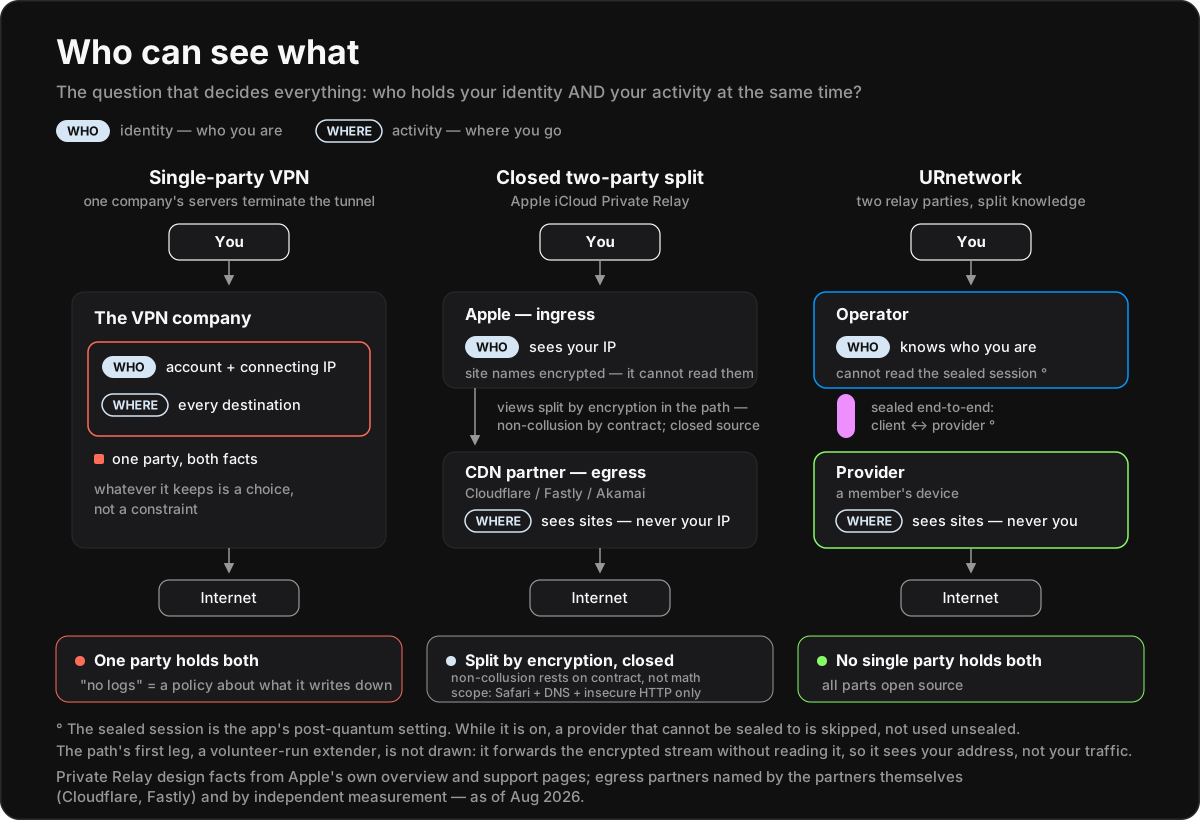
IPVanish is a long-running US datacenter VPN with unlimited devices and a 2016 logs handover on its record; URnetwork splits the path so the exit never learns who you are and the operator cannot read the sealed session.
Choose IPVanish if you want unlimited devices on one subscription, steady datacenter speeds, and a no-logs policy with recent third-party examinations. Choose URnetwork if you want the two halves of the trust question split by design, residential exits you can aim at a city, and an account that can know almost nothing about you. IPVanish's case rests on an examined policy. URnetwork's rests on a split path in public code.
IPVanish is one of the longest-running US VPNs, owned today by Ziff Davis after passing through Highwinds, StackPath, and J2 Global. It runs a large datacenter fleet, allows unlimited simultaneous devices on one subscription, and prices multi-year terms near the bottom of the mainstream market. Its no-logs policy has been examined twice, by Leviathan Security in 2022 and Schellman in 2025.
URnetwork uses member-run exits. The provider does not receive your source IP on the relayed path. Native apps can also seal traffic to the provider, with a switch that ships off. How URnetwork works explains the full design. The threat model holds the complete record of what is stored and enforced.
Six differences that affect the choice
| IPVanish | URnetwork | |
|---|---|---|
| Trust model | One company's server carries both ends of your tunnel; what is kept is policy | Two relay parties; the exit never sees your IP, and the operator cannot read the sealed session |
| Devices and plans | Unlimited simultaneous connections on any plan | Plans meter data, not device seats |
| External verification | No-logs examinations in 2022 and 2025; closed source | Open client and server code; no examination of its logging yet |
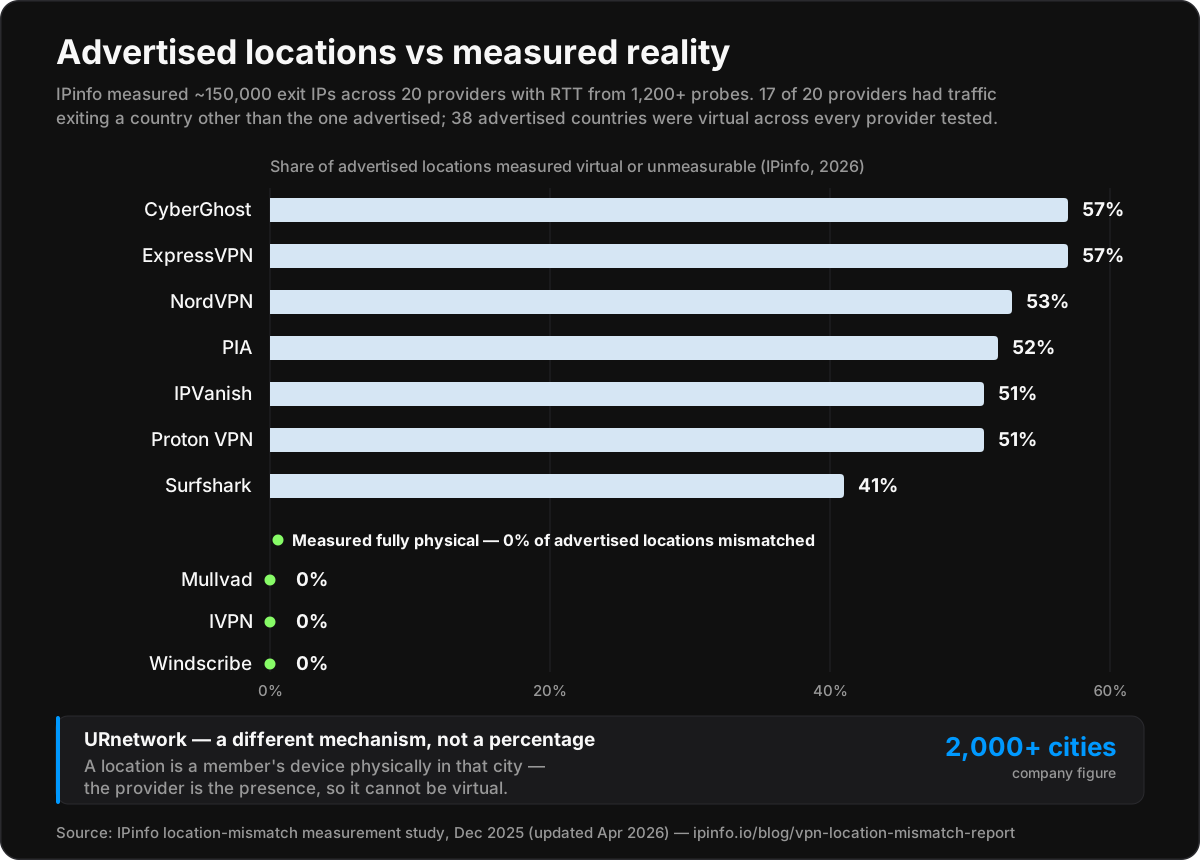
| Exit address | Datacenter ranges; 51% of advertised locations measured virtual or unmeasurable (IPinfo, December 2025) | Residential addresses in 90+ countries; browse countries, search for a city |
| Consistency | Tuned fleet, steady throughput | Member uplinks; URnetwork puts its average streaming speed at 40 Mbps+ |
| Account identity | Email, billing details, and the sign-up IP; no crypto payment option | Instant Account with no email; Pro payable in on-chain USDC |
Caveats below the table:
- Post-quantum encryption is URnetwork-side here: the X25519MLKEM768 client-to-provider session is a switch in the native apps that ships off, and switched on it skips any provider it cannot seal to rather than downgrading. IPVanish publishes no post-quantum feature. The browser extension has no sealed session; there, the operator's data path logs nothing, pinned by a test in the open code.
- IPVanish runs WireGuard, OpenVPN, and IKEv2 with mature apps across the major platforms. URnetwork uses its own transport over TLS/QUIC and ships on Android, iOS, macOS, Windows, and Linux plus a browser extension paired with its web app, each with an explicit kill switch.
- IPVanish lists at about $13 month-to-month, with two-year promotional rates near $2.20/month as of early 2026, and no free tier. URnetwork has a free daily allowance; Pro is $5/month or $40/year. Current numbers are at ur.io/products. The plans meter different things: for a household of heavy screens, weigh unmetered devices against a data allowance.
The 2016 handover and what changed after
In 2016, under then-owner Highwinds, IPVanish answered a US Department of Homeland Security summons in a criminal investigation. A first response and a follow-up produced a customer's name, email address, real IP address, and the dates and times he connected and disconnected. Its privacy policy at the time said IPVanish "does not collect or log any traffic or use of its Virtual Private Network service," and its homepage advertised a strict zero-logs policy. The episode became public in 2018 through court records.
The logs existed because the server position sees everything. A zero-logs banner is a record-keeping promise, and when legal process arrived, records existed to hand over. The same year, the same kind of demand landed on a competitor making the same promise: Private Internet Access, subpoenaed by the FBI, produced nothing useful, because nothing useful had been stored. The difference was not sincerity but what existed.
What came after is also on the record. The company has changed hands twice since, and the next owner's 2018 statement that "no logs existed" sits in tension with the logs already produced. The current policy has been examined by Leviathan Security in 2022 and by Schellman in February 2025. The Schellman report is a point-in-time validation of nine numbered no-log policy statements, through interviews, policy inspection, technical analysis of VPN configurations, and inspection of a baseline image and one example server; the audited entity is IPVanish, Inc., a J2 Global Ventures company. IPVanish has also withdrawn from markets as local requirements changed, rather than keep servers there: Russia in 2016, Hong Kong in 2020, India in 2022, Turkey in 2023.
The reviewer conflict
Ziff Davis owns IPVanish and much of the tech press that reviews VPNs: PCMag, Mashable, IGN, and, since 2024, CNET, along with Ookla's Speedtest. PCMag and CNET append a shared-parent disclosure note to their IPVanish reviews. A 2021 study of the conflict found those outlets restrained, with IPVanish not pushed up the rankings. The ownership is still the thing to know when reading a review or a speed test of this product.
The fleet and the location count
"150+ locations" is a city count that mixes physical and virtual presence, and the marketing pages do not mark which is which. IPinfo's December 2025 measurement study, timing round trips from 1,200+ probes against some 150,000 exit addresses across 20 providers, found 51% of IPVanish's advertised locations virtual or unmeasurable. A reviewer's hand-count names 39 virtual locations, India among them, served virtually since IPVanish withdrew its hardware over India's 2022 logging mandate. Where the exit addresses actually resolve puts the physical side near 62 countries and roughly 98 cities: substantial, and materially smaller than the headline.
The fleet claims have the same softness. The security page still says "we own and operate our entire network, including the servers," while independent reviews describe rented or colocated capacity, and the ownership wording no longer appears on the homepage or servers page. The fleet is not fully RAM-only; the conversion is pledged around 2027.
URnetwork's count is a different kind of claim with its own limit attached. A city is listed only while a member's device is online there, and the network geolocates the connection it observes, so presence cannot be fabricated the way a registered IP range can. An address that looks like a datacenter or a VPN is detected and demoted, not excluded. And nobody has measured URnetwork the way IPinfo measured IPVanish: what is on offer is a mechanism in open code, not an outside measurement.
Where IPVanish wins
- Unlimited simultaneous devices; one plan covers a household.
- Steady throughput from a tuned datacenter fleet.
- Recent independent no-logs examinations (2022, 2025). URnetwork's logging has had no examination at all.
- Very low per-month cost on long promotional terms.
Where URnetwork wins
- The split. The exit never learns who you are, and the operator cannot read the sealed session. No single party holds identity and destinations together, where IPVanish's server sees both by design.
- Residential exit addresses that blend in where datacenter ranges are flagged, searchable down to a city.
- Open source on both the client and the server side, versus fully closed.
- Retention limited by code rather than by policy alone; what the operator stores is recorded in the threat model.
- Thinner identity: a one-tap Instant Account with no email, wallet-signature sign-in, and a free tier.
- Members can share their connection as participants in the UR protocol; IPVanish has no equivalent role.
Limits and evidence
URnetwork's main limits:
- No independent audit covers the protocol, the connect engine, or the operator's server code. Two 2025 third-party assessments cover other surfaces: a penetration test of the web application and API (April–May 2025), and the Leviathan MASA AL2 assessment of the Android app, which passed. Leviathan writes that its assessment "should not be read as a holistic security evaluation or comprehensive penetration test." Neither examined logging, retention, or the data path.
- The split assumes the operator and the providers in your window are independent. Nothing in the system attests that independence, the operator could itself run providers, and no outside party has measured the fleet. See the threat model, §6.1.
- The WireGuard-compatible fallback endpoint assigns one stable tunnel address, so several providers could recognize the same client across sessions. The native tunnel is the recommended path.
- Coverage counts are self-published. IPVanish's map has been measured from outside; URnetwork's has not.
- URnetwork is the younger network, and speed moves with the providers in your window.
IPVanish's limit is structural. Its server sees your real IP and your destinations together, and the 2016 record shows what that position can produce under legal process. The examinations since are real evidence about the present: paid, scoped, point-in-time checks of one subsidiary inside a conglomerate. They do not change the capability, and the capability is the risk.
Trying URnetwork costs nothing: the Instant Account takes one tap and no email, so you can check the countries, cities, and sites you care about before either subscription spends a dollar. More questions are answered in the FAQ.