
URnetwork vs Hotspot Shield
Hotspot Shield built the original mass-market free VPN, ad-funded and speed-first; URnetwork splits the path so the exit never learns who you are and the operator cannot read the sealed session.
Choose Hotspot Shield if you want a household-name free VPN, apps with zero learning curve, and consistent datacenter speed. Choose URnetwork if you want the path split between two relay parties, storage limits enforced in open code, and residential exits you can aim at a city. Hotspot Shield's privacy case is a written policy with one commissioned review. URnetwork's is a structure you can check in public code.
Hotspot Shield launched in 2008 under AnchorFree and built the ad-supported free funnel that feeds a paid Premium product. Its proprietary Catapult Hydra transport has a speed reputation strong enough that rival security vendors have licensed it, and the apps also offer WireGuard and IKEv2. The brand has had four corporate homes. AnchorFree became Pango, was acquired by Aura in July 2020, and was spun back out as a standalone Pango Group in September 2024. In December 2024 Pango Group merged with Total Security to form Point Wild, which also owns TotalAV. Its privacy policy is issued by Anchorfree LLC in Boston and Pango GmbH in Switzerland.
URnetwork uses member-run exits. The provider does not receive your source IP on the relayed path. Native apps can also seal traffic to the provider, with a switch that ships off. How URnetwork works explains the full design. The threat model holds the complete record of what is stored and enforced.
Six differences that affect the choice
| Hotspot Shield | URnetwork | |
|---|---|---|
| Free tier | 500 MB/day at up to 2 Mbps, one US location, ad-supported; eight ad and attribution partners named in its own policy | Free daily data allowance funded by Pro subscriptions; no ads |
| Setup | Install and connect; refined since 2008 | Instant Account in one tap; a model that takes a minute to learn |
| Speed | Consistent datacenter throughput; Hydra engineered for long, lossy links | Member uplinks; URnetwork's own average streaming figure is 40 Mbps+ |
| Trust model | One company's servers see who you are and where you go; a policy governs what is kept | Two relay parties; the exit never sees your IP, and the operator cannot read the sealed session |
| Verification | Closed source, Hydra unpublished; one commissioned review of two policy sentences (Aon, 2023) | Open client and server code; storage limits enforced in code |
| Exit address | Datacenter ranges, rented largely from M247, Latitude.sh, and DataCamp | Residential addresses; ordinary traffic to the sites that receive it |
Caveats below the table:
- Post-quantum encryption is URnetwork-side here: the X25519MLKEM768 client-to-provider session is a switch in the native apps that ships off, and switched on it skips any provider it cannot seal to rather than downgrading. Hotspot Shield advertises no post-quantum feature. The browser extension has no sealed session; there, the operator's data path logs nothing, pinned by a test in the open code.
- Hotspot Shield ships polished consumer apps and offers Hydra, IKEv2, and WireGuard as protocol choices. URnetwork ships native apps on Android, iOS, macOS, Windows, and Linux plus a browser extension paired with its web app, each with an explicit kill switch.
- Hotspot Shield's paid plans run about $7–12 a month on annual billing as of August 2026, and its promotional pricing moves. URnetwork Pro is $5/month or $40/year on top of the free daily allowance. Current numbers are at ur.io/products.
The FTC complaint and the ad-supported free tier
On 7 August 2017 the Center for Democracy & Technology asked the US FTC to investigate AnchorFree over the free tier. The complaint alleged that the app injected JavaScript through iframes for advertising and tracking, used "more than five different third-party tracking libraries," and could "intercept and redirect HTTP requests" for retail domains including target.com and macys.com to advertising partners. The technical evidence rested substantially on a static analysis of the Android app, using Carnegie Mellon's Mobile App Compliance System. These were allegations by an advocacy group; they were never tested, and no public FTC action followed.
The free tier's economics are stated on the vendor's own pages today. The free-VPN page reads "We're ad supported, giving you total privacy with no charges." The policy names eight advertising and attribution partners: Unity Ads, Ironsource, Digital Turbine, InMobi, Kochava, Mintegral, Meta, and Appsflyer. Their SDKs "may collect… Device or mobile advertising identifiers" and the "Internet Protocol (IP) Address," the identifier a VPN exists to hide. One client bug also belongs on the record: CVE-2018-6460, disclosed by Paulos Yibelo in January 2018, a local web server in the Windows client that exposed configuration data over JSONP. AnchorFree fixed it.
The policy, the Aon review, and the transparency report
The current policy (version 1.0.0, effective 31 October 2024) states that the VPN products "do not log any information that associates your account credentials or identity with your VPN session activity" and that no records are kept of "what websites you were browsing or apps accessed through a VPN connection." The claim turns on the word associates. The same policy permits collection of account, billing, device (including a per-install device hash), diagnostic, and IP-derived location data for the life of the account.
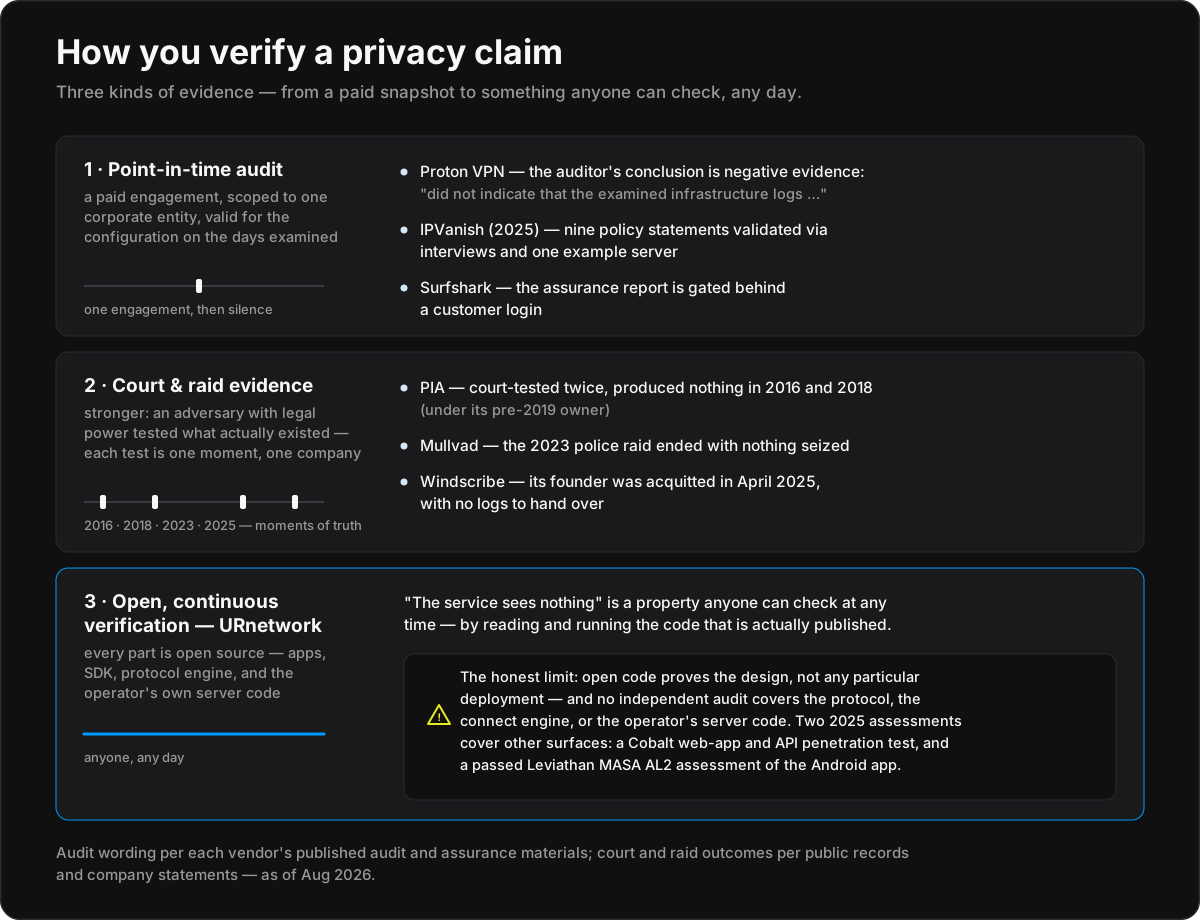
Aon, commissioned by Pango, checked the two logging statements above in August 2023. It reported that it "was unable to identify any indication that users' browsing activity may be correlated or identified back to a unique user identity," and that it found no logging of plaintext IP addresses. Its stated scope excluded the security of the hosting environment, and part of the work ran on a development VPN node. It is a real review, vendor-commissioned, scoped to two sentences of the vendor's own policy, at one point in time.
Pango's 2023 transparency report records 30 US and 52 international government requests for user data, with zero disclosures. The figures are self-reported, and they point the right way. A policy binds whoever owns the company at the time, and this brand has had four owners.
Hydra and the location map
Hydra earned its reputation as a transport engineered for throughput on long, lossy links, and the licensing by rival security vendors is real third-party respect. Hotspot Shield describes the security layer as conventional TLS 1.2 with ECDHE and RSA-2048 certificates; the patented part is how the payload moves inside the tunnel. No specification or code is published, so nobody outside the licensee circle can check that the implementation matches the description. The stated substitute is evaluation by the security companies that license the SDK, which is review under commercial agreements, never published.
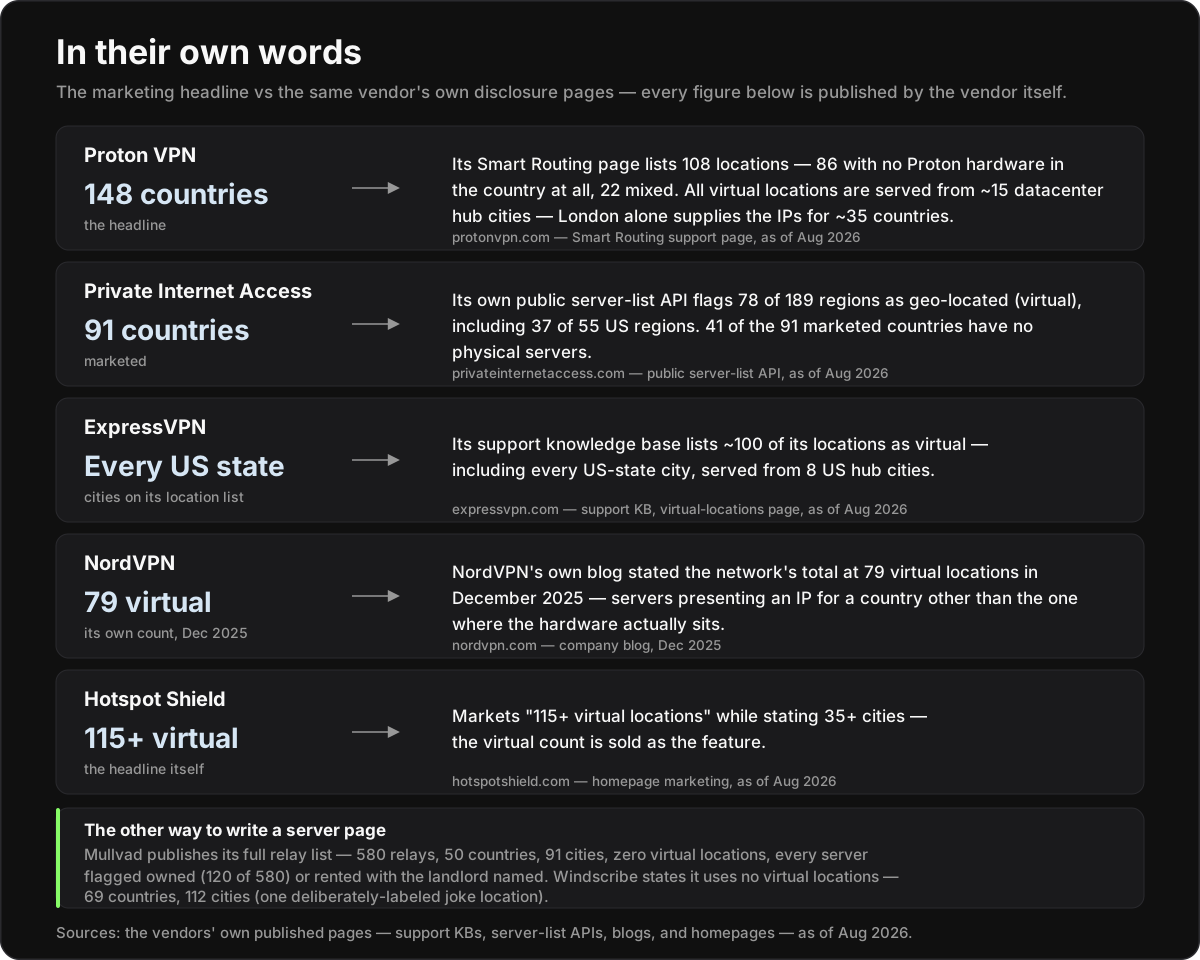
The location numbers repay a close read. The homepage markets "over 115+ virtual locations," and the plan page shows the sum: "115+ locations, including 80+ countries and 35+ cities." Elsewhere in the industry a virtual location means an IP registered to one country while the hardware sits in another. Hotspot Shield uses the looser sense of a place you can appear to be, labels even the free tier's single US exit a virtual location, and publishes no physical-versus-virtual breakdown. Independent observation finds its exit ranges in about 27 countries and 49 cities (netify.ai, read August 2026). The observed city count exceeds the advertised "35+"; the observed country count is far below the advertised "80+".
URnetwork counts differently: a location exists only while a member's device is online in it, and the platform geolocates the connection it observes rather than accepting a declared city. Presence cannot be fabricated the way a registered IP range can, though an address that looks like a datacenter or a VPN is detected and demoted, not excluded. The 2,000+ real cities figure is URnetwork's own count, and no outside party has measured it.
Where Hotspot Shield wins
- A free tier anyone can install and understand, refined since 2008.
- A speed-engineered transport with consistent datacenter performance, validated by licensing to rival security vendors.
- More paperwork than URnetwork has produced: a published transparency report and a commissioned review of its logging claims.
Where URnetwork wins
- The split. The exit never learns who you are, and the operator cannot read the sealed session. No single party holds identity and destinations together.
- Verification: storage limits enforced in code anyone can read, versus a policy reviewed once, at the vendor's request and scope.
- Whole-stack source: the apps, SDK, and server platform are public, where Hotspot Shield publishes neither client nor server code.
- Residential exits that blend in where datacenter ranges are flagged, targetable down to a city.
- A free tier with no ads attached, and an Instant Account that takes one tap and no email.
- The people carrying your traffic opted in and are paid under signed, metered contracts as participants in the UR protocol, with file-sharing and attack traffic dropped at each exit by an open-source filter.
Limits and evidence
URnetwork's main limits:
- No independent audit covers the protocol, the connect engine, or the operator's server code. Two 2025 third-party assessments cover other surfaces: a penetration test of the web application and API (April–May 2025), and the Leviathan MASA AL2 assessment of the Android app, which passed. Leviathan writes that its assessment "should not be read as a holistic security evaluation or comprehensive penetration test." Neither examined logging, retention, or the data path.
- The split assumes the operator and the providers in your window are independent. Nothing in the system attests that independence, the operator could itself run providers, and no outside party has measured the fleet. See the threat model, §6.1.
- Coverage counts are self-published. Outside observers have mapped Hotspot Shield's exit ranges; nobody has run that kind of measurement on URnetwork.
- URnetwork is the younger network, and speed moves with the providers in your window.
Hotspot Shield's limit is structural. Its servers terminate your tunnel, so one company can see your real IP and your destinations together, and what it keeps is a policy choice. The policy's no-logs claims were reviewed once, in 2023, at the vendor's request and scope, and the closed code means neither the promise nor Hydra itself can be checked from outside. On the free tier, the ad partners named in the policy receive the device advertising identifier and the IP address.
Trying URnetwork costs nothing: the Instant Account takes one tap and no email, so you can test both free tiers against your own sites before paying for either product. More questions are answered in the FAQ.