
URnetwork vs Proton VPN
Proton VPN is the establishment pick, with annual published audits and the only unlimited-data free tier among major VPNs; URnetwork splits the path so the exit never learns who you are and the operator cannot read the sealed session.
Choose Proton VPN if you want unlimited free data, annual published audits, and Secure Core's hardened entry. Choose URnetwork if you want residential exits, city selection, and a split path. Both publish open-source client apps and ship kill switches. Proton VPN is the more audited service. URnetwork splits visibility between its operator and a member-run provider.
Proton VPN comes from Proton AG in Geneva, the company behind Proton Mail. Since June 2024 its principal shareholder has been the nonprofit Proton Foundation; the operating company remains for-profit. It runs one of the largest datacenter fleets in the industry, and it is the only major VPN with an unlimited-data free tier.
URnetwork uses member-run exits. The provider does not receive your source IP on the relayed path. Native apps can also seal traffic to the provider, with a switch that ships off. How URnetwork works explains the full design. The threat model holds the complete record of what is stored and enforced.
Six differences that affect the choice
| Proton VPN | URnetwork | |
|---|---|---|
| Trust model | One organization end to end; Secure Core's two hops are both Proton | Two relay parties; the exit never sees your IP, and the operator cannot read the sealed session |
| Exit address | Datacenter ranges, publicly known, widely blocked by streaming and retail sites | Residential addresses; ordinary traffic to the sites you visit |
| Coverage and targeting | Advertises 148 countries; 86 have no Proton hardware inside them, by its own Smart Routing list | Member devices in 90+ countries; browse countries, search for a city |
| Free tier and price | Free: unlimited data, one device, a medium speed class, a small auto-assigned country set; Plus about $10/month, promos lower | Free: a daily data allowance on the full network; Pro $5/month or $40/year |
| External verification | Annual public no-logs audits, five years running; a transparency report with every VPN request denied | Open client and server code; no independent audit of the protocol or server code yet |
| Secure Core | Two-hop mode through entry servers Proton owns in Switzerland, Iceland, and Sweden | The split is the relayed default; the two parties are different organizations |
Caveats below the table:
- URnetwork offers post-quantum encryption as an opt-in: the X25519MLKEM768 client-to-provider session is a switch in the native apps that ships off, and switched on it skips any provider it cannot seal to rather than downgrading. The browser extension has no sealed session; there, the operator's data path logs nothing, pinned by a test in the open code.
- Port forwarding is Proton's alone here; URnetwork does not offer it. On kill switches the two are level, and URnetwork's extension defaults its own to on.
- The free tiers meter differently. Proton's caps choice: unlimited data on one device, a medium speed class, a small country set the app assigns. URnetwork's caps quantity: a daily allowance on the full network that stops when spent and renews the next day.
- A Proton account starts from an email-based Proton identity; payment can be bitcoin after signup or, unusually, cash mailed to Geneva, a real no-financial-trail option. URnetwork's Instant Account takes one tap and no email, and Pro can be paid in on-chain USDC. Current URnetwork numbers are at ur.io/products.
Secure Core and who runs the hops
Secure Core is Proton's hardened mode: traffic enters through servers Proton owns outright in Switzerland, Iceland, or Sweden, a former military base and an underground datacenter among them by Proton's own description, and exits from a second Proton server elsewhere. Against an outside attacker who compromises or monitors an exit server, it works: the exit sees destinations but never your real IP, because you entered through hardened hardware in another jurisdiction. That is a real defense, kept usable by stopping at two hops, and it beats a one-server VPN for high-risk users.
The record also states its boundary. Both hops belong to one organization. Proton AG terminates the tunnel at both ends of its own pair, so it can still associate your IP with your destinations, and a binding Swiss order, or an insider, spans the whole path. Proton markets Secure Core against timing and correlation attacks; there is no cover traffic or mixing behind that sentence, so an observer watching both ends of a path is out of scope for Secure Core and for URnetwork alike.
URnetwork splits the path between organizations instead. The provider never receives your source IP, and the operator cannot read the sealed session, so no single organization holds both your identity and your destinations. A two-hop chain inside one company cannot provide that property. On URnetwork the split is the relayed default rather than a mode; the seal that completes it is one switch, Post Quantum Encryption, which ships off.
Audits, transparency, and the 2021 Mail order
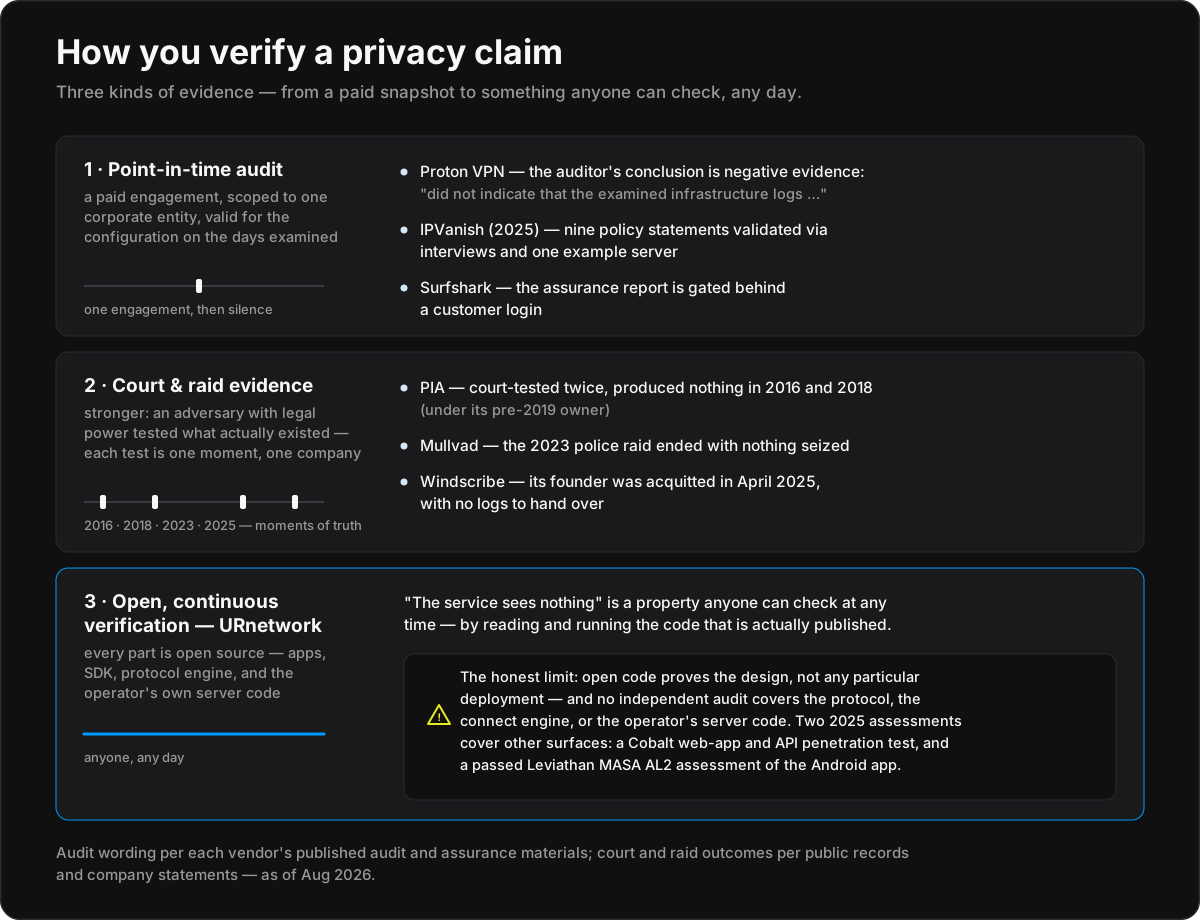
Proton's verification practice is the industry's most regular. Securitum has audited the no-logs setup annually for five consecutive years as of 2026, and the reports are downloadable in full without an account. The auditor's conclusion is negative evidence, quoted exactly: the audit "did not indicate that the examined Proton VPN server infrastructure logs users' browsing activity, DNS queries, destination services, network traffic contents or user-identifiable connection metadata," after several days on site with configuration files, procedures, and staff. Proton's marketing renders that as confirmation that no metadata logs are kept. An assurance review attests the systems examined, while they were examined; between audits you are back to the policy.
The transparency report separates Proton's two products with Proton's own numbers. Every legal request aimed at Proton VPN from 2020 through 2025 was denied, no logs existing to produce, while Proton Mail complied with 10,368 of 11,023 requests in 2024 alone under binding Swiss orders. The widely cited 2021 "Proton logging case" belongs to Mail: a French request routed through Europol became a binding Swiss order, and Proton was compelled to begin logging one Mail account's IP. Proton's own wording is that "under current Swiss law" VPN connections cannot be compelled the same way. The distinction is real, and it is legislative rather than architectural. The foundation completes the picture: since June 2024 the nonprofit Proton Foundation has been principal shareholder of the for-profit operating company, a structure whose stated purpose includes blocking hostile takeovers, while operations remain commercial. No public breach of Proton VPN infrastructure is on record.
Smart Routing and the country count
Proton advertises servers in 148 countries, and its own Smart Routing page explains the number: "instead of running servers physically inside those countries, we use servers that are, in reality, located elsewhere." As of mid-2026 that list runs to 108 smart-routed countries, 86 of them with no Proton hardware inside the country at all, "India" served from Singapore, all of it running out of about fifteen datacenter cities. Real hardware in roughly sixty countries is still one of the largest fleets anyone operates; the gap is between the fleet and the headline. Proton publishes the list, marks the servers in most apps, and explains the reason, hardware being unsafe in censorship states. That is more disclosure than its large rivals offer. IPinfo's December 2025 study still measured 51% of Proton's advertised locations virtual or unmeasurable, mid-pack among the twenty providers tested.
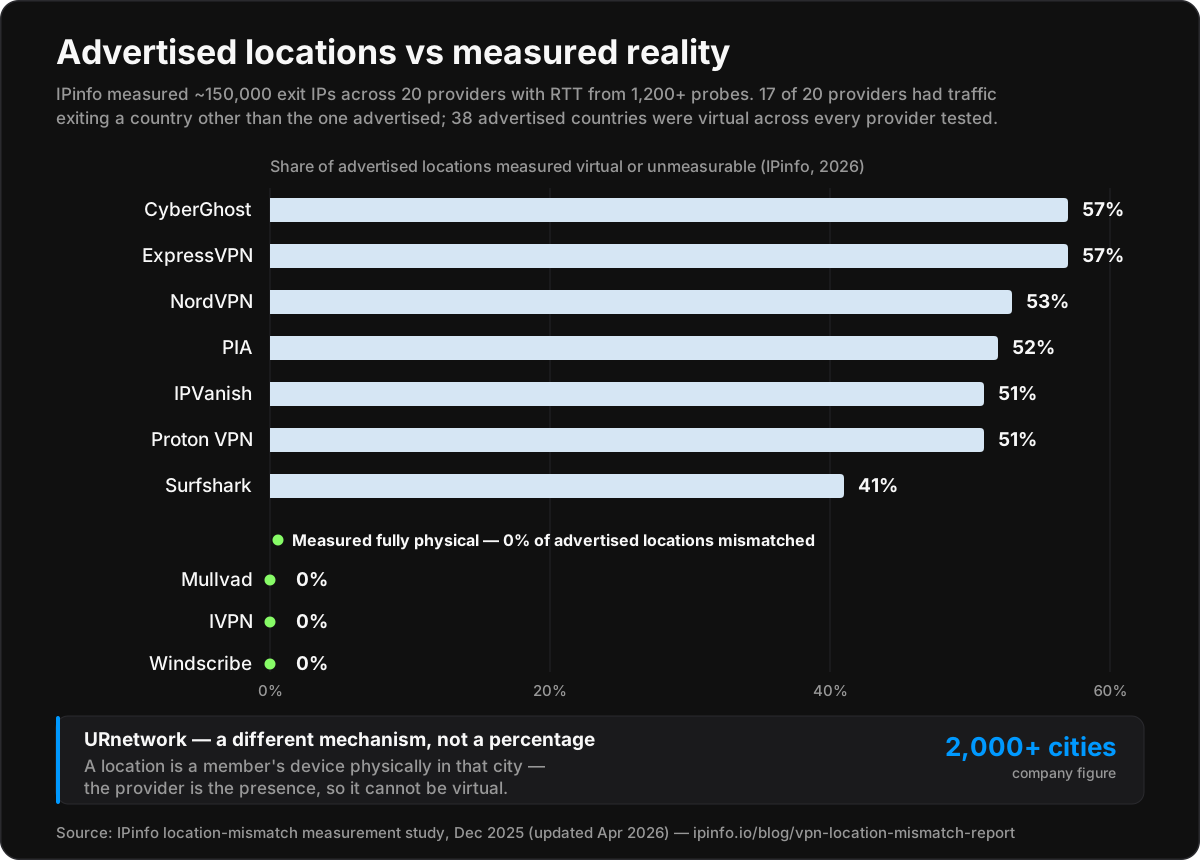
URnetwork's map is presence-backed: a location is listed only while a member's device is online in it, and the network geolocates the connection it observes rather than letting a provider declare a city. A provider egressing through its own VPN or a hosting range is detected and demoted, not excluded. Nobody has run IPinfo's study on URnetwork. Blocking differs the same way: Proton's published ranges are known VPN space, answered with its Stealth obfuscation protocol, while URnetwork's exits are residential addresses whose traffic is ordinary to the sites that receive it. Consistency runs Proton's way: datacenter throughput reads the same every session, while URnetwork's speed moves with each member's uplink. URnetwork puts its average streaming speed at 40 Mbps+.
Where Proton VPN wins
- The free tier. Unlimited data at no cost is unique among the majors, funded, in Proton's words, by its paying users.
- Verification. Five consecutive published audits and a transparency report with per-year numbers; URnetwork has neither a protocol audit nor a transparency report.
- Secure Core. Against exit-server compromise, two Proton-owned hops beat any single-server VPN, and the mode stays usable.
- Consistency. A large datacenter fleet returns the same speed every session.
- Port forwarding, which URnetwork does not offer.
Where URnetwork wins
- The split. The exit never learns who you are, and the operator cannot read the sealed session. No single party holds identity and destinations together; Secure Core's two hops are one party.
- The exit address. Residential IPs work where Proton's published ranges are blocked outright.
- Aim. Search a city by name wherever members are online, placed by the network rather than declared by the provider.
- Whole-stack source. Proton opens its clients; URnetwork opens the server side as well.
- Identity floor. An Instant Account with no email at all; Proton's cash-by-mail anonymizes the payment, not the account.
- Paid price. $5/month or $40/year against Plus at about $10/month standard.
- The supply side. Members can share their connection as participants in the UR protocol. Proton has no equivalent role.
Limits and evidence
URnetwork's main limits:
- No independent audit covers the protocol, the connect engine, or the operator's server code, and there is no URnetwork transparency report. Two 2025 third-party assessments cover other surfaces: a penetration test of the web application and API (April–May 2025), and the Leviathan MASA AL2 assessment of the Android app, which passed. Leviathan writes that its assessment "should not be read as a holistic security evaluation or comprehensive penetration test." Neither examined logging, retention, or the data path.
- The split assumes the operator and the providers in your window are independent. Nothing in the system attests that independence, and no outside party has measured the fleet. See the threat model, §6.1.
- The WireGuard-compatible fallback endpoint assigns one stable tunnel address, so several providers could recognize the same client across sessions. The native tunnel is the recommended path.
- Coverage counts are self-published. IPinfo measured Proton from outside; nobody has run that study on URnetwork.
Proton VPN's limit is structural. Its servers terminate your tunnel, so one organization can see your real IP and your destinations together, Secure Core included, since both of its hops are Proton's. The audits attest what examiners found on the systems they examined, when they looked. The 2021 Mail order marks where a binding Swiss order reaches; the VPN exemption is a fact of current legislation, not of architecture.
Trying URnetwork costs nothing: the Instant Account takes one tap and no email, so you can test it against your own sites before paying for either product. More questions are answered in the FAQ.