
URnetwork vs NymVPN
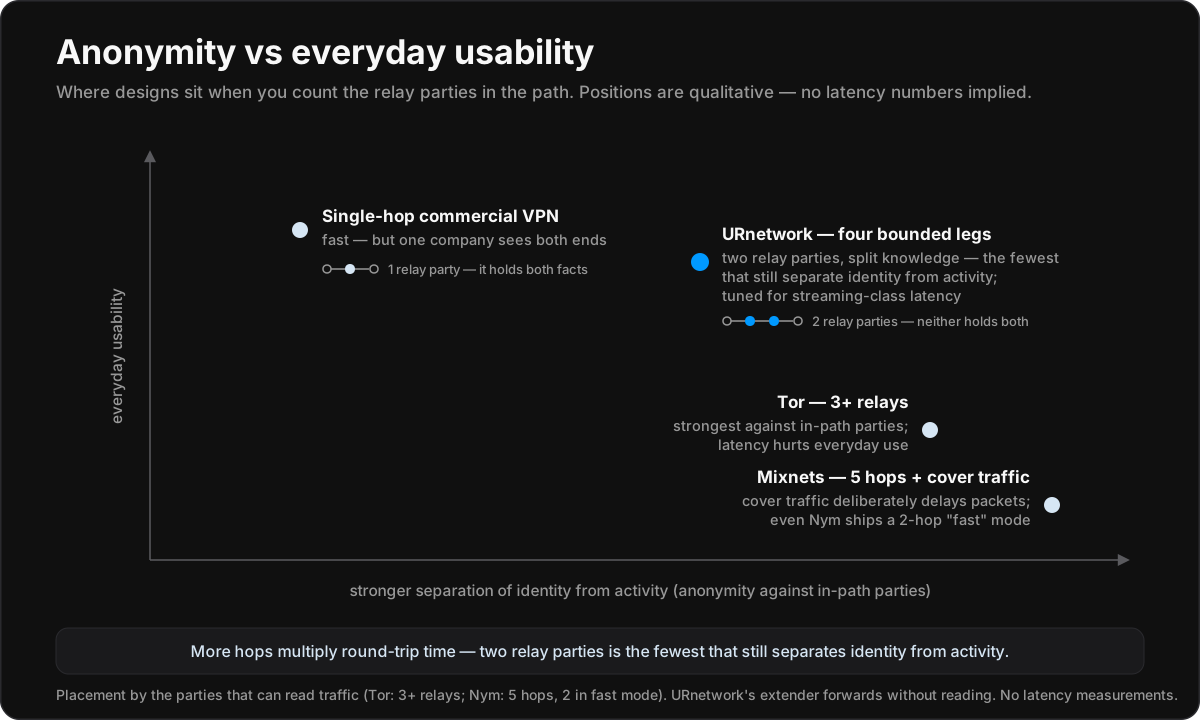
NymVPN ships the strongest anonymity design in commercial VPN, a five-hop mixnet that is not its default mode; URnetwork splits the path so the exit never learns who you are and the operator cannot read the sealed session.
Choose NymVPN if you need the mixnet's resistance to traffic analysis, payment unlinkability by cryptography, and a published protocol audit. Choose URnetwork if you want residential exits, city selection, and a split path. Both are open source and both answer the logging question with architecture instead of policy. NymVPN defends against the stronger adversary, in the mode that enables it. URnetwork splits visibility between its operator and a member-run provider.
NymVPN is the consumer product of Nym Technologies SA of Neuchâtel, Switzerland, launched in March 2025. Its design descends from published, peer-reviewed anonymity research; Sphinx, its packet format, has a long academic paper trail. Gateways and mix nodes are run by independent operators who bond NYM tokens, rather than by one company's fleet.
URnetwork uses member-run exits. The provider does not receive your source IP on the relayed path. Native apps can also seal traffic to the provider, with a switch that ships off. How URnetwork works explains the full design. The threat model holds the complete record of what is stored and enforced.
Six differences that affect the choice
| NymVPN | URnetwork | |
|---|---|---|
| Trust model | Entry gateway sees who you are, exit gateway sees your destinations; different operators | Two relay parties; the exit never sees your IP, and the operator cannot read the sealed session |
| Exit address | Network gateways | Residential addresses; ordinary traffic to the sites you visit |
| Coverage and targeting | Gateway selection | Member devices in 90+ countries (URnetwork's own count); browse countries, search for a city |
| Traffic analysis | Anonymous mode: a five-hop Sphinx mixnet with cover traffic and timing mixing; the default Fast mode has neither | No cover traffic or mixing; standard tunnel timing |
| Payment unlinkability | zk-nym credentials in production; cash, GNU Taler, and Monero accepted | One-tap account with no email; on-chain USDC |
| External verification | A published Cure53 audit (2024) of apps, backend, infrastructure, and cryptography | Open client and server code; no independent audit of the protocol or server code yet |
Caveats below the table:
- The mixnet is not what a new install runs. Fast mode, the default, is a two-hop tunnel on AmneziaWG, a censorship-resistant WireGuard fork; you select Anonymous mode to get the mixnet.
- URnetwork offers post-quantum encryption as an opt-in: the X25519MLKEM768 client-to-provider session is a switch in the native apps that ships off, and switched on it skips any provider it cannot seal to rather than downgrading. No published post-quantum claim was found for NymVPN. The browser extension has no sealed session; there, the operator's data path logs nothing, pinned by a test in the open code.
- NymVPN covers Windows, macOS, Linux, Android, and iOS, with no browser extension. URnetwork covers the same five plus a browser extension paired with its web app, and every URnetwork app has an explicit kill switch, with the extension's on by default.
- As of mid-2026 NymVPN runs about $8/month, or roughly $2.40–2.90/month on one- or two-year terms, with a seven-day trial on the longer plans that crypto payment cannot activate; there is no free tier. URnetwork Pro is $5/month or $40/year, with a free daily allowance. Current numbers are at ur.io/products.
Fast mode and Anonymous mode
NymVPN is two products in one client. Fast mode, the default, is a two-hop tunnel through decentralized gateways: an entry gateway that sees your address and an exit gateway that sees your destinations, run by different operators, so neither holds both halves. That is a real split-knowledge design, and it performs like a normal VPN. What it does not do, Nym's own documentation states: Fast mode "does not add timing obfuscation or cover traffic. Packets are forwarded immediately, so an adversary watching both gateways could still correlate timing to link your requests." Gateway independence is partly the user's job as well; a 2026 release added server families, which warns you, without stopping you, when your chosen entry and exit belong to the same operator, network, or subnet.
Anonymous mode is the reason Nym exists, and you switch to it. Traffic is wrapped in Sphinx packets, identical in size at every hop, and sent through five hops: an entry gateway, three mix nodes, and an exit gateway. Each node holds packets briefly, re-orders them, and blends them with cover traffic, dummy packets sent on a steady rhythm, so what enters the network cannot be lined up by timing with what leaves it. That defends against an adversary able to watch large parts of the internet at once, a different threat model from anything a conventional VPN addresses, and no other commercial VPN offers it. The costs are structural: mixing requires holding packets, so the delay is the mechanism rather than overhead, and continuous cover traffic spends bandwidth and battery. Nym publishes the trade. Its support pages say to expect significant delays and to switch to Fast mode for streaming, its docs call the mixnet unsuitable for real-time uses like video calls, and a 2026 tuning control puts the dials in the app. No measured end-to-end mixnet latency is published as of mid-2026; any number quoted at you is a tuning setting, not a measurement.
Off the traffic path, some coordination remains with the company, on Nym's own account: its 2026 roadmap says Nym "has relied on servers and APIs that are not fully decentralized" and targets removing the last of them by the end of the year. Node operators bond NYM tokens, and selection into the rewarded set is stake-weighted.
URnetwork does not attempt mixing. Its bet is that most people's adversary is the ordinary machinery: an ISP logging destinations, sites blocking datacenter ranges, a VPN able to see everything and promising not to look. Against that, it splits knowledge between two relay parties, the operator, which cannot read the sealed session, and the provider, which never receives your source IP, and it exits through members' home connections at streaming speed. URnetwork puts its average streaming speed at 40 Mbps+. It ships no cover traffic and no packet mixing, and this page does not claim a timing defense for it.
The Cure53 audit
Nym commissioned Cure53 in 2024 for a broad review with full source access, spanning the apps, the backend, the VPN infrastructure, and the cryptography, and published the report. It is not a clean bill of health: 43 findings, 12 of them security vulnerabilities, several rated Critical and concentrated in the backend and the credential cryptography, to be fixed "with the utmost urgency." Nym reports that all Critical and High findings were fixed and re-checked by Cure53, and has announced a next annual audit. Both halves count. Publishing an unflattering review of your own cryptography is the behavior you want from a privacy vendor, and real flaws in a serious design are the reminder that peer-reviewed research describes the paper, not the implementation.
Cure53's closing note states the position both of these products share, from outside either company: decentralization "hopes to mitigate the risk of centralized logging rather than depend on the possibly misleading assurance given by a no-log audit of a centralized entity. However, even decentralized servers can not be meaningfully subjected to a no-logs audit." Neither NymVPN nor URnetwork can hand you a no-logs audit of its exits; both offer designs in which any one party in the path holds a slice. No security incidents were found on record for either as of mid-2026; NymVPN is a young product and URnetwork a young network.
Payments and identity
Nym's zk-nym credentials are the standout. You pay, and the app receives a cryptographic credential proving entitlement to service without revealing which payment produced it, so the link between customer and user is not merely unrecorded but absent from the protocol. This is in production, issued by a quorum of blockchain validators and handled inside the app. The caveat the audit section earns: the credential cryptography is where Cure53's Critical findings landed, signature bypass and forgery among them, since fixed and re-checked. The payment menu behind it is unusually strong: cards and wallets, but also cash, GNU Taler, and cryptocurrency including Monero and Zcash. One structural note: Nym states all subscription payments are converted into NYM tokens, and node operators bond and earn the same token, so the supply side carries token exposure a fiat subscription does not.
URnetwork's Instant Account is created in one tap with no email. A recovery seed phrase, issued once and stored only as hashes, restores the account after a reinstall. The phrase is a URnetwork credential. URnetwork never asks for a crypto wallet's seed phrase or private key. Sign-in by Solana or Bittensor wallet signature is an alternative, and Pro can be paid in on-chain USDC. USDC is pseudonymous; its anonymity depends on your wallet's history. For a paying account, zk-nym is the cleaner cryptographic separation; URnetwork's free tier needs no payment at all, and Pro can be paid without a name attached.
Where NymVPN wins
- Traffic analysis, in Anonymous mode. Cover traffic and timing mixing defend against an observer of the network itself; nothing URnetwork ships addresses that adversary.
- Hiding that you are transmitting at all, in Anonymous mode, because cover traffic runs whether or not you are active.
- Payment unlinkability by construction. zk-nym credentials in production, plus cash, Taler, Monero, and Zcash at checkout.
- No company relay in the traffic path. Gateways and mix nodes are independently operated, so a legal demand reaches individual operators holding one slice each.
- A published audit of the protocol and its cryptography, findings included. URnetwork's two 2025 assessments cover other surfaces.
- Design pedigree in published anonymity research, open to academic attack.
Where URnetwork wins
- Speed with the split intact. The separation holds at streaming speed, with no mixing delay, for the sessions you leave running all day.
- The exit address. Residential member devices rather than network gateways, so sites treat you as a household and VPN-range blocklists do not apply.
- Aim. Search a city by name wherever members are online; NymVPN selects gateways.
- Surface coverage. The same five OS apps plus a browser extension paired with its web app.
- Everyday economics. A free daily allowance and $5/month Pro, against $8/month with no free tier.
- The supply side. Members can share their connection as participants in the UR protocol, metered under signed contracts; running a Nym node requires bonding NYM tokens.
Limits and evidence
URnetwork's main limits:
- No independent audit covers the protocol, the connect engine, or the operator's server code. Two 2025 third-party assessments cover other surfaces: a penetration test of the web application and API (April–May 2025), and the Leviathan MASA AL2 assessment of the Android app, which passed. Leviathan writes that its assessment "should not be read as a holistic security evaluation or comprehensive penetration test." Neither examined logging, retention, or the data path. NymVPN's published protocol audit is the deeper verification.
- No cover traffic and no packet mixing. An adversary able to watch both your connection and a provider's egress could correlate timing; a threat model that includes that observer belongs on the mixnet.
- The split assumes the operator and the providers in your window are independent. Nothing in the system attests that independence, and no outside party has measured the fleet. See the threat model, §6.1.
- The WireGuard-compatible fallback endpoint assigns one stable tunnel address, so several providers could recognize the same client across sessions. The native tunnel is the recommended path.
NymVPN's limit is the cost of its defense. The mixnet's delay is its mechanism: re-ordering requires holding packets, so no engineering removes the cost without removing the protection, which is why Nym itself ships Fast mode as the default and points streamers back to it. The headline protection exists only in the mode you select, and decentralization off the traffic path is still completing, on Nym's own 2026 roadmap. Fast mode remains a genuine two-operator split; what it lacks is the traffic-shape defense the brand is named for.
Trying URnetwork costs nothing: the Instant Account takes one tap and no email, so you can test it against your own sites before paying for either product. More questions are answered in the FAQ.