
URnetwork vs Cloudflare WARP
WARP is free last-mile encryption into Cloudflare's network, and Cloudflare says itself that it is not an anonymity product; URnetwork splits the path so the exit never learns who you are and the operator cannot read the sealed session.
Choose WARP if you want free, unlimited encryption with no account and the speed of a nearby Cloudflare edge. Choose URnetwork if you want an exit you choose down to a city, a residential address, and a split path in open code. Both ship hybrid post-quantum key agreement. WARP is the easier product. URnetwork splits visibility between its operator and a member-run provider.
Cloudflare WARP is the tunnel in the 1.1.1.1 app from Cloudflare, one of the largest networks on the internet. It encrypts traffic from your device into the nearest Cloudflare edge, using MASQUE by default since late 2024, with a WireGuard-based stack (BoringTun) still selectable. The base tier is free and unlimited with no account; WARP+ is about $5 a month as of early 2026. Cloudflare's launch post is direct about the job: WARP "is not designed to allow you to access geo-restricted content" and "will not hide your IP address from the websites you visit."
URnetwork uses member-run exits. The provider does not receive your source IP on the relayed path. Native apps can also seal traffic to the provider, with a switch that ships off. How URnetwork works explains the full design. The threat model holds the complete record of what is stored and enforced.
Six differences that affect the choice
| Cloudflare WARP | URnetwork | |
|---|---|---|
| Price | Free and unlimited; WARP+ about $5/month as of early 2026 | Free daily allowance; Pro $5/month or $40/year |
| Account | None required at all | One-tap account with no email; recovery seed phrase; on-chain USDC |
| Speed and consistency | Anycast to a nearby edge on a 300-plus-city network | Member uplinks; URnetwork puts its average streaming speed at 40 Mbps+ |
| Location choice | None; you surface from a Cloudflare address matched to your country | Browse countries, search for a city |
| Exit address | Cloudflare ranges, recognizable as Cloudflare | Residential member addresses; ordinary traffic to the sites you visit |
| Trust and verification | One company terminates the tunnel and can see source and destinations together; apps and service closed | Two relay parties: the exit never sees your IP, and the operator cannot read the sealed session; open client and server code |
Caveats below the table:
- Post-quantum: both ship it. WARP has been rolling out hybrid ML-KEM key agreement since September 2025, with temporary downgrades allowed in the first phase. URnetwork's X25519MLKEM768 client-to-provider session is a switch in the native apps that ships off; switched on, it skips any provider it cannot seal to rather than downgrading. The browser extension has no sealed session; there, the operator's data path logs nothing, pinned by a test in the open code.
- Filtering sits in different places: Cloudflare offers malware and adult-content blocking at its resolver (1.1.1.1 for Families), while URnetwork ships a "Block ads and trackers" toggle in every app, off by default, applied on your own device.
- Both cover Android, iOS, macOS, Windows, and Linux. URnetwork adds a browser extension paired with its web app, and an explicit kill switch on every platform. Current URnetwork prices are at ur.io/products.
- BoringTun is open source; the WARP apps and the service side are closed.
What WARP is, and is not
WARP's job is securing the stretch between your device and Cloudflare: your ISP or a coffee-shop network sees only an encrypted tunnel. Cloudflare scopes it that way itself, pointing anyone who wants anonymity to "a traditional VPN or a service like Tor." The mechanics have moved on since that 2019 post; the app now assigns "a Cloudflare IP address corresponding to the country in which you are connecting from", so websites see a Cloudflare address rather than yours. The substance stands: there is no location choice, the exit is near your real location, and one company knows whose session that address belongs to.
That position is the whole trust model. Cloudflare terminates the tunnel, so it can see your IP address and your destinations together, and what it does with that view is governed by pledges. The pledges exist and are specific: no user-identifiable log data written to disk, never sell browsing data, and an app policy that promises not to "retain a link" between your IP address and the websites you visit, while keeping pseudonymized account and operational data for up to two years. No third party has tested any of them.
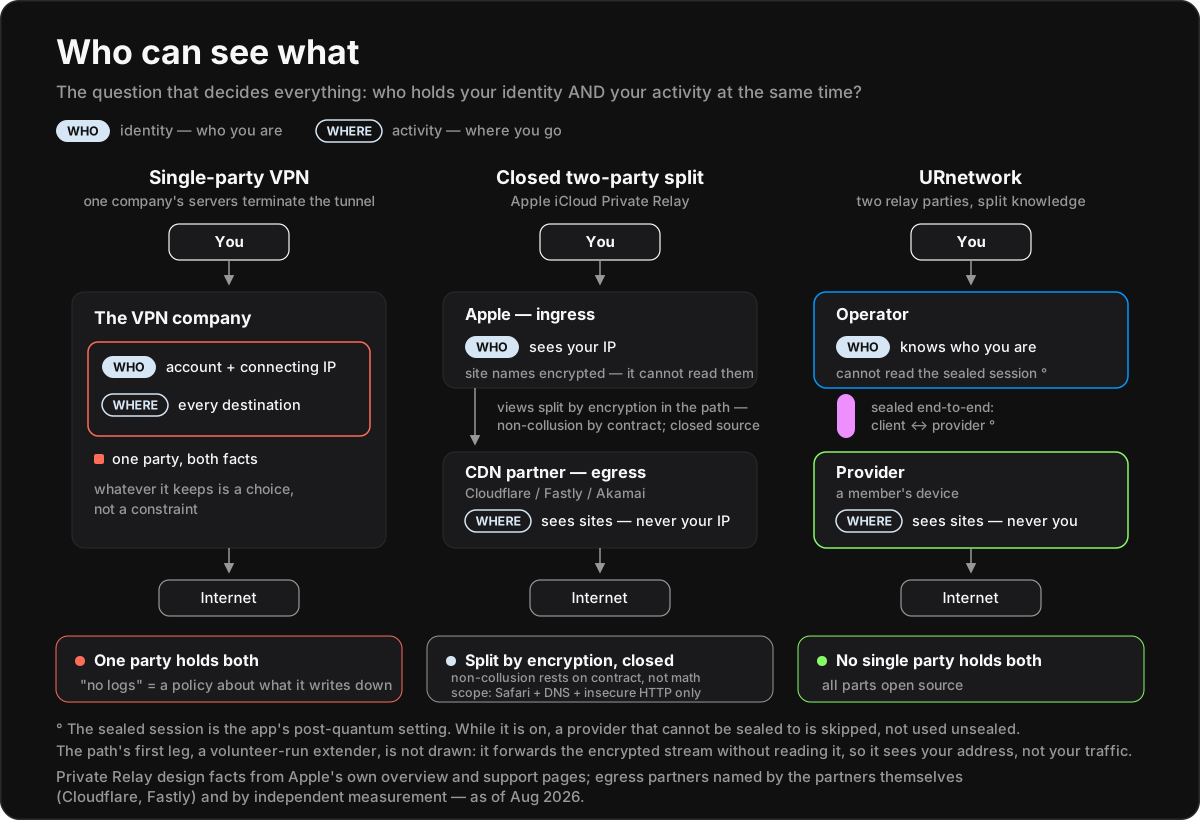
URnetwork is arranged so that view need not assemble. The provider that carries your traffic to the internet does not receive your source IP, and with the seal switched on the operator in the middle relays a session it cannot read, so no single party holds both your identity and your activity. The storage rules behind that are enforced in the open server code, with the full record in the threat model.
What the examinations cover
Cloudflare has twice commissioned an independent privacy examination, in 2020 and 2026, by a Big Four accounting firm (KPMG in the original 2018 pledge, unnamed in the delivered reports). Both cover the 1.1.1.1 public DNS resolver's commitments, not WARP. The findings were clean, down to the candid disclosure that at most 0.05% of packets, querying IPs included, are sampled for troubleshooting. Two scope notes matter. The 2018 pledge said annual, and the delivered examinations are six years apart. And the 2019 WARP posts promised to "regularly work with outside auditors" on WARP's own pledges; the examinations that followed were of the resolver. So WARP's privacy story is policy on top of full single-party visibility, from a company whose enterprise business gives it no advertising motive, and no audit has reached it.
The operational record is strong and openly reported. In July 2025 the 1.1.1.1 resolver had a roughly hour-long global outage; Cloudflare's postmortem calls it an internal configuration error, not an attack, and it was an availability incident rather than a privacy one. No WARP privacy breach is on record.
URnetwork has no independent audit of its protocol or the operator's server code either; the details are under Limits. Its compensating position is different in kind: the operator's storage design is enforced in public code that anyone can check on any day, rather than pledged in policy.
One company, several vantage points
Concentration is the other structural fact. The company that terminates your WARP tunnel also serves as an egress relay for Apple's iCloud Private Relay, where Apple's design withholds user identity from it; runs the 1.1.1.1 resolver; and reverse-proxies a large share of the web's sites as its core business, on a network spanning more than 300 cities. Each vantage point carries its own privacy controls, and nothing on record says Cloudflare combines them. The structural point stands anyway: a large fraction of internet traffic surfaces inside one company in different roles, and WARP is the role in which it also knows your address.
URnetwork's design goes the other way. Egress is dispersed across member households, each carrying a slice of your traffic, with per-site affinity keeping any one site on one exit. The operator coordinates but cannot read the sealed session, and its server code is public.
Where WARP wins
- Free, unlimited, no account, near-zero setup.
- Speed and latency: anycast to a nearby edge plus Cloudflare's backbone.
- Operational maturity and capacity a young decentralized network cannot match.
- Accurate self-description: the product does what its maker says, and does not claim what it does not do.
- The right tool for encrypting traffic on an untrusted network.
Where URnetwork wins
- The split. The exit never learns who you are, and the operator cannot read the sealed session. No single party holds identity and destinations together; Cloudflare sees both ends of the tunnel it terminates.
- Location choice down to a searched city; WARP offers none.
- Residential exit addresses; Cloudflare's ranges are recognizable as Cloudflare.
- Open client and server code, checkable continuously; WARP's pledges are policy, untested by any third party.
- A supply side: members can share their connection as participants in the UR protocol, under signed metered contracts, with an open-source filter dropping file-sharing and attack traffic before it leaves a member's line.
Limits and evidence
URnetwork's main limits:
- No independent audit covers the protocol, the connect engine, or the operator's server code. Two 2025 third-party assessments cover other surfaces: a penetration test of the web application and API (April–May 2025), and the Leviathan MASA AL2 assessment of the Android app, which passed. Leviathan writes that its assessment "should not be read as a holistic security evaluation or comprehensive penetration test." Neither examined logging, retention, or the data path.
- The split assumes the operator and the providers in your window are independent. Nothing in the system attests that independence, and no outside party has measured the fleet. See the threat model, §6.1.
- The WireGuard-compatible fallback endpoint assigns one stable tunnel address, so several providers could recognize the same client across sessions. The native tunnel is the recommended path.
- Coverage counts are self-published, with no outside measurement; the mechanism, a location existing only while a member's device is online in it, is the checkable part.
WARP's limit is the position, not the conduct. Cloudflare terminates the tunnel, so one company can see your address and your destinations together; its pledges about that view carry no third-party attestation, and the two examinations it cites cover the resolver, a different product. Cloudflare's own framing of WARP as transit encryption rather than anonymity is accurate, and the right way to use it.
Trying URnetwork costs nothing: the Instant Account takes one tap and no email, and WARP is free outright, so you can run each against your own sites before paying for anything. More questions are answered in the FAQ.