
URnetwork vs Tor
Tor is the strongest widely deployed anonymity network; URnetwork keeps the split-knowledge idea at everyday speed, exiting through residential addresses instead of a public relay list.
Choose Tor if your adversary may be a government, if you need onion services, or if the price must be zero. Choose URnetwork if you want split knowledge at streaming-class speed, exits that appear as ordinary home users, and a location you choose. Neither asks you to trust a no-logs promise. Tor's separation is deeper and its scrutiny unmatched. URnetwork splits visibility between its operator and a member-run provider and stays fast enough for video.
Tor is run by the nonprofit Tor Project, a US 501(c)(3). Roughly 10,000 volunteer relays served an estimated 3.5 to 4 million daily users in mid-2026, numbers anyone can recount from the project's live metrics, since every relay sits in a public consensus. A connection passes through three volunteer relays: a guard that sees your IP, a middle that sees neither end, and an exit that contacts the website, so no single relay learns both who you are and where you go. Two pieces of folklore do not survive the record: using Tor is legal in most of the world, and a 2020 study estimated that only about 7% of Tor users connect to onion services. The rest browse the ordinary web.
URnetwork uses member-run exits. The provider does not receive your source IP on the relayed path. Native apps can also seal traffic to the provider, with a switch that ships off. How URnetwork works explains the full design. The threat model holds the complete record of what is stored and enforced.
Six differences that affect the choice
| Tor | URnetwork | |
|---|---|---|
| Separation | Three volunteer relays; no relay sees both ends, and no operator exists at all | Two relay parties; the exit never sees your IP, and the operator cannot read the sealed session |
| Speed | High latency by design; poor for video and calls | Streaming-class; URnetwork's own average figure is 40 Mbps+ |
| Exit address | Published relay list, blocked or challenged across much of the web | Residential addresses on no public list |
| Location choice | Not a product feature | Browse countries, search for a city |
| Onion services | Server-side anonymity, unique to Tor | None |
| Price | Free and uncapped, funded by grants and donations | Free daily allowance; Pro $5/month or $40/year |
Caveats below the table:
- Post-quantum: Tor runs a hybrid X25519/ML-KEM-768 key exchange at the relay TLS layer in current releases, rolling out across relays; the circuit-layer onion handshake is still a proposal. URnetwork's X25519MLKEM768 client-to-provider session is a switch in the native apps that ships off; switched on, it skips any provider it cannot seal to rather than downgrading. The browser extension has no sealed session; there, the operator's data path logs nothing, pinned by a test in the open code.
- Tor Browser covers browsing and fails closed: if Tor drops, pages stop loading rather than loading outside it. Routing a whole phone or computer through Tor takes extra tooling. URnetwork is a full-device tunnel on Android, iOS, macOS, Windows, and Linux, with an explicit kill switch toggle in every app.
- Your ISP can tell that you connect to Tor, because entry addresses are public; bridges hide that. URnetwork traffic looks like ordinary encrypted traffic.
- Tor's capacity comes from unpaid volunteers. URnetwork's providers participate in the UR protocol under signed, metered contracts.
- Neither tool makes you anonymous to a site you sign in to.
What Tor says about its own limits
The Tor Project publishes its boundaries itself. "Generally it is impossible to have perfect anonymity, even with Tor," says its own support documentation. The concession is specific: an adversary able to watch both ends of a connection, or to observe enough guard relays, can correlate traffic timing without decrypting anything, and no low-latency design can eliminate that.
It has been done in practice. German reporting in September 2024 revealed that police had deanonymized users of Ricochet, a long-retired messenger, through guard discovery and timing analysis conducted around 2019 to 2021. The Tor Project's response: the attack targeted an application that lacked the vanguards defense, which has shipped in Tor since 0.4.7 and in Ricochet's maintained successor since 2022, and Tor Browser users were not shown to be affected.
Two more episodes show the network policing itself. In 2020, a malicious operator controlling roughly a quarter of exit capacity at peak, downgrading HTTPS on cryptocurrency sites, was identified and ejected. Across 2020 and 2021 the directory authorities expelled KAX17, a cluster of more than 900 relays positioned to observe traffic; those relays could contribute to correlation but could not read encrypted content. Attacks are published, defenses ship, the network continues. No commercial product is examined this way.
One folk claim runs the other direction. Onion routing began at the US Naval Research Lab, and US government internet-freedom programs long supplied much of the project's funding, which feeds a persistent "government-built, so backdoored" story. The funding history is real. The backdoor has never been found: the code is open, releases are signed, Tor Browser builds are reproducible, and two decades of adversarial scrutiny have surfaced nothing.
Exits, bridges, and extenders
Tor's onion encryption ends at the exit relay. For a plain-HTTP site the exit can read and alter what passes; with HTTPS it sees the destination domain and nothing inside. VPN marketing repeats the first half against Tor while omitting the symmetry: every egress terminates encryption, a VPN's server and a URnetwork provider included. The difference is who the exit is. A Tor exit does not know who you are. A single-company VPN's egress belongs to the one company that does. A URnetwork provider sees destinations the way an ISP does, and never your IP on the relayed path.
Both networks assume their front door gets blocked, and both let volunteers run disguised entries. Tor's bridges include Snowflake, which turns a volunteer's browser into an entry point, plus WebTunnel and obfs4. URnetwork's equivalent is the extender: a volunteer-run first hop on an independent address and a believable port that forwards the encrypted session to the operator. The same caveat applies on both systems: a bridge or an extender is your first hop, so its operator sees your real IP. And on both systems the first hop reads nothing: a bridge carries Tor's layered encryption, and an extender forwards a session that stays encrypted end to end past it.
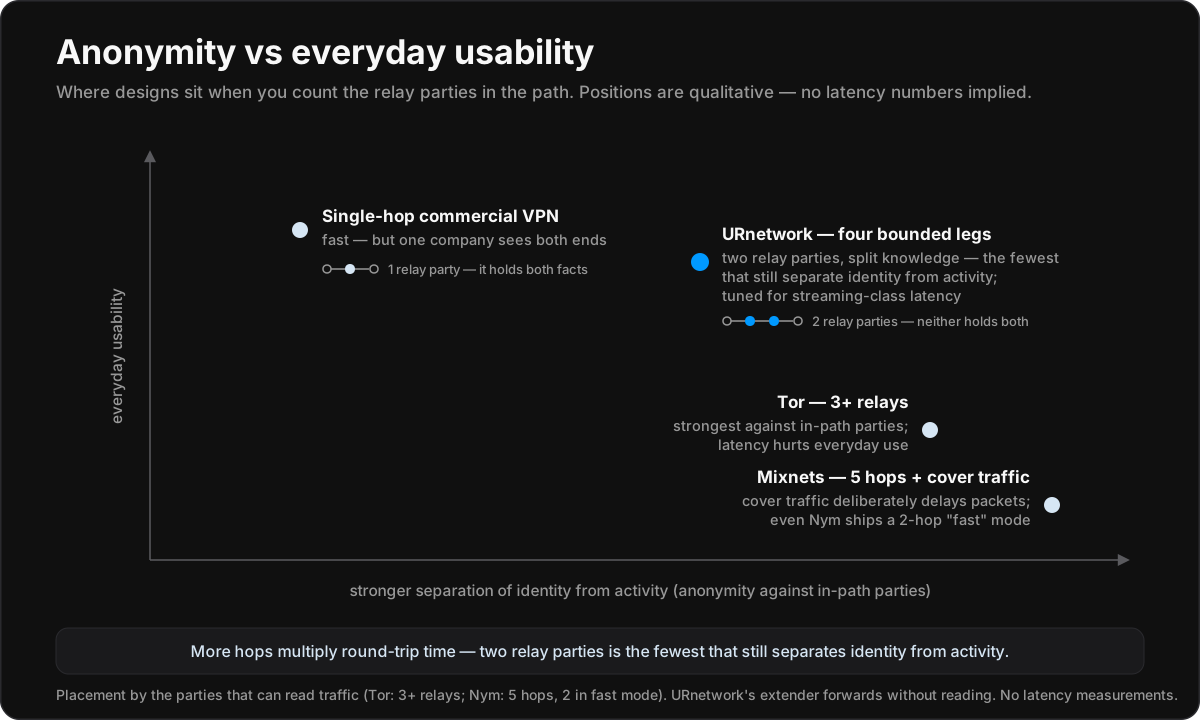
After the door, the routes differ on purpose. Tor chains three relays and rebuilds circuits as you browse, each relay adding its own leg to every round trip, because its adversary is an observer able to watch much of the network at once. URnetwork's path runs through two relay parties, the operator and then a member's device, and spreads a session across a window of several providers with each site pinned to one. Tor buys deeper separation with latency. URnetwork keeps the two properties that matter, a provider blind to who you are and an operator unable to read the sealed session, at speeds where video and calls are normal use.
Accounts and payment
Tor has no account system: nothing to sign up for, nothing to pay, ever. URnetwork reaches a similar floor by other means. The Instant Account is one tap with no email, and the recovery seed phrase the server issues once restores the account after a reinstall. That phrase is URnetwork's own credential; no URnetwork screen ever asks for a crypto wallet's seed phrase or private key. The free daily allowance requires no payment. Pro is where a trail can start: on-chain USDC keeps it to a wallet address on a public ledger, and an app-store purchase ties it to that store account. Tor never has anything to bill.
Where Tor wins
- Anonymity against the most capable adversaries: a longer, churning relay chain with no operator anywhere in it.
- Scrutiny. Two decades of published attacks, shipped defenses, and academic study, with reproducible Tor Browser builds.
- Onion services: server-side anonymity nothing else in this set offers.
- Mature censorship circumvention (Snowflake, WebTunnel, obfs4) with a research community behind it.
- Free, uncapped, and accountless.
Where URnetwork wins
- Speed. Split knowledge at streaming-class throughput; URnetwork's own average figure is 40 Mbps+.
- The exit address. Residential IPs on no public list, where Tor's published exits are blocked or challenged by many sites.
- Choosing where you appear: browse countries, search for a city, with a location listed only while a member's device is online in it.
- Whole-device coverage with ordinary apps on Android, iOS, macOS, Windows, and Linux, plus the browser extension and web app.
- A contracted supply side: providers participate in the UR protocol rather than depending on volunteer goodwill.
Limits and evidence
URnetwork's main limits:
- No independent audit covers the protocol, the connect engine, or the operator's server code. Two 2025 third-party assessments cover other surfaces: a penetration test of the web application and API (April–May 2025), and the Leviathan MASA AL2 assessment of the Android app, which passed. Leviathan writes that its assessment "should not be read as a holistic security evaluation or comprehensive penetration test." Neither examined logging, retention, or the data path.
- URnetwork's structure includes an operator at all: it authenticates you, assigns providers, and relays your traffic. The sealed session keeps it from reading what it carries, and while the seal is on a provider it cannot seal to is skipped rather than used unsealed — so the cost is availability, not a silent downgrade. No app yet shows a per-connection sealed-or-not verdict. Tor needs no such caveat.
- The split assumes the operator and the providers in your window are independent. Nothing in the system attests that independence, the operator could itself run providers, and no outside party has measured the fleet. See the threat model, §6.1.
- Tor's relay counts can be recounted by anyone from the public consensus. URnetwork's provider and location counts come from its own live stats feed: open and unauthenticated, but the operator reporting on itself.
Tor's limits are the ones it publishes. Latency is structural and permanent, and the project discourages torrenting. Exits can read plain-HTTP payloads. Using Tor is visible to your ISP unless you use a bridge, and timing correlation by an adversary watching both ends remains possible, as the project has said for as long as it has existed. None of that is a scandal. It is the price of the strongest separation deployed at scale.
Many careful people run both: URnetwork as the everyday layer, Tor Browser for the moments that need maximum anonymity. Trying either costs nothing, and URnetwork's Instant Account takes one tap and no email. More questions are answered in the FAQ.