
URnetwork vs TunnelBear
TunnelBear is the simplest consumer VPN and the first to publish an outside security audit; URnetwork splits the path so the exit never learns who you are and the operator cannot read the sealed session.
Choose TunnelBear if you want the easiest possible VPN, the longest unbroken run of annual outside audits in the category, and steady datacenter speeds. Choose URnetwork if you want a split path, an email-free account, and residential exits aimed at a city. Both have free tiers. TunnelBear is the friendlier product. URnetwork splits visibility between its operator and a member-run provider.
TunnelBear is a Toronto-built VPN, owned by McAfee since 2018, that wraps a WireGuard/OpenVPN/IKEv2 service in bears and plain language. In 2016 it became the first consumer VPN to publish a third-party security audit, and Cure53 has audited it every year since 2017, nine years running by its own count. A free tier gives 2 GB each month, and GhostBear obfuscation helps on networks that block VPNs.
URnetwork uses member-run exits. The provider does not receive your source IP on the relayed path. Native apps can also seal traffic to the provider, with a switch that ships off. How URnetwork works explains the full design. The threat model holds the complete record of what is stored and enforced.
Six differences that affect the choice
| TunnelBear | URnetwork | |
|---|---|---|
| Trust model | One company's server sees your IP and your destinations together; a policy not to record them | Two relay parties; the exit never sees your IP, and the operator cannot read the sealed session |
| Outside testing | Cure53 audits every year since 2017; full public reports for 2020–2023, none since | Open client and server code; no independent audit of the protocol or server code |
| Simplicity | Pick a country, switch on; almost nothing to configure | A connect button by default; city search, sharing, and wallet options when you want them |
| Consistency | Datacenter servers; steady speeds | Member uplinks; URnetwork puts its average streaming speed at 40 Mbps+ |
| Account and payment | Email required; credit card or the iOS App Store only | One-tap account with no email; wallet sign-in; on-chain USDC |
| Exit and targeting | Datacenter ranges; 47 countries advertised; city choice in the US and Canada only | Residential addresses; browse countries, search for a city |
Caveats below the table:
- Free tiers: TunnelBear's is 2 GB a month, and since 26 January 2026 free users no longer choose their country; the change was pre-announced with cost reasons given. URnetwork's free allowance resets daily and keeps location choice. Paid: TunnelBear Unlimited from $3.33/month as of mid-2026; URnetwork Pro $5/month or $40/year, current numbers at ur.io/products.
- Post-quantum encryption runs URnetwork's way: the X25519MLKEM768 client-to-provider session is a switch in the native apps that ships off, and switched on it skips any provider it cannot seal to rather than downgrading. The browser extension has no sealed session; there, the operator's data path logs nothing, pinned by a test in the open code. TunnelBear makes no post-quantum claim.
- Both address blocked networks: TunnelBear with GhostBear obfuscation, URnetwork with extenders, entry hops on independent addresses and believable ports.
- TunnelBear publishes no physical-versus-virtual breakdown of its 47 countries, and no outside study has measured it. The claim is modest by category standards; the gap is the missing disclosure, not inflation.
- Both ship a kill switch (TunnelBear's is named VigilantBear); URnetwork's is an explicit toggle on every platform, and its browser extension pairs with the ur.io web app.
The audit record, exactly
TunnelBear's distinction is real: it started the consumer VPN audit habit, and Cure53 has tested it annually since 2017, the longest such run in the category. The record needs dating, though. Full public reports exist for the 2020 through 2023 audits on cure53.de. The 2024 audit was announced in November 2025 as a blog summary with no report attached, describing ten findings of medium severity or higher, all said to be addressed; there is no document to check. The 2025 audit has no publication at all, and TunnelBear's own audits page still led with the 2023 report as of mid-2026. The audits appear to continue; the publishing has stopped.
The last readable report (October–November 2023) cuts both ways: 13 findings, two rated High and none Critical, with Cure53 crediting "a marked security improvement with each passing round of testing" while flagging that "some flaws located in prior audits have either been incorrectly resolved or simply ignored." Scope matters as much as cadence. These are penetration tests and source-code audits of apps and infrastructure, not an inspection of what TunnelBear's servers record; no no-logs attestation exists for TunnelBear. And one marketing line should be discarded: the homepage still claims to be "the only VPN in the industry to perform annual, independent security audits", which is false; Nord, ExpressVPN, Surfshark, IVPN, Mullvad, and Windscribe all publish independent audits.
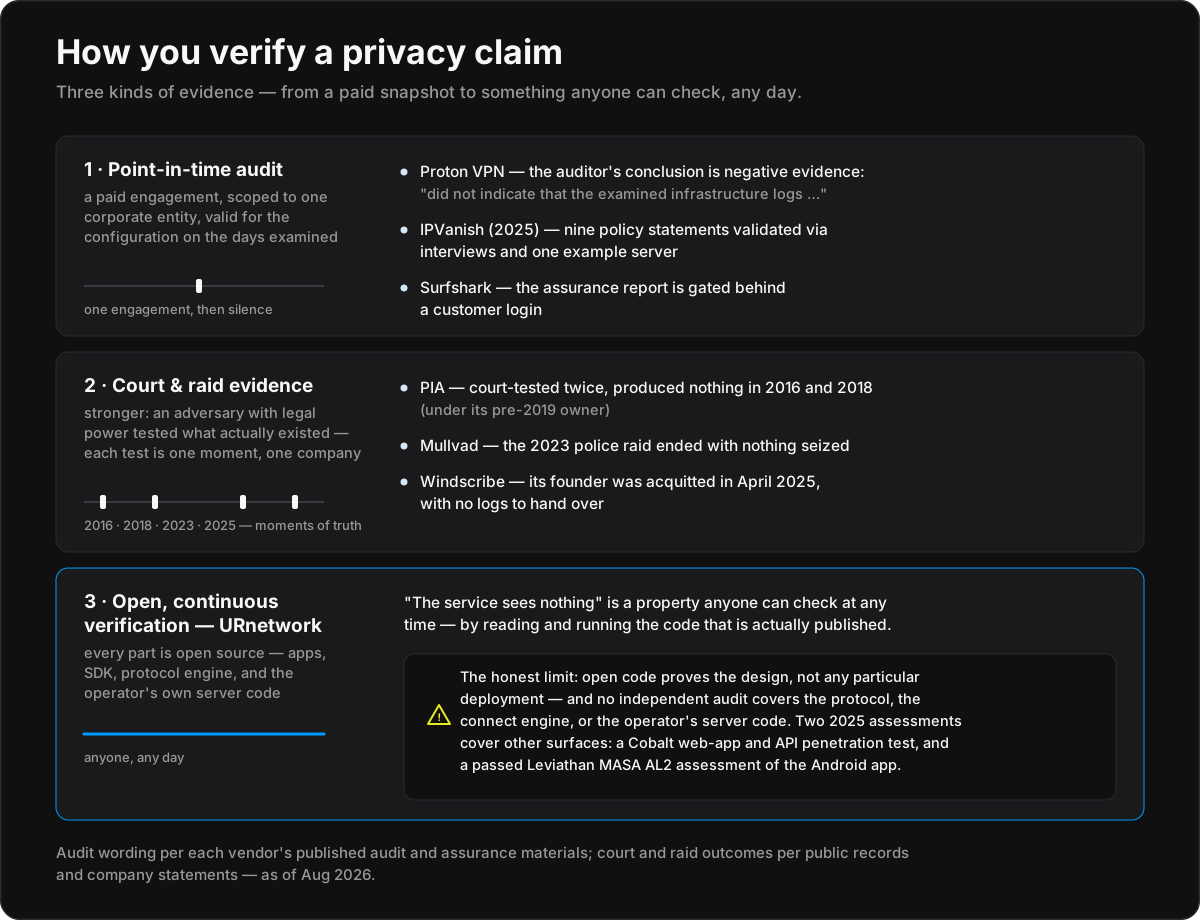
URnetwork sits in the other column: no independent audit covers its protocol or the operator's server code (two 2025 assessments cover other surfaces; see Limits), and its client and server code are open, so the storage and routing claims can be verified continuously rather than annually.
One company, one policy
TunnelBear's server terminates your tunnel, so one company can see your account, your real IP, and every destination you connect to at the same moment. What restrains that view is policy, and TunnelBear's is among the better-drafted in the category: it names what it does not collect (connection IPs, DNS queries, any record of the sites and apps you use) rather than hiding behind "no logs." The same policy lists what it does keep: an email-identified account, paid status, app and OS versions, monthly usage totals, geolocation at continent, country, and city level, crash and device data, and a card's last four digits, with an analytics processor among its providers and 30-day deletion after cancellation.
Ownership frames the jurisdiction. McAfee has owned TunnelBear since 2018, which places it under US law, and McAfee appears nowhere on TunnelBear's homepage or in its privacy policy; the 2023 audit engagement was commissioned by McAfee ULC. Nothing suggests the acquisition changed what TunnelBear collects; the fair criticism is the quiet disclosure. The operational record is clean: no breach, leak, server seizure, or court case on record. The one notable vulnerability, CVE-2018-10381 (2018), was a local privilege-escalation flaw in the Windows maintenance service, patched. Its 9.8 rating scores the exposed named pipe rather than a remote attack: exploiting it required code already running on the machine.
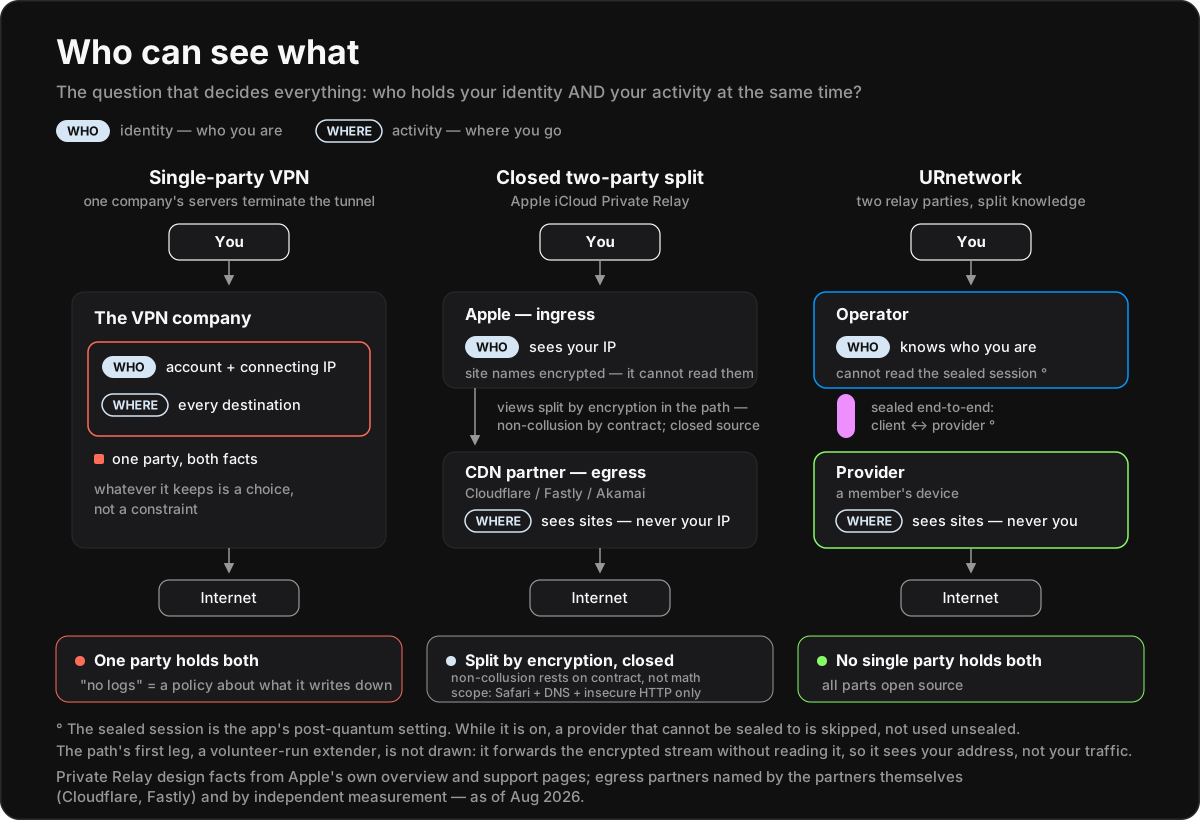
On URnetwork's relayed path, with the seal switched on, the two halves never meet: the provider that carries your traffic does not receive your source IP, and the operator relays a session it cannot read, so no single party holds both your identity and your activity. What the operator stores is constrained in open server code, with the complete record in the threat model.
Where TunnelBear wins
- The easiest VPN there is for someone who will never open a settings screen.
- Nine years of annual outside testing, with four full reports (2020–2023) anyone can read; no young network can match that history.
- A privacy policy that names what it does not collect instead of gesturing at "no logs."
- Steady datacenter speeds.
- Corporate stability and consumer-grade support.
Where URnetwork wins
- The split. The exit never learns who you are, and the operator cannot read the sealed session. No single party holds identity and destinations together; TunnelBear's server sees both.
- Verification that does not expire: open client and server code, versus a closed stack and reports that have stopped appearing.
- Account anonymity: a one-tap email-free account backed by a recovery seed phrase (URnetwork's own credential; it never asks for a crypto wallet's seed phrase or key), wallet-signature sign-in, and on-chain USDC payment. TunnelBear requires an email and a card.
- Residential exits with city search anywhere providers are online; TunnelBear offers cities in two countries.
- A free tier that keeps location choice and resets daily.
- A supply side: members can share their connection as participants in the UR protocol, with an open-source filter dropping file-sharing and attack traffic before it leaves a member's line.
Limits and evidence
URnetwork's main limits:
- No independent audit covers the protocol, the connect engine, or the operator's server code. Two 2025 third-party assessments cover other surfaces: a penetration test of the web application and API (April–May 2025), and the Leviathan MASA AL2 assessment of the Android app, which passed. Leviathan writes that its assessment "should not be read as a holistic security evaluation or comprehensive penetration test." Neither examined logging, retention, or the data path.
- The split assumes the operator and the providers in your window are independent. Nothing in the system attests that independence, and no outside party has measured the fleet. See the threat model, §6.1.
- The WireGuard-compatible fallback endpoint assigns one stable tunnel address, so several providers could recognize the same client across sessions. The native tunnel is the recommended path.
- Coverage counts are self-published on both sides, with no outside measurement of either fleet; URnetwork's mechanism, a location existing only while a member's device is online in it, is the checkable part.
TunnelBear's limit is the position every one-company VPN shares: its server terminates the tunnel where it can see your address and your destinations together, and its audits test the software around that position rather than attesting what is recorded in it. Since 2023 there is a second limit: the newest results exist only as vendor summaries, so the published record a buyer can read stops at the 2023 report.
Trying URnetwork costs nothing: the Instant Account takes one tap and no email, and both free tiers let you test against your own sites before paying for either. More questions are answered in the FAQ.