
URnetwork vs Hola VPN
Hola is one of the most installed unblocking tools ever made, and its free tier is paid for by enrolling users' devices as peers in the Bright Data proxy network; URnetwork is the same residential idea rebuilt on explicit opt-in, metered contracts, and a filter at each member's exit.
Choose Hola if you want one-click unblocking in a browser, no account or payment, and the most established residential peer network. Choose URnetwork if you want exits that opted in, protection engineered for the member at each exit, and open code you can verify. Both route traffic through real household addresses. The difference is what surrounds the person carrying it.
Hola VPN is built by Hola VPN Ltd. of Israel and pioneered the peer-to-peer residential model in consumer software. Its homepage advertises "more than 324 million members" alongside "263 million Downloads" (hola.org, August 2026; both figures are the company's own). Its FAQ describes today's architecture as a datacenter front end: clients reach "our standard data center proxy servers", and a request then goes to the proxy itself, to another datacenter, or "to our P2P network". Paid tiers exist as well.
URnetwork uses member-run exits. The provider does not receive your source IP on the relayed path. Native apps can also seal traffic to the provider, with a switch that ships off. How URnetwork works explains the full design. The threat model holds the complete record of what is stored and enforced.
Six differences that affect the choice
| Hola | URnetwork | |
|---|---|---|
| Setup | One click in the browser; no account or sign-in | Instant Account in one tap; the extension pairs with the ur.io web app |
| Funding the free tier | Free users "may be a peer on the Bright Data network"; Premium is the documented opt-out | Free daily allowance funded by Pro subscriptions; no peering attached |
| Network scale | Self-reported: "more than 324 million members" and "263 million Downloads" on one homepage | Young member network; live counts in the app, 2,000+ real cities by URnetwork's own count |
| Joining the exit pool | A condition of free use, stated in the legal and help pages | An in-app switch, off by default; share publicly or with your own devices only |
| Protection at the exit | Policy controls: peers route "only ... specific requests from whitelisted sites", drawn on while idle | An open-source filter on the member's device drops file-sharing and attack traffic before it leaves their line |
| Verifiability | Closed source; no published independent audit | Open client and server code |
Caveats below the table:
- Post-quantum encryption is URnetwork-side here: the X25519MLKEM768 client-to-provider session is a switch in the native apps that ships off, and switched on it skips any provider it cannot seal to rather than downgrading. Hola advertises no equivalent. The browser extension has no sealed session; there, the operator's data path logs nothing, pinned by a test in the open code.
- Hola states its transport as "https proxy or IKEv2" with AES ciphers; the same FAQ also lists PPTP and DES3, both long deprecated. The code is closed, with no published independent audit, so no encryption claim can be checked from outside.
- Hola is browser-first, with mobile products. URnetwork ships native apps on Android, iOS, macOS, Windows, and Linux plus the extension and web app, each with an explicit kill switch.
- Hola's free tier costs no money, and Premium prices vary. URnetwork's free tier is a daily data allowance; Pro is $5/month or $40/year. Current numbers are at ur.io/products.
- Hola advertises "195 countries to browse from", a marketing count no outside party has measured.
The Bright Data record
Three dates carry the history, and most of the paperwork is Hola's own.
- May and June 2015: 8chan's operator traced a flood of junk requests, heavy enough to crash the site's PHP backend, to a paying customer of Luminati, Hola's commercial bandwidth-resale arm at the time. Hola confirmed it had been selling free users' bandwidth, and its founder said most users were "probably not aware of this". In the same weeks, researchers published six client vulnerabilities, including remote code execution, privilege escalation, arbitrary local file read, and persistent tracking, and disputed Hola's claim to have fixed them; Vectra Networks documented a console that stayed active while Hola was idle and a Hola code-signing certificate installed into Windows' trusted-publisher store. These events are a decade old and the client has been rewritten since; they defined the risks of low-visibility peering rather than describing today's software.
- August 2017: Hola sold a majority stake in Luminati to EMK Capital, a London private-equity firm. Luminati became Bright Data in 2021, remains an EMK company, and lists Hola's founders as its own. The corporate separation is real. The supply relationship continues.
- 14 April 2026, the date on the current privacy policy: "In return for free usage of Hola Product and services ... you may be a peer on the Bright Data network ... You may opt out by becoming a Premium user."
The disclosure has a location pattern. The peer arrangement is stated in the privacy policy, the terms, a dedicated Bright Data SDK page, the public FAQ, and a June 2026 help article. It appears nowhere on the homepage, the about page, the mobile product page, or the Chrome Web Store listing (all checked August 2026). What peers receive is the free service itself: compensation in kind, not in money, and not metered.
What the policy collects
Hola does not claim "no logs"; its own documents describe collection. The privacy policy dated 14 April 2026 lists IP address, name and email, payment details, "names of applications that are installed on the user's device", operating system and browser type, and "browsing history and access times and dates", with log data retained "for a period of up to 12 months". The Chrome Web Store privacy panel for the same product, updated 4 August 2026, states that the developer does not log browsing activity. Both statements are current and first-party. With the code closed, neither can be checked from outside.
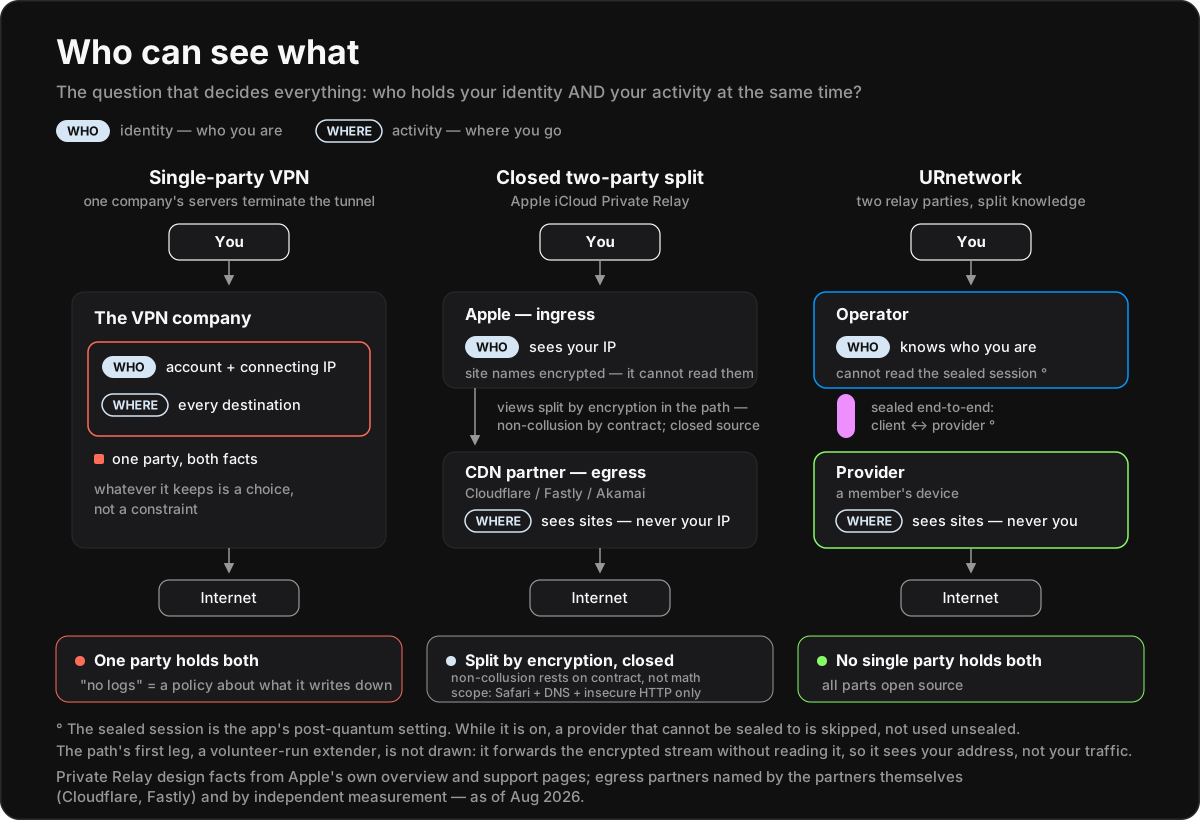
URnetwork's counterpart claims live in code rather than policy. The provider never receives your source IP on the relayed path, and with the seal switched on the operator cannot read the session, so no single party holds your identity and your destinations together. What the operator does store is recorded in the threat model.
Carrying strangers' traffic
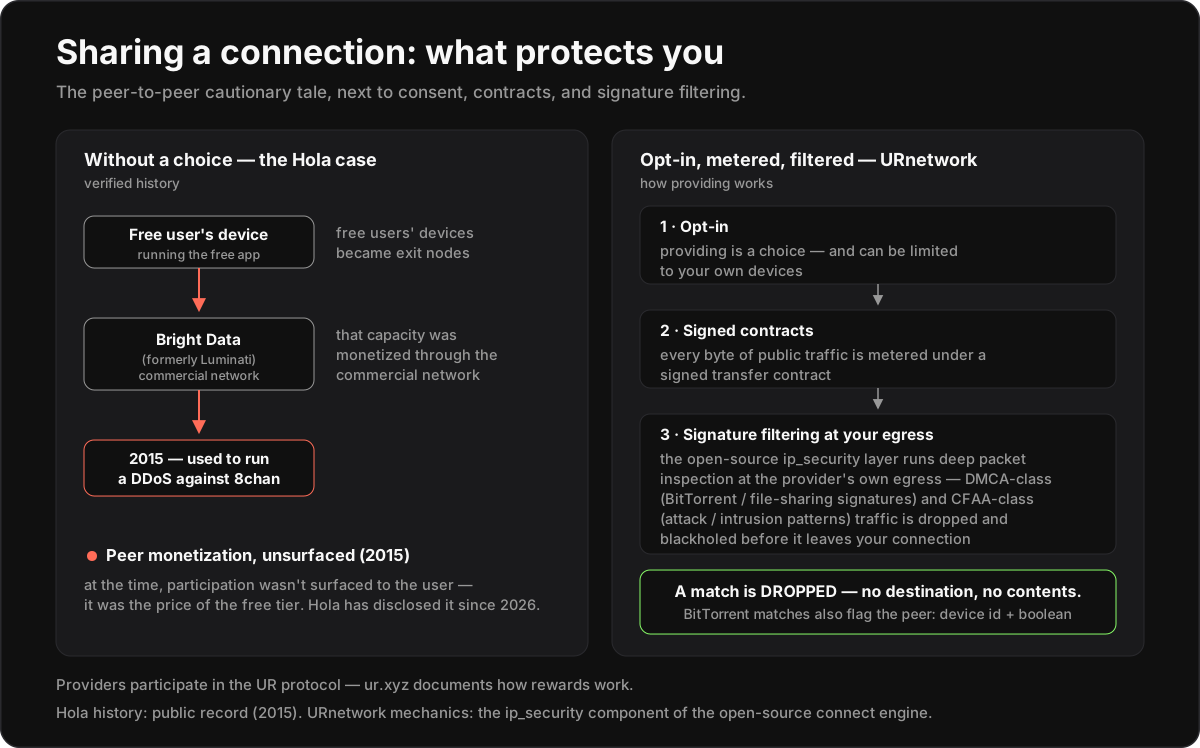
When traffic exits from a household connection, the question is what protects the household, and the exposure is symmetrical: strangers' destinations exit from the peer's address, and outside observers attribute that activity to the peer's connection. Hola's protections are policy, run from the network side: peers route "only ... specific requests from whitelisted sites", devices are drawn on while idle on Windows and Android, and the terms promise a best effort not to spend battery or roaming data. The Bright Data SDK page adds that Bright Data "monitors all of its network traffic to ensure your safety", and that the indexing "runs in the background even after closing the application". In 2015, peers had no say in what crossed their lines, and some of that capacity, resold through Luminati, carried a DDoS attack.
URnetwork's protection runs on the member's own device instead. An open-source inspection layer at each provider's egress drops file-sharing and attack traffic before it leaves the member's connection, recording no destination, domain, or contents. The same filter applies to traffic you send as a client, so your own torrenting would be dropped too; URnetwork is deliberately not a torrenting product. Carried bytes use the member's connection and data plan, and providing can be paused or stopped in the app at any time. The mechanism is documented in the overview.
Where Hola wins
- Free, casual, one-click unblocking at enormous scale. For a reader who has seen how the peer model works and accepts it, nothing is more established at that job.
- Nothing to set up: no account, no sign-in, one click in the browser. URnetwork's extension requires signing in first.
- The peer arrangement is stated in writing, in the policy, the terms, a dedicated SDK page, and the FAQ, and Premium is a real, named opt-out.
Where URnetwork wins
- Consent. Providing is opt-in and off by default, never a side effect of installing a free app.
- Compensation. Members who carry traffic do so under signed, metered contracts, as participants in the UR protocol. On free Hola, the free service is the compensation, and the bandwidth is sold on.
- Protection for the participant. The filter runs at the member's own exit, dropping file-sharing and attack traffic before it leaves their line, with no destination or contents recorded.
- The split. The exit never learns who you are, and the operator cannot read the sealed session. No single party holds identity and destinations together.
- Verifiability. Open client and server code, versus a closed stack whose encryption claims cannot be checked.
- Account anonymity. An Instant Account takes one tap and no email, and is restored on a new device by its recovery phrase.
Limits and evidence
URnetwork's main limits:
- No independent audit covers the protocol, the connect engine, or the operator's server code. Two 2025 third-party assessments cover other surfaces: a penetration test of the web application and API (April–May 2025), and the Leviathan MASA AL2 assessment of the Android app, which passed. Leviathan writes that its assessment "should not be read as a holistic security evaluation or comprehensive penetration test." Neither examined logging, retention, or the data path.
- The split assumes the operator and the providers in your window are independent. Nothing in the system attests that independence, the operator could itself run providers, and no outside party has measured the fleet. See the threat model, §6.1.
- Coverage counts are self-published on both sides. No outside party has measured Hola's 195-country claim or URnetwork's city count.
- URnetwork is the younger network, and speed moves with the providers in your window.
Hola's limit is structural as well as historical. One company directs the network and terminates connections at its own proxy servers; the policy permits broad collection with 12-month retention; and the closed code means the encryption, the whitelist, and the idle-only rule are promises rather than anything a user can verify. The record above is Hola's own current paperwork plus the documented 2015 events.
Trying URnetwork costs nothing: the Instant Account takes one tap and no email, so you can test the exits you care about before paying for either product. More questions are answered in the FAQ.