
URnetwork vs Orchid
Orchid invented the pay-per-packet VPN marketplace and documents its own limits more candidly than most of the industry; URnetwork is an operated network that splits the path so the exit never learns who you are and the operator cannot read the sealed session.
Choose Orchid if you are crypto-fluent and want no account and no subscription, paying providers per packet from a wallet, with circuits you can chain across several of them. Choose URnetwork if you want an actively shipped product, residential exits under contract that you can search by city, and no token anywhere in the purchase. Both are open source. Orchid's separation is an option you assemble; URnetwork's is the default on every session.
Orchid is built by Orchid Labs Inc. of San Francisco and was founded in 2017. There is no subscription: you pay bandwidth providers per packet through probabilistic nanopayments, from a wallet you fund yourself or from a prepaid account bought in the app. Providers stake OXT, an ERC-20 token on Ethereum, to advertise themselves, and the shipping app filters selection through a curated provider list.
URnetwork uses member-run exits. The provider does not receive your source IP on the relayed path. Native apps can also seal traffic to the provider, with a switch that ships off. How URnetwork works explains the full design. The threat model holds the complete record of what is stored and enforced.
Six differences that affect the choice
| Orchid | URnetwork | |
|---|---|---|
| Account path | Keys funded from your own wallet, no account; or a $1 in-app purchase tied to a store account | Instant Account in one tap, no email; a recovery phrase restores it |
| Payment model | Per-packet nanopayments; no subscription | A free daily allowance plus flat plans in ordinary money or on-chain USDC |
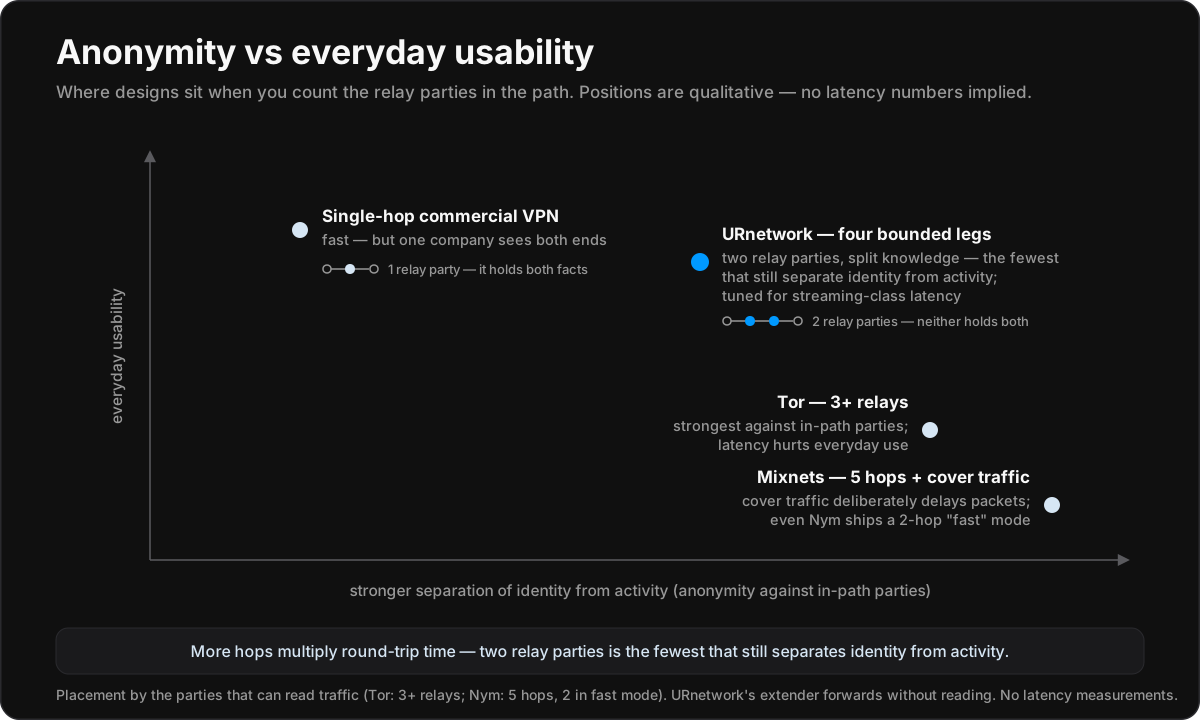
| Circuits and the split | Single hop by default; user-chained circuits opt-in, "use at your own risk" | Two relay parties on every session; the exit never sees your IP, and the operator cannot read the sealed session |
| Maintenance | iOS app last updated May 2023, Android December 2024 | Apps shipping on Android, iOS, macOS, Windows, and Linux plus extension and web |
| Exits and targeting | Per-provider; residential mix and depth not visible until you fund an account | Residential member devices; browse countries, search for a city |
| Token | OXT staked by providers; purchased accounts hold xDAI that cannot be withdrawn | None; nothing to buy, stake, or hold |
Caveats below the table:
- Post-quantum encryption is URnetwork-side here: the X25519MLKEM768 client-to-provider session is a switch in the native apps that ships off, and switched on it skips any provider it cannot seal to rather than downgrading. Orchid advertises no equivalent. The browser extension has no sealed session; there, the operator's data path logs nothing, pinned by a test in the open code.
- Orchid's VPN ships for iOS, macOS, and Android, by its own docs. URnetwork ships native apps on Android, iOS, macOS, Windows, and Linux plus a browser extension paired with its web app, each with an explicit kill switch.
- Cost on Orchid tracks usage. The $1 in-app purchase buys a stablecoin balance that cannot be withdrawn; funding through the dApp keeps the balance yours, at the cost of acquiring a token and paying on-chain fees, and Orchid's docs note that when fees rise, providers stop accepting payment from small accounts. URnetwork Pro is $5/month or $40/year over the free allowance. Current numbers are at ur.io/products.
Nanopayments and the two funding paths
The payment design is elegant. Probabilistic nanopayments are tiny chance-based payments that settle on-chain only occasionally, which makes paying per packet feasible. Providers stake OXT as collateral to advertise themselves, and client selection is stake-weighted. Stake is committed capital, an economic signal. It cannot say whether a provider logs or throttles, which is why a curated list sits on top of it, and repointed stake carries a withdrawal delay of about three months.
The two funding paths differ sharply in what they reveal. Fund keys from your own wallet through the dApp and there is no account at all: real anonymity, as good as your acquisition path. Orchid's own FAQ states the catch: crypto bought "on an exchange with their real identity" lets that exchange be compelled to link a name to the funding trail. The path the app puts in front of a new user is the other one: "Get started for $1," an Apple or Google in-app purchase tied to a store account and a card. Those accounts hold xDAI on the Gnosis chain, and Orchid's docs state the crypto cannot be transferred back out of a purchased account.
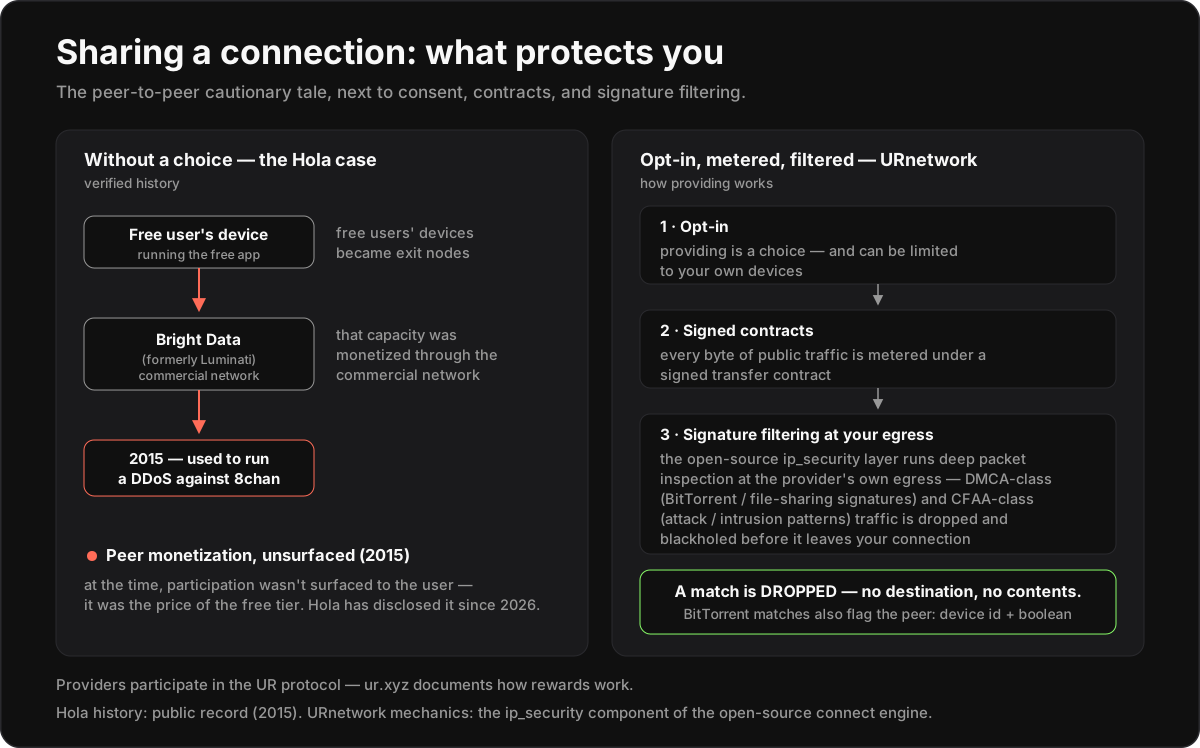
What a provider carries is also between buyer and seller; the protocol takes no position on complaints that follow. URnetwork's providers carry traffic under signed, metered contracts, with an open-source filter at each member's exit that drops file-sharing and attack traffic before it leaves their line, recording no destination or contents.
URnetwork reaches the anonymous account without the crypto fluency. "Create Instant Account" is one tap, asks for no email, and returns a recovery seedphrase that is the whole credential and survives a reinstall. That phrase is URnetwork's own recovery credential, shown once. URnetwork never asks for a crypto wallet's seed phrase, private key, or mnemonic, and no screen in any app requests one. A Solana or Bittensor wallet signs you in instead by signing a challenge message; URnetwork receives the address, the message, and the signature, never the key. Pro can be paid on-chain in USDC, so the paid tier need not touch a name or a card.
The curated list and the chained circuit
Orchid's marketing sells a decentralized marketplace with "no trust required." The record beneath it is specific. The whitepaper's own word is a "whitelist… consisting of trusted VPN partners." The shipping app's default curator is a single-owner on-chain allowlist, the documented connect sequence includes checking that a provider is in the curator, and Orchid's docs state that accounts bought with the $1 purchase "connect only to preferred providers." Reaching the open marketplace means funding your own keys through the dApp instead. A fully permissionless curator exists in the same contract file and is not what ships.
The multi-hop design gets both its credit and its labels. Orchid circuits can chain several independent providers so that no one provider sees both ends, and hops can be mixed with OpenVPN and WireGuard hops: real configurability. The default circuit is a single hop. Orchid's FAQ calls multi-hop an advanced feature, "use at your own risk," three times, and advises funding each hop from a separate wallet for the separation to hold. No latency cost is disclosed anywhere in the marketing or docs, and each added hop stretches the round trip by that provider's own latency.
Below both paths sits the same floor: the protocol does not enforce logging behavior, so each provider's own policy governs. Orchid says so itself, without marketing around it: "if the provider maintains logs, those logs could be sold to advertisers or otherwise used against you," and it makes no no-logs claim anywhere on its site. Payments settle on public chains, so funding flows are pseudonymous, with no mixing layer.
Project cadence
A privacy tool's safety decays when the parts around it stop moving, so the dates matter. The repository last saw a push on 22 February 2026, and the last tagged release is January 2025. The iOS app was last updated in May 2023, the Android app in December 2024, the blog has been silent since August 2022, and the privacy policy was last updated in August 2019. The named audits, ConsenSys Diligence and Certora, are scoped by Orchid's own store copy "on all decentralized smart contracts"; the one retrievable report (January 2020) covers a single token-distribution contract, and both audit links on Orchid's audits page were dead when checked in August 2026. Orchid publishes no usage statistics of any kind, so network depth is discoverable only after funding an account. In May 2026 Upbit and Bithumb placed OXT on their delisting watchlists, Bithumb citing inadequate issuer disclosure and shortcomings in business progress; no outcome had been announced as of August
- The company has reoriented toward a marketplace for GenAI, storage, and
bandwidth, and the recent repository activity sits in the GenAI and storage directories.
Where Orchid wins
- No-account usage on the dApp path: keys you generate, funded from your own wallet, pay per packet, nothing to register.
- Circuits you can chain across several independent providers, mixable with OpenVPN and WireGuard hops, for those willing to pay each hop's added latency and fund each hop separately.
- Unusually candid documentation: it tells buyers what providers can see, warns that exchange purchases can deanonymize them, and answers "am I totally private?" with "No."
- Pay-per-use with no subscription, and a protocol that is permissionless at its base layer.
Where URnetwork wins
- An actively shipped product: maintained apps on five platforms plus the extension and web app, against mobile apps years out of date.
- The split as the default on every session: the exit never sees your IP. With the seal switched on, the operator cannot read the session either, and no single party holds identity and destinations together, with nothing to assemble.
- Residential exits as the product promise, under consent, contracts, and payment, with live provider counts visible before you pay.
- Protection for the participant: the open-source filter drops file-sharing and attack traffic at each member's own exit; Orchid leaves that exposure between buyer and seller.
- Platform-side storage rules enforced in open code, recorded in the threat model, versus each provider's word.
- No token: flat pricing in money or USDC, nothing to stake, no balance to strand. Providers participate in the UR protocol without staking capital.
Limits and evidence
URnetwork's main limits:
- No independent audit covers the protocol, the connect engine, or the operator's server code. Two 2025 third-party assessments cover other surfaces: a penetration test of the web application and API (April–May 2025), and the Leviathan MASA AL2 assessment of the Android app, which passed. Leviathan writes that its assessment "should not be read as a holistic security evaluation or comprehensive penetration test." Neither examined logging, retention, or the data path.
- The split assumes the operator and the providers in your window are independent. Nothing in the system attests that independence, the operator could itself run providers, and no outside party has measured the fleet. See the threat model, §6.1.
- Coverage counts are self-published on both sides. Orchid publishes no usage statistics at all; URnetwork's city count is its own, and no outside party has measured either network.
- URnetwork is the younger network, and speed moves with the providers in your window.
Orchid's limit is structural and operational at once. The default product is a single hop through a curated list, so the provider you reach can see your IP and your destinations together, governed only by its own policy. The separation that fixes this is opt-in, labelled "use at your own risk" by its own FAQ, and paid for in latency and wallet management. And the shipped apps are years old, on a project that has moved its work elsewhere.
Trying URnetwork costs nothing: the Instant Account takes one tap and no email, so you can test the residential model against your own sites before funding either product. More questions are answered in the FAQ.