
URnetwork vs Tailscale
Tailscale connects machines you own into a private encrypted mesh; URnetwork is private egress to the public internet. They are different tools, and they overlap at exactly one point: the Mullvad exit-node add-on.
Choose Tailscale for reaching your own devices: the mesh is its whole job, it is the best product in its category, and nothing on this page argues otherwise. Choose URnetwork for the public internet: residential exits, a split path, and an account that need not be you. Most people asking this question should keep using Tailscale for the first job. This page maps the boundary, and what happens at the one point where the two jobs touch.
Tailscale is a zero-configuration WireGuard mesh from Tailscale Inc. of Toronto, venture-funded with a $160M Series C in April
- It joins your laptop, phone, servers and VMs into a private network,
punches through NATs for direct peer-to-peer links, and falls back to its DERP relays when no direct path exists. Private keys never leave your devices, and relayed packets are ciphertext to the relay.
URnetwork uses member-run exits. The provider does not receive your source IP on the relayed path. Native apps can also seal traffic to the provider, with a switch that ships off. How URnetwork works explains the full design. The threat model holds the complete record of what is stored and enforced.
Six differences that affect the choice
| Tailscale | URnetwork | |
|---|---|---|
| Job | Private mesh between devices you own | Private egress to the public internet |
| Public-internet exit | None by default; your own machine, or one Mullvad datacenter exit via a paid add-on | Member devices on residential addresses in 90+ countries; browse countries, search for a city |
| What the operator holds | Account identity, device inventory, public IPs, and a connection graph with byte counts; mesh contents stay ciphertext | Two relay parties; the exit never sees your IP, and the operator cannot read the sealed session |
| Accounts | Bound to a Google, Microsoft, GitHub or Okta identity; no anonymous tailnets, by design | Instant Account in one tap, no email; wallet sign-in; on-chain USDC |
| Verification | SOC 2 Type II; 40+ public security bulletins; audit reports on request | Open client and server code; no independent audit of the protocol or server code yet |
| Free tier and price | Free personal tier; paid team plans; Mullvad add-on about $5/month per 5 devices | Free daily allowance; Pro $5/month or $40/year |
Caveats below the table:
- Post-quantum encryption is URnetwork-side here: the X25519MLKEM768 client-to-provider session is a switch in the native apps that ships off, and switched on it skips any provider it cannot seal to rather than downgrading. The browser extension has no sealed session; there, the operator's data path logs nothing, pinned by a test in the open code.
- Both ship on Android, iOS, macOS, Windows, and Linux. URnetwork adds a browser extension paired with its web app and an explicit kill switch toggle on every platform, default-on in the extension.
- Tailscale clients can opt out of connection logging with
--no-logs-no-support, at the stated cost of technical support. - The two run together: Tailscale holding the system tunnel and URnetwork's extension covering the browser, since the extension is a proxy and does not claim the OS route. On mobile you switch, because the OS runs one VPN profile at a time.
The mesh, and the key server
Inside a tailnet, the see-nothing claim is mostly mechanism. Each device generates its own WireGuard key pair, and the private key never leaves it. The coordination server distributes public keys and access policy. DERP relays forward encrypted packets they cannot decrypt, and the relay code is open source. Tailscale's privacy policy scopes its promise to the content of traffic, which is the defensible scope.
The residual trust is in key distribution, and Tailscale names it before its critics do. Its tailnet lock page states that a malicious Tailscale "could send or receive traffic to your existing nodes in plaintext" by inserting nodes into your network. Tailnet lock is the fix: new nodes must be signed by keys on machines you control. Three facts keep it from settling the matter. It is off by default. It is available on the Personal and Enterprise plans but not the paid tiers between them. And a November 2025 bulletin, TS-2025-008, reports that it silently skipped signature checks on nodes without a state directory from the feature's introduction until version 1.90.8. For most tailnets, the security page's flat "cannot inspect your traffic" is therefore a strong reason for trust rather than a property in force.
What Tailscale does hold is metadata, and more of it than a quick reading suggests: account identity, device inventory, public keys, policy, public IP addresses, and a named log product, Inter-Node Traffic Logs, recording open and close events with byte statistics for every inter-machine connection, with no retention period published.
The disclosure practice around all of this is unusually good. More than 40 public security bulletins since 2022, most voluntary, with timelines and researcher credit. The critical one, CVE-2022-41924 in November 2022, allowed remote code execution on Windows clients via DNS rebinding and was fixed in 1.32.3. The one verified privacy incident, TS-2025-004 in May 2025, put unrelated strangers who shared an email domain into the same tailnet: 664 domains affected, no confirmed exploitation, fixed by defaulting user approval on. In April 2024, network flow logs kept collecting from fifteen tailnets after a beta transition with nothing in the dashboard saying so; fixed within days, those tailnets notified. SOC 2 Type II covers security, availability and confidentiality. The Latacora audit reports are available on request rather than published.
The Mullvad add-on: where the jobs touch
Tailscale is not an egress-privacy product by default. Your browsing leaves your device the ordinary way: your ISP sees it, and sites see your real address. That is a design choice, not a gap. When a Tailscale user wants the browsing hidden too, there are two options, and they differ sharply.
Your own exit node relocates the watching rather than removing it. Your home ISP sees every destination, and every site sees your home address. Renting a VPS as an exit is the same move with a worse profile: a single-tenant address identifies you, because everything leaving it is yours.
The Mullvad add-on, about $5 per month for every five devices, supplies a real crowd, and its data path is better than a reader might guess: your device dials the Mullvad server directly, reusing its existing WireGuard key, so the traffic never crosses Tailscale's infrastructure. Mullvad's server terminates the tunnel, so it can see the connecting address and destinations together, with a no-logs policy backed by the strongest record in the industry, including the April 2023 raid that produced nothing (see URnetwork vs Mullvad).
What the add-on does not do is hand the job away. Tailscale's own documentation states the three facts that matter: it generates and manages the Mullvad accounts, and you cannot bring your own; "Tailscale knows which Mullvad accounts belong to which Tailscale users"; and its client logs can show which user connected to which Mullvad exit server, unless the device opted out of logging. Mullvad receives no identity information from Tailscale. So the arrangement adds a second observer holding a verified identity and a billing record; it does not import Mullvad's anonymous-account model. Tailscale says this itself in the launch post: "It's not true anonymity, because that's a problem Tailscale is not trying to solve." Few vendors write that sentence about their own feature.
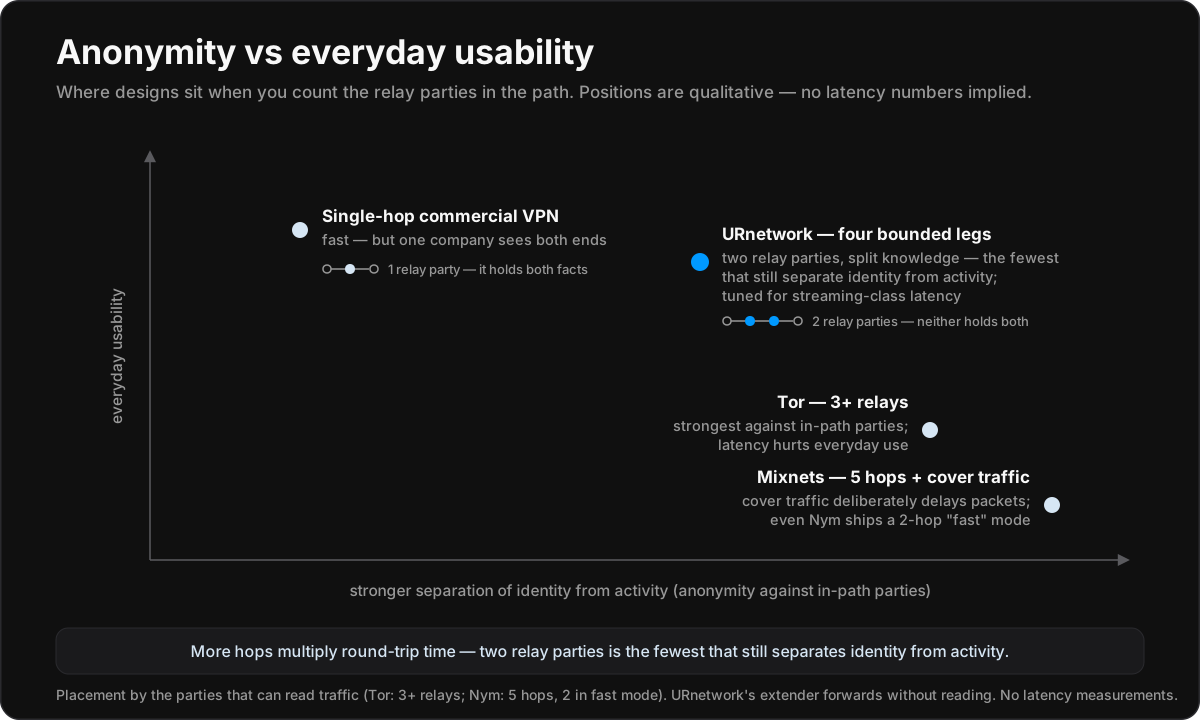
URnetwork's answer to the same question is structural. The provider that puts your traffic on the internet never receives your source IP, and with the seal switched on the operator cannot read the session it relays, so no single party holds your identity and your destinations together. An account can be nobody: one tap, no email, no identity provider, with a recovery seed phrase that is URnetwork's own credential and never a crypto wallet's. What the operator stores is recorded in the threat model.
Where Tailscale wins
- Everything mesh: reaching your own devices and services from anywhere, with direct encrypted links, no port forwarding, no static IPs.
- End-to-end encryption between your endpoints with nothing to configure, plus MagicDNS, access policy, Tailscale SSH, and device approval.
- Operational maturity: SOC 2 Type II, 40+ public bulletins, years of polished clients. URnetwork has no equivalent evidence or feature set.
- A free personal tier that stays useful rather than a trial.
- Disclosure habits: the closed coordination server is named as closed on its own open-source page, and the DERP relay code is open.
Where URnetwork wins
- Public-internet egress is the product, not an add-on: residential exits in 90+ countries, searchable to a city.
- The split. The exit never learns who you are, and the operator cannot read the sealed session. No single party holds identity and destinations together.
- Exits that blend in where datacenter ranges, Mullvad's included, are blocked or challenged.
- Accounts that need not be you: one tap, no email, wallet or seed-phrase sign-in, USDC. A tailnet is identity-bound by design.
- Whole-stack source, coordination server included. Tailscale's control plane is closed; Headscale, the community alternative, is unaffiliated, single-tailnet, and scoped by its maintainers to hobbyists.
- The supply side: members can share their connection in the UR protocol, and can limit providing to their own devices. A tailnet has no equivalent role.
Limits and evidence
URnetwork's main limits:
- No independent audit covers the protocol, the connect engine, or the operator's server code. Two 2025 third-party assessments cover other surfaces: a penetration test of the web application and API (April–May 2025), and the Leviathan MASA AL2 assessment of the Android app, which passed. Leviathan writes that its assessment "should not be read as a holistic security evaluation or comprehensive penetration test." Neither examined logging, retention, or the data path.
- The split assumes the operator and the providers in your window are independent. Nothing in the system attests that independence, the operator could itself run providers, and no outside party has measured the fleet. See the threat model, §6.1.
- The WireGuard-compatible fallback endpoint assigns one stable tunnel address, so several providers could recognize the same client across sessions. The native tunnel is the recommended path.
- Exits are consumer devices: speed moves with the provider window, and a long-lived transfer can re-pin mid-session when a provider goes offline.
Tailscale's limit is scope, and it is deliberate: it does not try to hide you from the internet. Its operator holds an identity-bound account, device inventory, public IPs and a connection graph; its control plane distributes the keys and is closed source, with tailnet lock closing the key gap only where it is available and enabled. The Mullvad add-on hands egress to a well-tested company while Tailscale keeps the record of who you are and which exit you used.
Keep Tailscale for the mesh. Add URnetwork when the question is the public internet. Trying it costs nothing: the Instant Account takes one tap and no email. More questions are answered in the FAQ.