
URnetwork vs Mullvad
Mullvad is the most proven datacenter VPN; URnetwork splits the path so the exit never learns who you are and the operator cannot read the sealed session.
Choose Mullvad if you value a long audit record, stable datacenter servers, and cash payments. Choose URnetwork if you want residential exits, city selection, and a split path. Both support anonymous accounts and post-quantum encryption. Mullvad is more proven. URnetwork splits visibility between its operator and a member-run provider.
Mullvad is run by Amagicom AB in Gothenburg, Sweden. Privacy researchers measure other VPNs against it. It has held a flat €5 per month for its whole life, with no discounts and no free tier.
URnetwork uses member-run exits. The provider does not receive your source IP on the relayed path. Native apps can also seal traffic to the provider, with a switch that ships off. How URnetwork works explains the full design. The threat model holds the complete record of what is stored and enforced.
Six differences that affect the choice
| Mullvad | URnetwork | |
|---|---|---|
| Trust model | One company, engineered to hold minimal data | Two relay parties; the exit never sees your IP, and the operator cannot read the sealed session |
| Exit address | Datacenter ranges, publicly listed, widely blocked by streaming and retail sites | Residential addresses; ordinary traffic to the sites you visit |
| Coverage and targeting | ~580 servers, 50 countries, 91 cities (live public list, mid-2026); pick a server | Member devices in 90+ countries; browse countries, search for a city |
| External verification | Published audit reports since 2018; a 2023 raid found nothing | Open client and server code; no independent audit of the protocol or server code yet |
| Consistency | Diskless datacenter fleet; predictable | Member uplinks; speed moves with the provider |
| Payment without a trail | Cash by post, Monero, vouchers | One-tap account with no email; on-chain USDC |
Caveats below the table:
- Post-quantum encryption ships on both sides, with different defaults. Mullvad's quantum-resistant tunnels are default on desktop and a setting on mobile. URnetwork's X25519MLKEM768 client-to-provider session is a switch in the native apps that ships off; switched on, it skips any provider it cannot seal to rather than downgrading. The browser extension has no sealed session; there, the operator's data path logs nothing, pinned by a test in the open code.
- DAITA, Mullvad's cover-traffic defense against traffic analysis, has no URnetwork equivalent. It is native on about a fifth of Mullvad's servers and reached by automatic multihop from the rest.
- Both cover Android, iOS, macOS, Windows, and Linux, each with an explicit kill switch. URnetwork adds a browser extension paired with its web app.
- Mullvad is €5/month, flat. URnetwork Pro is $5/month or $40/year, with a free daily data allowance. Current numbers are at ur.io/products.
Privacy track record
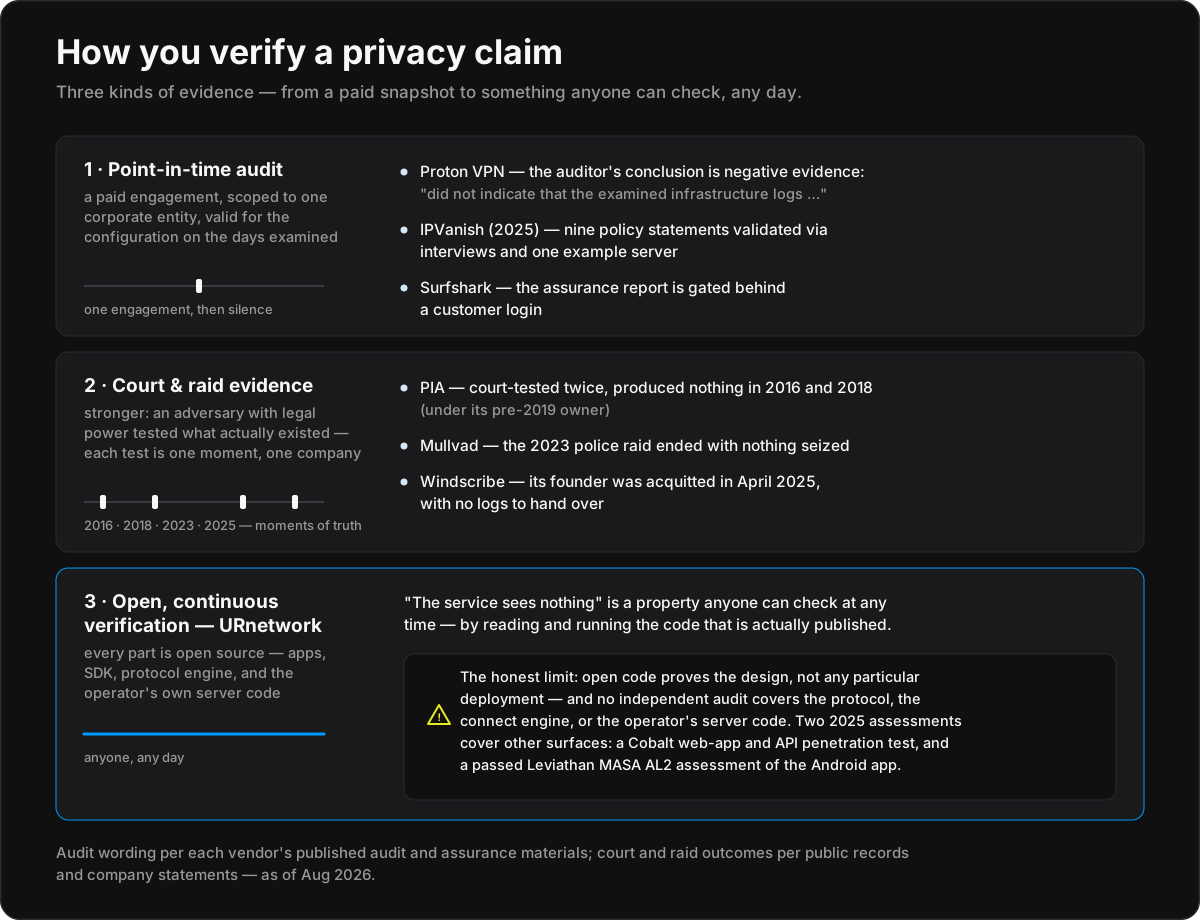
In April 2023, officers of the Swedish police's National Operations Department arrived at Mullvad's Gothenburg office with a search warrant for customer data. They left with nothing, because the data sought did not exist. It was the first warrant in the company's 14-plus years. It remains the industry's best adversarial, unscheduled test of a no-logs claim.
The audit record is the deepest published in the industry: reports since 2018 from Assured, Cure53, Atredis, X41, NCC Group, and Leviathan. 2026 alone brought three external assessments. X41 audited the payment and account backend in January. Assured audited Mullvad's in-house WireGuard implementation in March. Leviathan ran its standardized MASA assessment of the Android app in June. All Mullvad apps are open source, and the Android app has had reproducible builds since 2025. Desktop builds are not reproducible yet, and the server side is not published.
URnetwork's Android app holds an assessment from the same lab under the same programme: Leviathan, MASA assurance level AL2, completed May 2025, passed. It is the same standardized checklist. It carries the same weight for both products and settles nothing about either operator's servers. URnetwork is the more open codebase; Mullvad is the more verified one.
Two more dated events belong on the record.
- May 2026: a third-party post showed that exit-IP assignment let sites link one device across Mullvad server switches, without identifying it. Mullvad published within five days and announced a new assignment scheme to remove the correlation.
- July 2026: Mullvad published a statement on a co-owner's personal donation of about SEK 5 million to a Swedish political party. It called the donation private and said the company "does not condone it, nor condemn it". No user data or technical guarantee was involved. It belongs on this list because in a single-company model, ownership is part of what you trust.
Audits, industry-wide, are paid, scoped, and point-in-time. The raid is stronger evidence because it was adversarial and unscheduled, and Mullvad passed it.
Datacenter consistency, residential variance
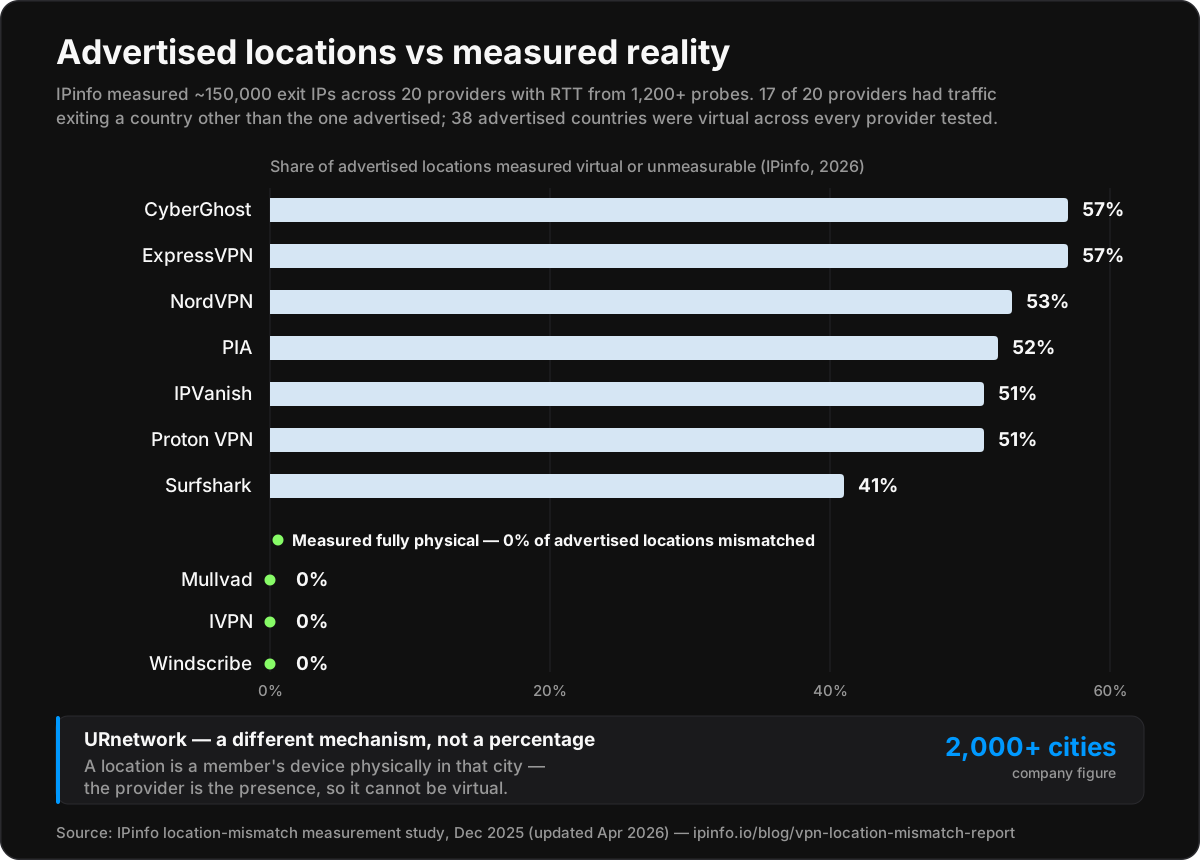
Mullvad's fleet is the disclosure benchmark of the industry. A live public page and API list every server's city, hosting company, online status, and an owned-or-rented flag. About a fifth of servers are owned outright; the rest are rented from hosts Mullvad names. Every server has run diskless since 2023 on Mullvad's System Transparency stack. The fleet is WireGuard-only; OpenVPN was removed in January 2026 after fourteen months of notice. There are no virtual locations, and IPinfo's December 2025 study (updated April 2026) confirmed that from outside. Mozilla VPN runs on Mullvad's network, and Tailscale sells Mullvad exit nodes.
The same fleet is Mullvad's most common everyday failure. Its ranges are publicly known, so many streaming and retail sites block them wholesale. URnetwork's exits are residential addresses, and their traffic is ordinary to the sites that receive it.
Coverage is checked differently on each side. Mullvad's list can be verified server by server, and has been measured from outside. URnetwork's answer is structural: a location exists only while a member's device is online in it, so presence cannot be fabricated the way a registered IP range can. Live counts are published without a login at api.bringyour.com/stats/last-90. Nobody has run IPinfo's study on URnetwork.
Consistency runs Mullvad's way. Its servers behave the same every day. URnetwork's speed moves with each member's uplink; URnetwork puts its average streaming speed at 40 Mbps+.
Payments and identity
Mullvad issues numbered accounts with no email and no name. It takes cash by post, Monero, bitcoin, vouchers, and cards. Its own policy documents what card and PayPal payments leave behind: PayPal name, email, and country; card type, country, and last four digits; a transaction-to-account link deleted after about 20 days; bookkeeping kept seven years under Swedish law. That trail exists at any VPN that takes cards, URnetwork included. Cash and Monero leave no such trail.
URnetwork's Instant Account is created in one tap with no email. A recovery seed phrase, issued once and stored only as hashes, restores the account after a reinstall. The phrase is a URnetwork credential. URnetwork never asks for a crypto wallet's seed phrase or private key. Sign-in by Solana or Bittensor wallet signature is an alternative, and Pro can be paid in on-chain USDC. USDC is pseudonymous; its anonymity depends on your wallet's history.
One difference runs each way. Only Mullvad takes cash in an envelope, which appears on no ledger. Only URnetwork opens an account with nothing typed at all, and adds wallet-native identity.
Where Mullvad wins
- Payment with no trail at all. Posted cash and Monero appear on no ledger. URnetwork's USDC lives on a public chain.
- Proof under pressure. The 2023 raid found nothing. URnetwork's storage design is open code, but no court or raid has tested it.
- External verification. Published audit reports since 2018, three assessments in 2026 alone, and reproducible Android builds. URnetwork has no audit of its protocol or server code.
- Fleet disclosure. A live server list names each server's city, hosting company, and ownership, with no virtual locations.
- Traffic-analysis defense. DAITA has no URnetwork equivalent.
Where URnetwork wins
- The split. The exit never learns who you are, and the operator cannot read the sealed session. No single party holds identity and destinations together.
- The exit address. Residential IPs work where Mullvad's known ranges are blocked outright.
- Reach and aim. Exits in more than 90 countries versus 50, searchable down to a city.
- One-tap anonymity. An Instant Account with no email, restored on a new device by its recovery phrase.
- Price. $40/year against €60/year, plus a free tier with a daily data allowance.
- Whole-stack source. The server code is public, not only the apps.
- The supply side. Members can share their connection as participants in the UR protocol. Mullvad has no equivalent role.
Limits and evidence
URnetwork's main limits:
- No independent audit covers the protocol, the connect engine, or the operator's server code. Two 2025 third-party assessments cover other surfaces: a penetration test of the web application and API (April–May 2025), and the Leviathan MASA AL2 assessment of the Android app, which passed. Leviathan writes that its assessment "should not be read as a holistic security evaluation or comprehensive penetration test." Neither examined logging, retention, or the data path.
- The split assumes the operator and the providers in your window are independent. Nothing in the system attests that independence, and no outside party has measured the fleet. See the threat model, §6.1.
- The WireGuard-compatible fallback endpoint assigns one stable tunnel address, so several providers could recognize the same client across sessions. The native tunnel is the recommended path.
- Coverage counts are self-published. Mullvad's zero-virtual-location result was measured from outside; URnetwork's has not been.
Mullvad's limit is structural. Its server terminates your tunnel, so one position can see your real IP and your destinations together. Its own multihop chains two Mullvad servers, which is cover against a network observer, not against Mullvad. Everything else in the design works to keep that position empty, and the raid is the evidence that it has.
Trying URnetwork costs nothing: the Instant Account takes one tap and no email, so you can test it against your own sites before paying for either product. More questions are answered in the FAQ.