
URnetwork vs Sentinel
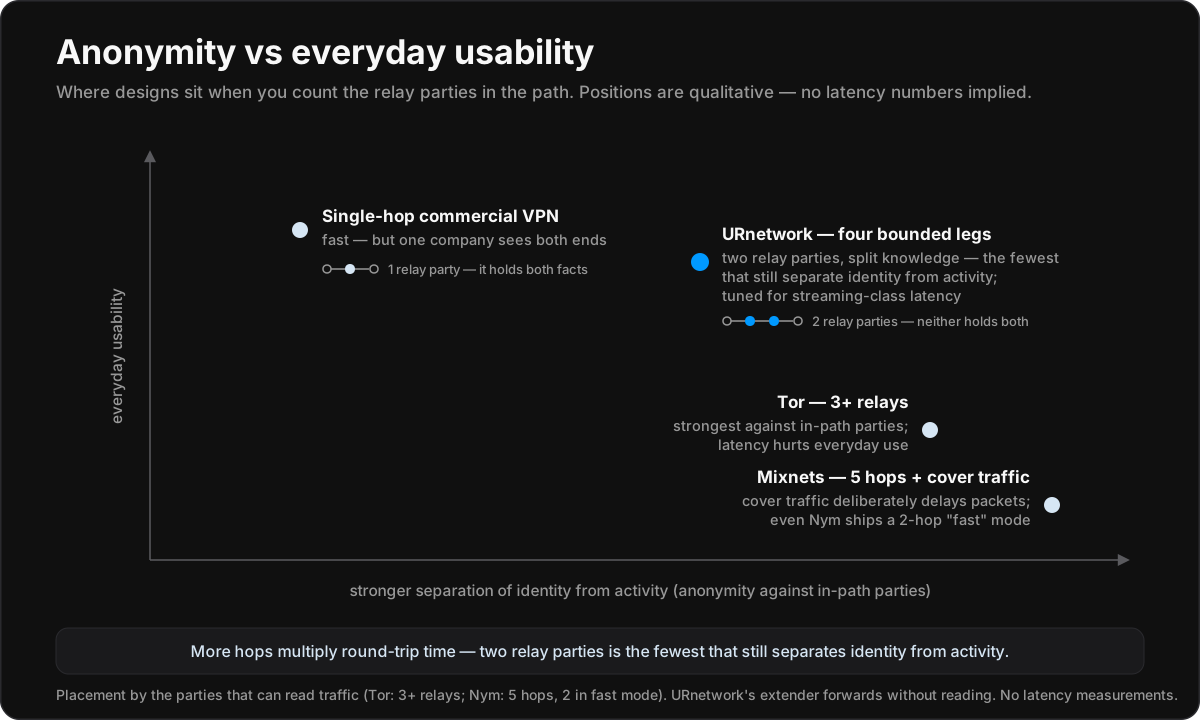
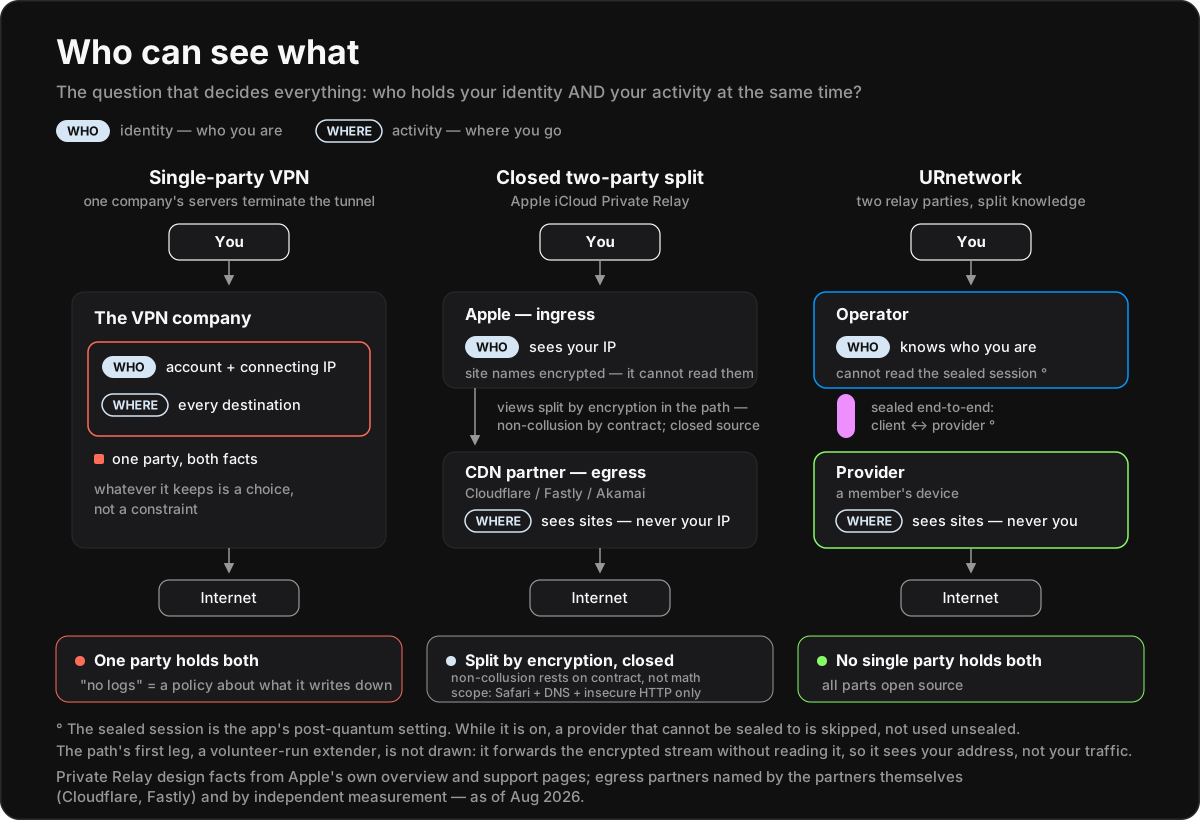
Sentinel decentralizes the coordinator, a public blockchain that matches you to an independent node; URnetwork keeps one accountable operator and splits every session so the exit never learns who you are and the operator cannot read the sealed session.
Choose Sentinel if you want no company in the coordination loop, protocol variety with V2Ray where censorship is the adversary, and the most active development of the major dVPNs. Choose URnetwork if you want every session split between two relay parties, one open stack under one policy instead of per-app trust, and residential exits you can search by city. Both hold that exits should be independent, consenting, and paid; they differ on what to decentralize.
Sentinel is not one VPN but a protocol with an app ecosystem on top: a public Cosmos-SDK blockchain where independent node operators sell bandwidth, and a family of independently branded consumer apps that buy from that shared supply. The sentinel.co site and the first-party Shield app are published by one UK company, Capybara Publishing Ltd; the other apps belong to other companies. Nodes speak WireGuard, V2Ray, and OpenVPN, and operators earn the network's token, renamed from DVPN to P2P in 2025.
URnetwork uses member-run exits. The provider does not receive your source IP on the relayed path. Native apps can also seal traffic to the provider, with a switch that ships off. How URnetwork works explains the full design. The threat model holds the complete record of what is stored and enforced.
Six differences that affect the choice
| Sentinel | URnetwork | |
|---|---|---|
| Coordinator | Public Cosmos-SDK chain; no company required in the loop | One accountable operator, BringYour, Inc. |
| Traffic path | Direct tunnel to one node, which sees your IP and your destinations together | Two relay parties; the exit never sees your IP, and the operator cannot read the sealed session |
| Protocols | WireGuard, V2Ray, OpenVPN | Own transport over TLS/QUIC |
| Apps and policies | Independently owned app brands; policies and payment handling vary per vendor | One first-party app set, one policy |
| Exits | Whatever machine an operator registers; no vetting, no residential requirement | Residential member devices; browse countries, search for a city |
| Development | Chain and node repos updated within days (August 2026); the fastest-moving of the major dVPNs | One open codebase, apps through server, actively shipped |
Caveats below the table:
- Post-quantum encryption is URnetwork-side here: the X25519MLKEM768 client-to-provider session is a switch in the native apps that ships off, and switched on it skips any provider it cannot seal to rather than downgrading. Sentinel advertises no post-quantum feature. The browser extension has no sealed session; there, the operator's data path logs nothing, pinned by a test in the open code.
- Everyday controls are uniform on URnetwork: native apps on Android, iOS, macOS, Windows, and Linux plus a browser extension paired with the web app, each with an explicit kill switch. On Sentinel, those controls vary with the app you install.
- Sentinel pricing depends on the app, and the consumer apps take ordinary payment as well as crypto. URnetwork has a free daily allowance and Pro at $5/month or $40/year. Current numbers are at ur.io/products.
The chain and the node economics
The chain is the marketplace. Node operators register on it, third-party apps match their users to nodes, and payment settles on-chain; many storefronts share one node supply, and the project is broadening toward a general peer-to-peer bandwidth marketplace. Operators earn the network's token. Registration is permissionless: the node-setup docs impose no vetting, no KYC, no logging policy, and no check on where a node physically sits. Sentinel's own node documentation also describes network revenue as substantially subsidized by in-app advertising.
Once matched, your device opens a WireGuard, V2Ray, or OpenVPN tunnel straight to the node. One hop keeps the path short, and it makes that node the classic VPN endpoint: it sees your real IP on one side and your destinations on the other for the length of the session, and the party in that seat is a pseudonymous stranger paid per gigabyte. Sites' own HTTPS still hides page contents; what is exposed is the metadata.
The counts around the network need their dates. Marketing on sentinel.co counts operators and cities in the thousands with no methodology and no as-of date attached. Sentinel's own statistics page showed roughly 1,500 nodes online in August 2026, and community monitoring the same week placed about a third of the fleet in the United States. On a permissionless network a node's location is wherever its IP appears to be, and the docs describe no way to check where a node physically sits.
URnetwork's coverage answer is structural: a location is a member's device physically in it and online now, and the platform geolocates the connection it observes rather than letting a provider declare a city. That is 2,000+ real cities by URnetwork's own count, with live counts in the app. An exit that looks like a datacenter or a VPN is detected and demoted, not excluded, and no outside party has measured URnetwork either. Every byte a provider carries moves under a signed, metered contract, and an open-source filter at the member's own exit drops file-sharing and attack traffic before it leaves their line, recording no destination or contents. On Sentinel, what a node carries and what protects its operator is up to each node and each app.
Which app are you trusting?
sentinel.co lists separately owned consumer apps under one heading, "Products," under one company's copyright, without saying they are other companies. The relationship is not always at arm's length either: one listed app is shipped by the company of the person sentinel.co presents as Sentinel's CEO. The policies vary radically with the brand. At least one app in the product list ships advertising networks, Google Analytics, and Firebase behind a "no-logs" headline, while the first-party Shield policy makes different promises. Whichever app you install is the party that sees your account and payment details, and the public chain records payment flows pseudonymously, forever.
The homepage sells "provable encryption" and never says provable how, or by whom. No attestation, no reproducible-build check, and no audit is published anywhere in the project. The flagship Shield app's store listing states both halves of the problem: it "can prove that your browsing history and information is not being stored," and, a few lines later, that it "doesn't control and own the exit-servers." Whoever does not control the exit server cannot prove what that server keeps. The open chain and node code is readable, and that is real; readable code is not evidence that the node you were matched to is running it. Shield's own releases date to November 2025, its Android build is a direct download from Sentinel's site, and its Google Play listing no longer resolves.
URnetwork's answer to the same question is one public codebase from the app in your hand to the operator server and the provider engine, so both endpoints of the sealed session live in code anyone can read. What that does not cover, an audit of the protocol or the operator's server code, is stated under Limits below.
Where Sentinel wins
- Coordination without a company: the chain-based marketplace removes the operator as a required trusted party, the strongest decentralization story in this comparison set.
- Genuine multi-protocol support: V2Ray where censorship is the adversary, plus WireGuard and OpenVPN.
- The most active development cadence of the major dVPNs as of August 2026, on an open Cosmos appchain anyone can inspect or build on.
- Fiat payment options in the consumer apps; no crypto required to start.
- A shorter path in principle: one direct hop, with no relay leg in the middle.
Where URnetwork wins
- Split knowledge on every session: the exit never sees your IP, and the operator cannot read the sealed session. No single party holds identity and destinations together, versus a direct tunnel that hands one node both.
- One integrated, open stack under one privacy policy, versus per-app trust that varies by vendor.
- Storage limits enforced in code, recorded in the threat model, rather than per-app promises.
- Real presence: residential exits in 2,000+ real cities by URnetwork's own count, searchable by city, with live counts in the app.
- Protection for the member at the exit: file-sharing and attack traffic dropped before it leaves their line, with no destination or contents recorded.
- One price for one product, and no token to acquire. Providers participate in the UR protocol by running the app.
Limits and evidence
URnetwork's main limits:
- No independent audit covers the protocol, the connect engine, or the operator's server code. Two 2025 third-party assessments cover other surfaces: a penetration test of the web application and API (April–May 2025), and the Leviathan MASA AL2 assessment of the Android app, which passed. Leviathan writes that its assessment "should not be read as a holistic security evaluation or comprehensive penetration test." Neither examined logging, retention, or the data path.
- The split assumes the operator and the providers in your window are independent. Nothing in the system attests that independence, the operator could itself run providers, and no outside party has measured the fleet. See the threat model, §6.1.
- Coverage counts are self-published on both sides. No outside party has measured Sentinel's node map or URnetwork's presence claims.
- URnetwork is the younger product set, and speed moves with the providers in your window; on Sentinel it moves with the node you were matched to.
Sentinel's limit is the seat at the end of the tunnel. Each session hands one node your IP and your destinations together, the node took no vetting to register, and the promises around that fact belong to whichever app you installed, with no named audit behind any of them. Decentralizing the coordinator is real, and it does not split the traffic.
Trying URnetwork costs nothing: the Instant Account takes one tap and no email, so you can test the split path against your own sites before paying for either product. More questions are answered in the FAQ.