
URnetwork vs Apple iCloud Private Relay
Private Relay is the closest big-tech relative of URnetwork's split design; URnetwork applies the same idea to the whole device, in open code, with residential exits you choose.
Choose Private Relay if you live in Safari on Apple hardware, want protection that ships with an iCloud+ plan you may already pay for, and prefer infrastructure run at Apple and CDN scale. Choose URnetwork if you want every app on every platform covered, a residential exit in a city you choose, and a split you can check in open code. Both split the path between two parties instead of trusting one. Private Relay is the more effortless. URnetwork covers more and publishes its code.
iCloud Private Relay comes with every paid iCloud+ plan, from $0.99 a month; the free 5 GB iCloud tier does not include it. Apple's support page says it is "designed to protect your privacy by ensuring that when you browse the web in Safari, no single party — not even Apple — can see both who you are and what sites you're visiting." Two hops carry that design: Apple runs the first, which sees your IP address, and a contracted content-delivery network runs the second, which assigns your exit address and connects you to the site. Apple does not name its egress partners; Akamai, Cloudflare, and Fastly are identified by the partners' own posts and by outside measurement.
URnetwork uses member-run exits. The provider does not receive your source IP on the relayed path. Native apps can also seal traffic to the provider, with a switch that ships off. How URnetwork works explains the full design. The threat model holds the complete record of what is stored and enforced.
Six differences that affect the choice
| iCloud Private Relay | URnetwork | |
|---|---|---|
| Scope | Safari browsing, DNS queries, and insecure app HTTP, on Apple devices | All device traffic; apps on Android, iOS, macOS, Windows, and Linux, plus a browser extension and web app |
| Setup and price | Included with paid iCloud+ from $0.99/month; on automatically within its scope | A separate app; free daily allowance; Pro $5/month or $40/year |
| Infrastructure | Apple ingress and CDN egress; rarely noticeable in use | Member uplinks; speed moves with the providers carrying you |
| Exit and location | Shared CDN addresses matched to your real region; no location choice, by design | Residential addresses; browse countries, search for a city |
| Trust model | Two hops; the split of views is enforced by encryption; keeping the operators' views uncombined rests on contract and policy | Two relay parties; the exit never sees your IP, and the operator cannot read the sealed session |
| Verification | Closed implementation, described in a published architecture paper; no independent audit of the running service | Open client and server code; no independent audit of the protocol or server code yet |
Caveats below the table:
- Accounts differ sharply. Private Relay requires a signed-in Apple Account with a paid iCloud+ plan; inside the path, blind-signature tokens let the relays confirm a subscription "without actually identifying the user." URnetwork's Instant Account is one tap with no email, backed by a recovery seed phrase (URnetwork's own credential; it never asks for a crypto wallet's seed phrase or key), and Pro can be paid in on-chain USDC. Current URnetwork prices are at ur.io/products.
- Post-quantum encryption runs URnetwork's way: the X25519MLKEM768 client-to-provider session is a switch in the native apps that ships off, and switched on it skips any provider it cannot seal to rather than downgrading. The browser extension has no sealed session; there, the operator's data path logs nothing, pinned by a test in the open code. Private Relay's key exchanges (TLS 1.3, HPKE) are classical, and Apple makes no post-quantum claim for it.
- The two do not stack. Apple's own note is that traffic on a VPN "will not use Private Relay"; while URnetwork is connected, it carries Safari's traffic itself. The practical pattern is Private Relay always on, and URnetwork connected when you need what it adds.
Two hops, and what enforces the split
Private Relay's separation is built with encryption, not just promised. Apple's architecture overview describes the mechanics: the website names you request are encrypted at the first hop and "cannot be seen by either party", the second hop "has no knowledge of the user's original IP address", your device validates each proxy's TLS 1.3 public key against expected values, DNS travels as Oblivious DNS over HTTPS, and RSA blind-signature tokens authenticate subscribers without identifying them. Within the path, no single hop is positioned to hold both your address and your destinations. That is a real structural step past the one-company VPN, and URnetwork's sealed session is conceptually close to it: the same layered-encryption move, applied to everything the device sends.
What the construction cannot do is bind the two operators to each other. The egress terminates your connections, so it observes which sites Private Relay users visit, as any exit does, including a URnetwork provider. Keeping the ingress and egress views uncombined is an organizational property: contracts, and, in Apple's own words, "a minimal logging policy" (its paper also lists what the proxies do log). Apple selects and pays both parties, writes the client, and can replace a partner at any time. The implementations are closed, so nothing lets an outsider confirm the deployment matches the paper. And a 2022 university measurement, written up on APNIC's blog, found ingress addresses in Akamai's network as well as Apple's; Akamai also operates egress relays, and the researchers concluded a single entity could observe both sides at the network level.
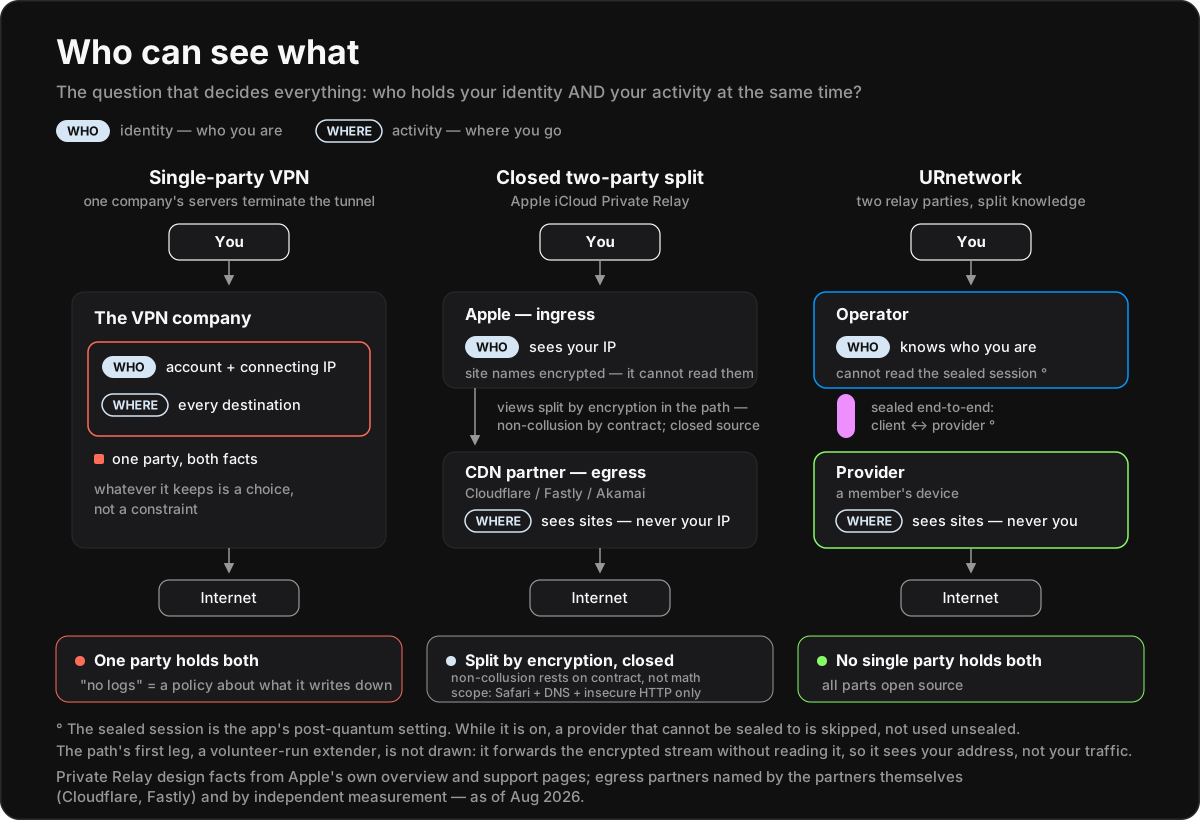
URnetwork's differences are who the parties are and what you can check. Its exits are plural: traffic leaves through several member households at once, each carrying a slice, rather than through three CDN corporations that each aggregate the browsing of every user they terminate. Its code is open on both sides, client and server. And the exit is yours to place, in a country or a searched city, from a residential address.
Scope, location, and availability
Apple's developer page states the scope exactly: "Private Relay protects users' web browsing in Safari, DNS resolution queries, and insecure http app traffic." Chrome, Firefox, and ordinary app traffic bypass it, and Apple's own paper is direct that it is not a VPN. The marketing line "Just turn it on and you're instantly protected" carries none of that scope; the support and developer pages do.
No location choice is a design refusal, not a gap: Private Relay "does not provide any methods to spoof location", and exit addresses are chosen to represent your coarse city-level location by default. Apple publishes the entire egress list and feeds it to geolocation databases, so websites can recognize Private Relay users as a class, and third-party databases still misplace relay addresses often enough that Apple maintains correction guidance. Availability has edges too: the feature is not offered in China mainland, Russia, and a number of other countries as of mid-2026, and any network can turn it off with Apple's cooperation, since Apple documents how. In January 2022, T-Mobile US restricted it on plans with content filtering, and some European carriers blocked it on some plans after petitioning the European Commission against the feature.
URnetwork's scope is the whole device on Android, iOS, macOS, Windows, and Linux, plus a browser extension paired with its web app. You choose the exit country or search for a city, and the address you surface from is a member's residential one. A location exists only while a member's device is online in it, and the platform geolocates the connection it observes rather than trusting a declared city.
Where Private Relay wins
- A structural improvement over the one-company VPN for the traffic it covers, enforced by encryption in the path and on automatically within its scope.
- Zero setup and effectively zero cost for anyone already paying for iCloud+.
- Apple-scale reliability; battery- and performance-friendly.
- The far end is a professionally run CDN under contract rather than an unknown household, if that is your preference.
Where URnetwork wins
- Coverage: every app and browser on the device, on Android, iOS, macOS, Windows, and Linux, plus the browser extension and web app.
- Open source on both sides, so the claims can be checked rather than taken on the companies' description.
- Plural residential exits, each seeing a slice; no CDN aggregation point, and no party selected and paid by the other.
- Location choice down to a searched city; Private Relay offers none, by design.
- No Apple Account anywhere: a one-tap email-free account, wallet-signature sign-in, on-chain USDC payment.
- Offered, and built for reachability, in places where Private Relay is not available.
Limits and evidence
URnetwork's main limits:
- No independent audit covers the protocol, the connect engine, or the operator's server code. Two 2025 third-party assessments cover other surfaces: a penetration test of the web application and API (April–May 2025), and the Leviathan MASA AL2 assessment of the Android app, which passed. Leviathan writes that its assessment "should not be read as a holistic security evaluation or comprehensive penetration test." Neither examined logging, retention, or the data path.
- The split assumes the operator and the providers in your window are independent. Nothing in the system attests that independence, and no outside party has measured the fleet. See the threat model, §6.1.
- The WireGuard-compatible fallback endpoint assigns one stable tunnel address, so several providers could recognize the same client across sessions. The native tunnel is the recommended path.
- Coverage counts are self-published, with no outside measurement. Apple's egress list, by contrast, is public and checkable address by address.
Private Relay's limits are scope and verification rather than structure. The design separates the two views by construction, but the implementation is closed, so whether the deployment matches the paper cannot be checked from outside. The two operators are selected and paid by one of them, and keeping their views uncombined is a property of contract and policy, with one measured overlap already on record. The product covers Safari, DNS, and insecure app HTTP on Apple hardware, offers no location choice, and exits only through CDN addresses. Most of this is stated in Apple's own documents.
Trying URnetwork costs nothing: the Instant Account takes one tap and no email, so you can run it beside Private Relay and see what each covers on your own sites. More questions are answered in the FAQ.