
URnetwork vs Mysterium
Mysterium is the most established paid-residential dVPN; URnetwork filters what leaves a member's line and splits the path so the exit never learns who you are and the operator cannot read the sealed session.
Choose Mysterium if you want the longest-running network of this kind, a plug-and-earn hardware ecosystem, and per-gigabyte billing. Choose URnetwork if you want a split path, filtered member exits, and an email-free account with a free tier. Both pay consenting residential exits, the opposite of Hola-style silent peer harvesting. Mysterium has the more established supply side. URnetwork splits visibility between its operator and a member-run provider.
Mysterium has run since 2017, developed by BlockDev AG of Zug, Switzerland, with its development team in Lithuania. Node runners share their connections and earn MYST tokens; consumers buy a tiered subscription in ordinary money. The node software is GPL-3.0 and under active development.
URnetwork uses member-run exits. The provider does not receive your source IP on the relayed path. Native apps can also seal traffic to the provider, with a switch that ships off. How URnetwork works explains the full design. The threat model holds the complete record of what is stored and enforced.
Six differences that affect the choice
| Mysterium | URnetwork | |
|---|---|---|
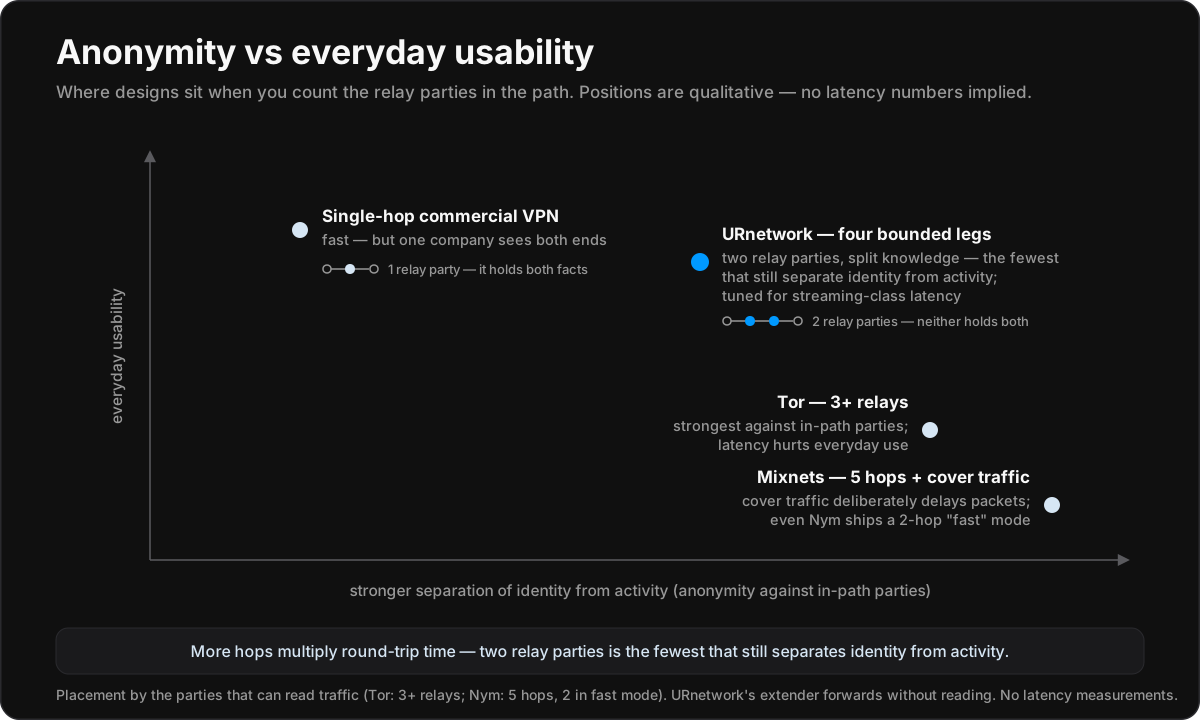
| Trust model | Direct tunnel to your chosen node; that node can see your IP and your destinations together | Two relay parties; the exit never sees your IP, and the operator cannot read the sealed session |
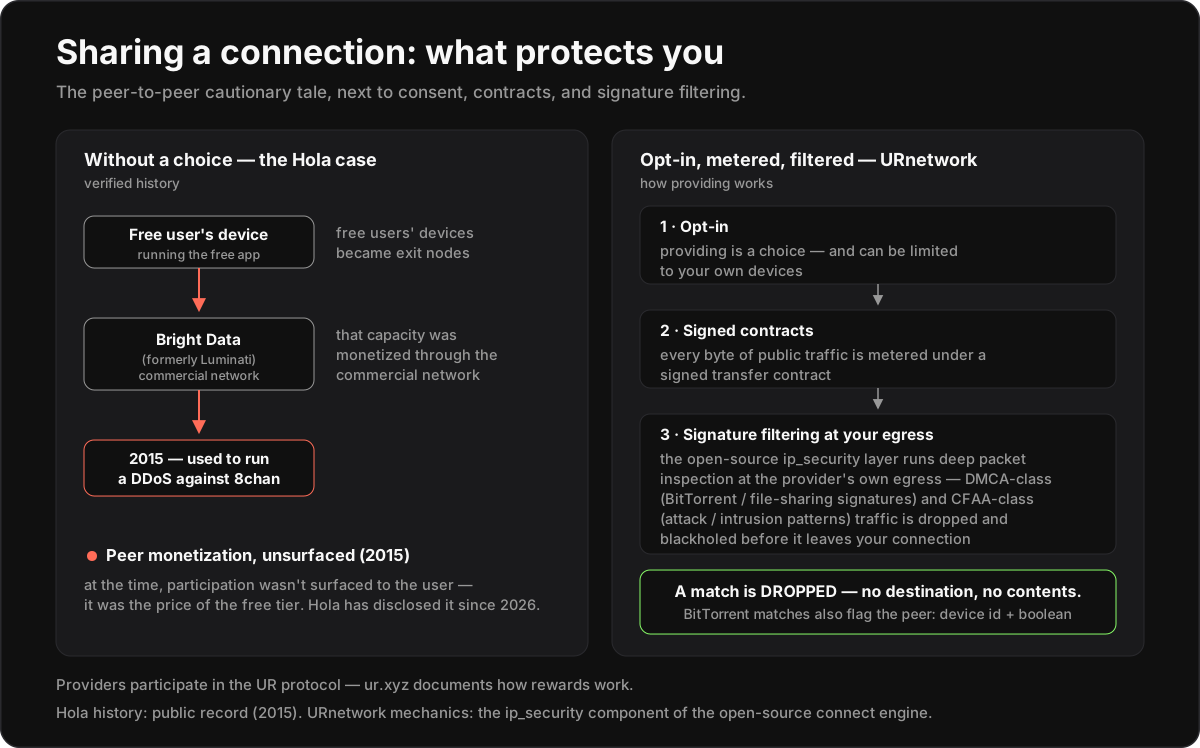
| Participation safety | An identity allow-list decides who may connect; no content filtering in the node; use at the runner's sole risk, per its terms | An open-source filter at each exit drops file-sharing and attack traffic before it leaves; every byte moves under a signed contract |
| Maturity and coverage | Running since 2017; ~10,400 live nodes in 119 countries by its own API in August 2026 (22,000+ / 135+ claimed) | Young network; a location is listed only while a member's device is online in it |
| Supply side | Dedicated nodes and plug-and-earn boxes (Raspberry Pi, Avado, Nebra, DAppNode), paid in MYST | A switch inside the regular app; providers participate in the UR protocol |
| Metered payment | Per-gigabyte MYST billing in the legacy desktop app | One-off data packs priced in USDC |
| Account and price | Email-linked subscription; $10.49–18.49 month to month; no free tier | One-tap account with no email; free daily allowance; Pro $5/month or $40/year |
Caveats below the table:
- Both sides are open source: Mysterium's GPL-3.0 node and URnetwork's apps and server code. Neither has an independent audit of its protocol or server code; the details are under Limits.
- The residential premise is partial on Mysterium's side. Its own discovery data classifies about 60% of live nodes as residential and roughly a third as hosting or CDN space, with Oracle Cloud the largest single network in the fleet, and sixty of its 119 live countries held ten nodes or fewer.
- Post-quantum encryption runs URnetwork's way. The X25519MLKEM768 client-to-provider session is a switch in the native apps that ships off, and switched on it skips any provider it cannot seal to rather than downgrading; the browser extension has no sealed session, and there the operator's data path logs nothing, pinned by a test in the open code. Mysterium makes no post-quantum claim.
- Platforms split on Mysterium's side: the current app covers Windows, macOS, iOS, Android and a Chrome extension, while Linux lives only in the legacy app, which has no iOS build. URnetwork ships on Android, iOS, macOS, Windows, Linux, the browser extension and the web, each with an explicit kill switch.
- Speeds on both fleets move with the devices carrying you. URnetwork puts its average streaming speed at 40 Mbps+.
One fleet, two kinds of customer
On Mysterium, your machine is the exit when you run a node: whatever a paying stranger requests leaves your line under your IP, and abuse and copyright complaints go to the address that was observed. Mysterium's default protection is an allow-list. Its trust service publishes one policy, titled "Whitelisted traffic" and described as "Traffic vetted via business contracts"; a node in the default mode refuses any consumer identity not on the list, which held about 194,000 identities when last queried. Accepting public traffic, the open consumer VPN, is a separate choice. The help centre states that it carries "a higher risk of abuse since it is open to anyone," with higher earnings to match, and names seven countries where it recommends against open exits: Canada, the US, the UK, Italy, Australia, Germany and India. That disclosure is clearer than most bandwidth-buying schemes manage.
The limits are on the record too. The allow-list decides who may connect, never what they may do: the node's open-source code contains no file-sharing, copyright or attack-traffic filtering of any kind, the optional hostname allow-list is off by default, and a permitted customer's request leaves a runner's line unexamined. The terms say so. Mysterium "cannot guarantee that no illegal or criminal traffic passes in or through the Network and that you will never face any legal liability," use is "at your sole risk," and the runner indemnifies the company. Vocabulary is the other gap. The default customers are commercial data-collection ones, and Mysterium's developer docs ship a web-scraping workshop describing nodes as HTTP proxies on residential networks, yet "proxy" and "scraping" appear nowhere in the node-runner signup flow, which asks how you would like to "sell your Internet data" to "verified businesses," and nowhere in the terms a runner accepts. The facts are published, just not where you agree to them.
URnetwork engineers for the person sharing. Providing is a switch inside the regular app, off until a member turns it on, with a choice of audience: the public network, or only your own account's devices. Every byte is metered under a signed contract. Before traffic leaves a member's connection, an open-source filter on the member's own device drops the two classes that get sharers in trouble, file-sharing signatures and attack patterns. A match drops the packet and records no destination, domain or payload anywhere; a plaintext file-sharing signature also flags the sending device to the operator with exactly two fields, a device id and a boolean, and the operator stores nothing on receipt. The demand a member's line carries is the same metered traffic the apps and SDK generate; no separate data-collection product is resold on members' lines.
What the node sees, and what the record shows
Decentralization changes who could log, thousands of small operators instead of one company, but not what can be seen. The Mysterium node you exit through carries your tunnel and forwards your traffic: one party positioned to see both your address and your destinations, the same both-ends view a conventional VPN server has. Mysterium's own consumer help article is direct about what does the protecting: node runners cannot read your traffic because almost everything is HTTPS, the sites' encryption rather than the tunnel's, since the tunnel ends at the node.
"No logs" is policy on top, and the policy is in tension with itself. The consumer privacy policy pledges not to store "the websites you visit, your IP addresses, browsing history, or session data," then discloses processing email address, bandwidth volumes and session timestamps, server logs containing your IP address, and a processor list including Google Analytics, Firebase, Microsoft Clarity, Hotjar, Reddit and X Corp. The node-runner terms forbid runners from keeping timestamps, bandwidth figures or user IPs, while Mysterium's own safety article tells runners those IPs appear in the node logs, and nothing in the software enforces the ban.
The dated record: in July 2026 a critical flaw was published in the node itself (CVE-2026-31309, CVSS 9.8). An unauthenticated request to the node's local management endpoint could rewrite its configuration and take the node over. It was present from a May 2023 release and fixed in version 1.36.0 in November 2025, eight months before the July 2026 disclosure — the ordinary coordinated-disclosure order, not a gap left open. A public proof-of-concept exists. No published evidence says it was exploited or that user traffic was exposed, and the risk fell on node runners' own machines. Beyond that, no confirmed breach of Mysterium user data has surfaced in nearly a decade.
On URnetwork's side the split holds instead: the provider never receives your source IP, and with the seal switched on the operator relays a session it cannot read, so no single party holds both your identity and your activity. Locations are counted the strict way, existing only while a member's device is online in them, with the city derived from the connection the network observes rather than declared by the node; an address that looks like hosting, a VPN or a re-announced range is demoted in the ranking, not excluded. URnetwork states 2,000+ cities; read that as a company figure, with the mechanism as the checkable part.
The payment rail
Mysterium splits its consumer product across two apps. The current app is a tiered subscription in ordinary money, and signing up creates an account tied to your email address. The legacy desktop app bills per gigabyte from a MYST wallet, the more private of its two paths. Advertised rates of roughly $2.59 to $4.79 a month require a two-year prepayment; month to month the same tiers run about $10.49 to $18.49 as of August 2026, and there is no free tier. Node runners are paid in MYST.
URnetwork's metered equivalent is on-chain USDC: Pro can be paid in USDC from a wallet, and one-off data packs are bought the same way, priced in USDC and chain-neutral, so you pay for a gigabyte allowance without attaching an identity. Metered buying is a convenience on both sides; neither is an anonymity advantage over the other. The account itself can hold no email at all: an Instant Account is created in one tap, and its only credential is a recovery seed phrase URnetwork generates and shows once. Sign-in by wallet signature (Solana or Bittensor) is an alternative, where the wallet signs a challenge and URnetwork receives an address, a message and a signature. URnetwork never asks for a wallet's seed phrase or private key; the recovery phrase is URnetwork's own credential and nothing else. URnetwork is free at the base with a daily allowance, and Pro is $5/month or $40/year (current numbers at ur.io/products). Providers participate in the UR protocol, which ur.xyz documents in full.
Where Mysterium wins
- Maturity: the longest-running network of this kind, with the most established paid-residential fleet and very active open-source development.
- A real plug-and-earn hardware ecosystem: dedicated boxes that earn on a shelf.
- Per-gigabyte billing from a MYST wallet in the legacy desktop app, a metered alternative to a subscription.
- Disclosure to node runners that is clearer than most such schemes: the business-traffic default is stated in its help centre, along with the countries where it recommends against open exits.
Where URnetwork wins
- Participation safety is engineered, not only consented to: signature filtering of file-sharing and attack traffic at every exit, signed metered contracts, and no separate data-collection product resold on members' lines.
- The split. The provider never sees your IP, and the operator cannot read the sealed session. No single party holds identity and destinations together; a Mysterium node sees both ends of the tunnel it terminates.
- Storage minimization enforced in open server code, with no analytics or session-replay processors between you and the service.
- Locations that exist only while a member's device is online in them, with the city derived from the observed connection rather than declared.
- A free daily allowance, a one-tap email-free account, and an explicit kill switch on every platform.
Limits and evidence
URnetwork's main limits:
- No independent audit covers the protocol, the connect engine, or the operator's server code. Two 2025 third-party assessments cover other surfaces: a penetration test of the web application and API (April–May 2025), and the Leviathan MASA AL2 assessment of the Android app, which passed. Leviathan writes that its assessment "should not be read as a holistic security evaluation or comprehensive penetration test." Neither examined logging, retention, or the data path.
- The split assumes the operator and the providers in your window are independent. Nothing in the system attests that independence, and no outside party has measured the fleet. See the threat model, §6.1.
- The WireGuard-compatible fallback endpoint assigns one stable tunnel address, so several providers could recognize the same client across sessions. The native tunnel is the recommended path.
- Coverage counts are self-published on both sides. Mysterium's can at least be queried live through its public discovery API; URnetwork's have no outside measurement, and the mechanism is the checkable part.
Mysterium's limit is structural. The tunnel terminates at the node you picked, so one small operator stands where it can see your real IP and your destinations together, with HTTPS rather than the tunnel keeping content unread, as Mysterium's own help centre states. For the person running that node, the protection is an allow-list over who may connect, with no filtering of what a permitted customer sends. No named independent audit exists for Mysterium either; both codebases are open.
Trying URnetwork costs nothing: the Instant Account takes one tap and no email, so you can test both networks against your own sites before paying for either. More questions are answered in the FAQ.