
URnetwork vs IVPN
IVPN is the classic VPN with the cleanest conduct record and an annual published audit cadence; URnetwork splits the path so the exit never learns who you are and the operator cannot read the sealed session.
Choose IVPN if you value an annual audit record, cash and Monero payment, and predictable datacenter speed. Choose URnetwork if you want residential exits, city selection, and a split path. Both open accounts with no email, and both offer a post-quantum key exchange, on by default at IVPN and a switch that ships off at URnetwork. IVPN is the more verified. URnetwork splits visibility between its operator and a member-run provider.
IVPN is run by IVPN Limited of Gibraltar, under the same ownership since 2009 and renamed from Privatus Limited in 2023. It closed its own affiliate program in 2016 in protest of paid rankings, publishes an open-source tool built to talk people out of buying a VPN, and prices without discount theater. Accounts are random ID numbers with no email attached.
URnetwork uses member-run exits. The provider does not receive your source IP on the relayed path. Native apps can also seal traffic to the provider, with a switch that ships off. How URnetwork works explains the full design. The threat model holds the complete record of what is stored and enforced.
Six differences that affect the choice
| IVPN | URnetwork | |
|---|---|---|
| Trust model | One company; its servers terminate the tunnel, and "no logs" is the policy at that position | Two relay parties; the exit never sees your IP, and the operator cannot read the sealed session |
| Exit address | Datacenter ranges, publicly listed, widely blocked by streaming and retail sites | Residential addresses; ordinary traffic to the sites you visit |
| Coverage and targeting | 41 countries and 58 cities, every host named, none virtual (its own API); pick a server | Member devices in 90+ countries; browse countries, search for a city |
| External verification | Eight Cure53 audits since 2019 with published reports, a transparency report, a signed warrant canary | Open client and server code; no independent audit of the protocol or server code yet |
| Consistency | Dedicated bare-metal fleet; predictable | Member uplinks; speed moves with the provider |
| Payment without a trail | Cash by post, Monero to its own node, bitcoin via its own payment server | One-tap account with no email; on-chain USDC |
Caveats below the table:
- Post-quantum encryption ships on both sides but is on by default only at IVPN, whose quantum-resistant WireGuard connections are default in its own apps, on all platforms and all WireGuard servers; IVPN states the scope itself: apps only, WireGuard only, and not entirely quantum-proof. URnetwork's X25519MLKEM768 client-to-provider session is a switch in the native apps that ships off; switched on, it skips any provider it cannot seal to rather than downgrading. The browser extension has no sealed session; there, the operator's data path logs nothing, pinned by a test in the open code.
- Kill switches: URnetwork ships an explicit toggle on every platform, default-on in the extension. IVPN's firewall covers Windows, macOS and Linux; its own knowledge base documents none on iOS 16 and later, removed in 2023 rather than shipped broken, and Android defers to the operating system's always-on mode.
- Multi-hop is included in every IVPN plan as of May 2026 and chains two IVPN servers; both hops belong to the same company.
- IVPN sells three tiers as of mid-2026, roughly $6, $8 and $10 a month or $60 to $100 a year, with no free tier, a $2 one-week plan, and a 30-day refund. URnetwork Pro is $5/month or $40/year with a free daily allowance. Current numbers are at ur.io/products.
- File sharing: IVPN restricts no protocols and asks users to keep P2P off its US exits; port forwarding was removed in 2023. URnetwork drops BitTorrent-class traffic at each provider's exit, lawful downloads included. It is not a torrenting product.
The audit stack
Eight Cure53 engagements since 2019, roughly one a year, each announced before it ran and published after: a no-logs audit in 2019, the full infrastructure in 2020, the apps on every platform in 2021 and again in 2022, the rebuilt gateway infrastructure in 2023, the web stack and API in 2024, the Mailx and modDNS services in 2025, and the Unlinked Access cryptography in 2026. The work is white-box, with repository access, and the 2019 conclusion is quotable: "all of the IVPN's privacy statements could be verified as truthful within the defined scope."
The most useful sentence in the record is IVPN's own case against the genre. It has declined to commission another no-logs audit since 2019, and its CEO wrote down why in 2026: "Audits are a snapshot in time: any VPN service receiving a 'no-logs' stamp from independent evaluators can update its systems and start collecting sensitive data the following day." The most audited independent company in the category treats audits as evidence about conduct on a date, not proof of a property. That calibration applies to every audit cited on this page, URnetwork's assessments included.
The legal record is quieter than a raid and still real: a published transparency report counts 34 law-enforcement requests since 2016, three of them valid, and zero that produced data, alongside a monthly PGP-signed warrant canary stating that no warrant, search or seizure has ever been served.
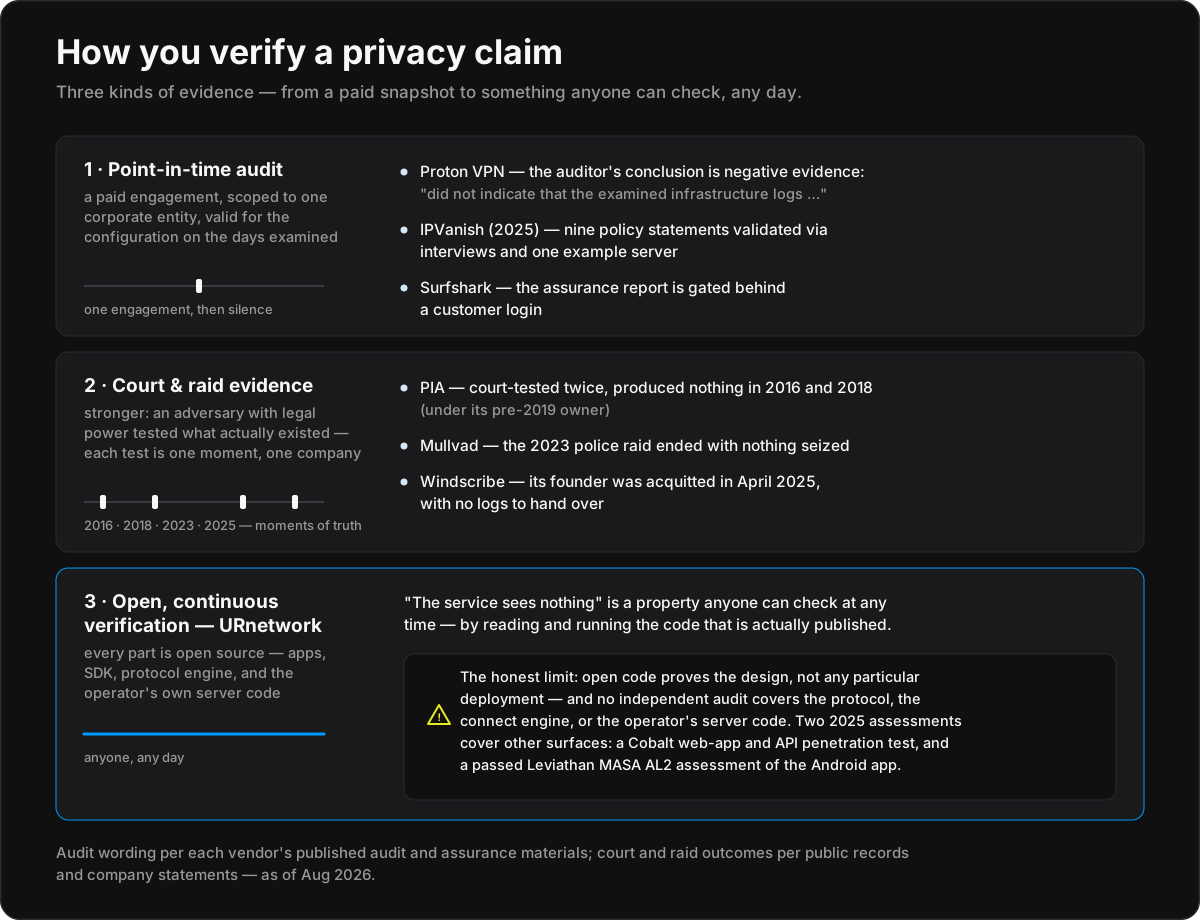
URnetwork's side of this ledger is different in kind. No independent audit covers its protocol or the operator's server code; two 2025 assessments cover other surfaces and are listed under Limits. What it offers instead is continuous rather than annual: the clients and the operator's server code are open source, so the storage design can be checked by anyone on any day. Verification by publication is not verification by examination, and this page does not blur the two.
Feature removals as disclosure
IVPN's record includes a pattern few vendors show: deleting features, including paid ones, and publishing the reasons.
- Port forwarding, a paid feature, was closed to new reservations in June 2023 and removed that September. The stated reason: "We have no insights into how any one specific customer uses IVPN, and that needs to stay that way." A company that cannot see per-customer behavior cannot police abuse selectively, so its only lever is removing the capability for everyone.
- The iOS kill switch was removed in August 2023 after Apple's networking leaked traffic around it on iOS 16, in IVPN's words "to avoid providing a false sense of security." It remains on iOS 15, where it works.
- The custom Android kill switch was removed in 2021 because it could gap between handovers; users are pointed at Android's native always-on mode.
- In 2024 IVPN published reproduction steps for an Android OS-level DNS leak that affected every VPN app, its own included.
The same disclosure habit covers marketing. The affiliate program has stayed closed since 2016, the homepage still says "We never pay for reviews," and the ethics page names the payments IVPN does make: sponsorships of privacy organizations and support for a short, named list of privacy educators.
URnetwork's egress filter is the port-forwarding reasoning applied at the exit. The connect engine inspects traffic at each provider's own connection and drops file-sharing and attack traffic before it leaves that member's line, recording no destination, domain, or contents. Enforcement without a record: the alternative, forwarding everything and answering complaints with logs, requires exactly the logs this design exists to avoid. The cost is the hard exclusion stated above.
The map, measured
IVPN's location numbers are the most verifiable in the commercial field. The homepage claims gateways in 41 countries on dedicated bare metal, "no shared VPS, no virtual locations." Its public server API returns exactly 41 countries and 58 cities and names the hosting company behind every gateway. An independent infrastructure observer sees 40 countries and 57 cities. And IPinfo's December 2025 study measured IVPN at 0% virtual locations, one of three providers in twenty to score zero, with Mullvad and Windscribe. When this documentation warns about location counts, IVPN is the standard it holds others to.
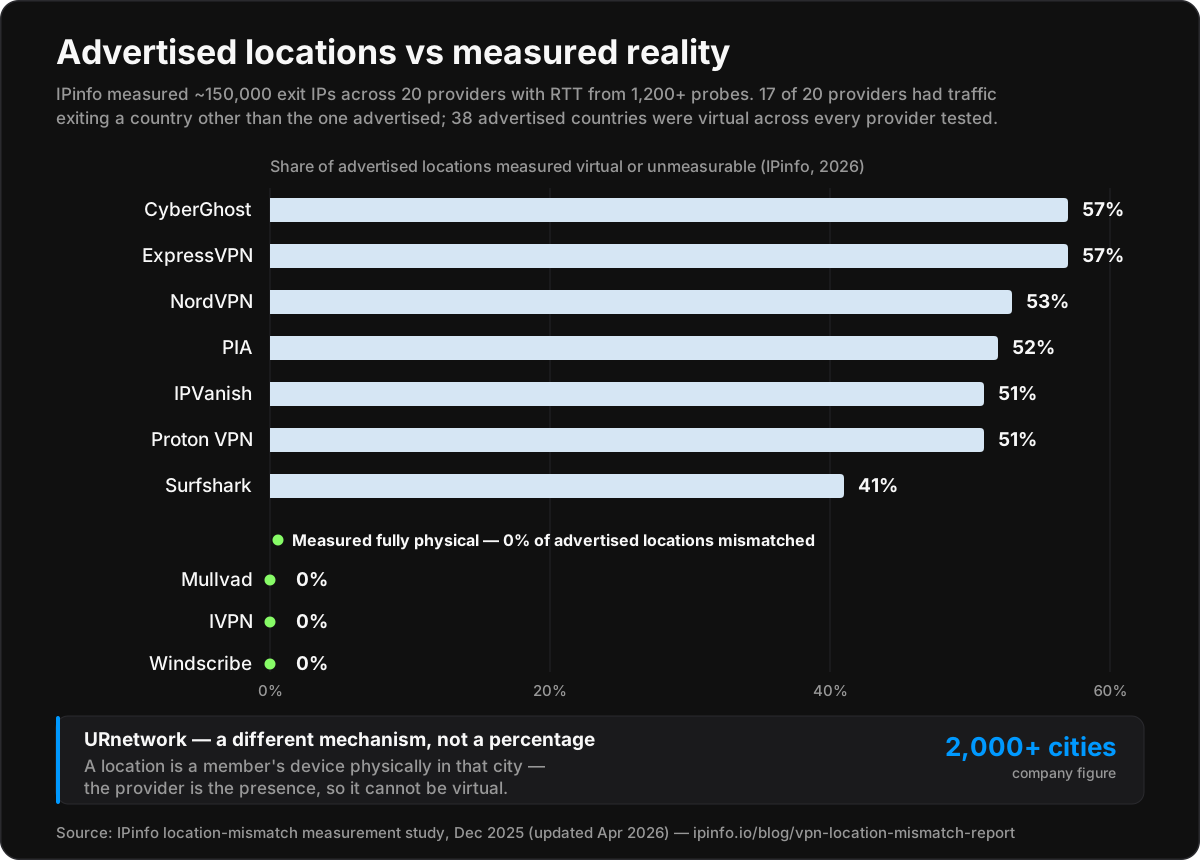
The contrast that survives all that disclosure is the kind of address. IVPN's 88 servers sit in fifteen named hosting companies' racks, in ranges published in routing data before anyone connects, which is why streaming and retail sites can block them wholesale. URnetwork's exits are members' own connections: a location exists only while a member's device is online in it, the network geolocates the connection it observes rather than accepting a declared city, and 2,000+ real cities is stated as checkable against the live feed at api.bringyour.com/stats/last-90, published without a login. Hold that to IVPN's own standard: IVPN's zero was measured from outside, and nobody has measured URnetwork. A mechanism you can check is not yet a measurement someone made.
Where IVPN wins
- External verification: eight published Cure53 audits since 2019, a transparency report, and a signed warrant canary. URnetwork's two 2025 assessments cover other surfaces, and its protocol and server code have none.
- Payment with no ledger: cash by post and Monero. URnetwork's USDC lives on a public chain.
- Consistency. Bare-metal servers behave the same every session.
- Jurisdiction: Gibraltar rather than the US, if legal process is your concern.
- Conduct: a decade of choices that cost revenue, from the closed affiliate program to deleted paid features, each explained in public.
- P2P: no protocol restrictions, against URnetwork's BitTorrent drop.
Where URnetwork wins
- The split. The exit never learns who you are, and the operator cannot read the sealed session. No single party holds identity and destinations together.
- The exit address. Residential IPs work where IVPN's datacenter ranges are recognized and blocked.
- Reach and aim. Member devices in 90+ countries and 2,000+ real cities by the live feed, searchable to a city, against 41 countries and 58 cities.
- Plural exits. A window of several providers at once, each site pinned to one, instead of one well-known server address.
- One-tap anonymity plus recovery: an Instant Account with no email, restored on a new device by its recovery phrase. IVPN's account IDs are equally anonymous; the phrase adds reinstall recovery.
- Whole-stack source. Client and server code are public, against open apps and an open website with the server side unpublished.
- Price and a free tier: $5/month or $40/year plus a free daily allowance; IVPN starts at about $6 with none.
- The supply side. Members can share their connection as participants in the UR protocol. IVPN has no equivalent role.
Limits and evidence
URnetwork's main limits:
- No independent audit covers the protocol, the connect engine, or the operator's server code. Two 2025 third-party assessments cover other surfaces: a penetration test of the web application and API (April–May 2025), and the Leviathan MASA AL2 assessment of the Android app, which passed. Leviathan writes that its assessment "should not be read as a holistic security evaluation or comprehensive penetration test." Neither examined logging, retention, or the data path.
- The split assumes the operator and the providers in your window are independent. Nothing in the system attests that independence, the operator could itself run providers, and no outside party has measured the fleet. See the threat model, §6.1.
- URnetwork publishes no transparency report and no warrant canary. IVPN publishes both.
- The WireGuard-compatible fallback endpoint assigns one stable tunnel address, so several providers could recognize the same client across sessions. The native tunnel is the recommended path.
- Coverage counts are self-published on both sides. IVPN's were confirmed from outside twice; URnetwork's have not been measured.
IVPN's limit is structural. Its servers terminate the tunnel, so one position can see your connecting IP and your destinations together, and the policy decides what is recorded from that view. Multi-hop splits the view across two machines the same company runs. Everything else in IVPN's design reduces what that position is given: no email, cash and Monero, and a no-logs policy audited once and then argued against as a genre by its own CEO.
Trying URnetwork costs nothing: the Instant Account takes one tap and no email, so you can test it against your own sites before paying for either product. More questions are answered in the FAQ.