
URnetwork vs Safing SPN
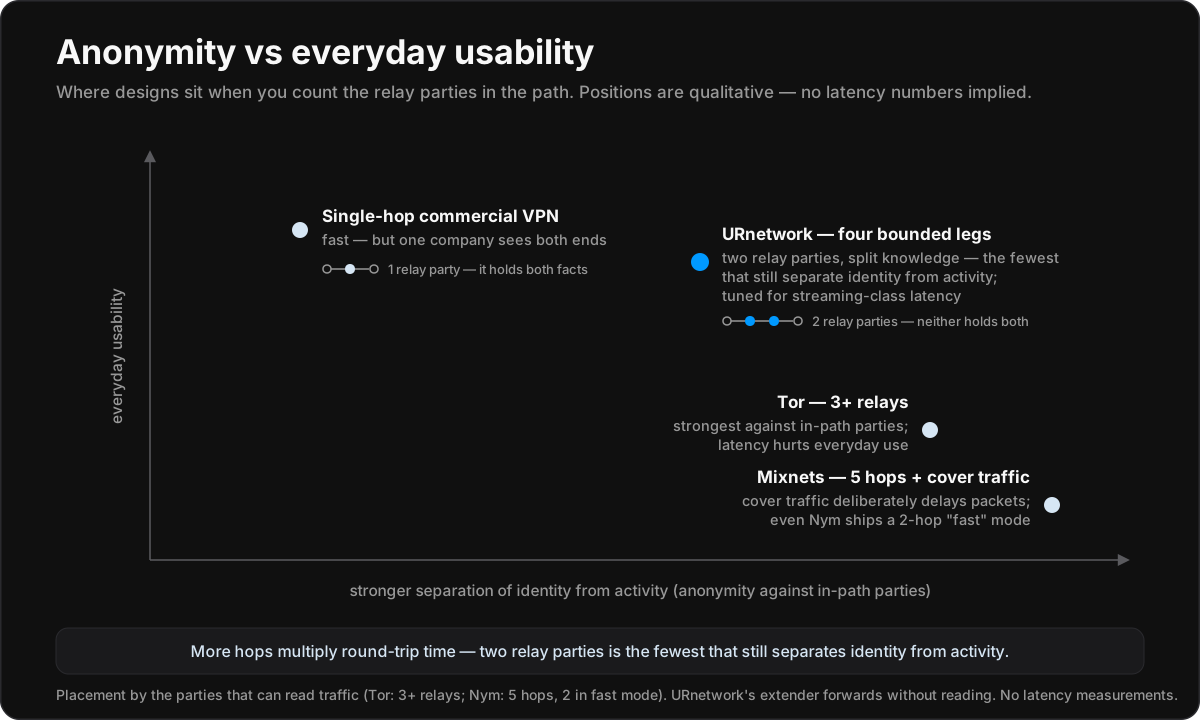
Safing's SPN is a paid multi-hop network built into the Portmaster firewall, routing each connection from a Home Node to an Exit Node near its destination over servers in datacenters; URnetwork splits every session so a residential exit never learns who you are and the operator cannot read the sealed session.
Choose Safing SPN if you are on Windows or Linux and want an application firewall with a multi-hop network inside it, per-connection exit selection, and an audited crypto library. Choose URnetwork if you need phones and macOS too, residential exits you can pick by city, a free daily allowance, and a one-tap account with no email. Both split entry from exit across different nodes; they differ on where the exits sit and on platforms.
Safing publishes Portmaster, an open-source application firewall (GPL-3.0), and sells the SPN inside it. SPN access comes with Portmaster Plus at €40/year or Pro at €8/month or €80/year; Portmaster itself is free, the SPN is not, and there is no trial: "Providing the network costs us money." Payment is by card, PayPal, cash, Bitcoin or Monero. Portmaster runs on Windows and Linux; "Mac and Mobile are planned but not yet available," the pricing page says.
URnetwork uses member-run exits. The provider does not receive your source IP on the relayed path. Native apps can also seal traffic to the provider, with a switch that ships off. How URnetwork works explains the full design. The threat model holds the complete record of what is stored and enforced.
Six differences that affect the choice
| Safing SPN | URnetwork | |
|---|---|---|
| Traffic path | Multi-hop with layered encryption at each hop, from your Home Node to an Exit Node chosen per destination | Two relay parties; the exit never sees your IP, and the operator cannot read the sealed session |
| Who runs the nodes | Safing's servers plus volunteer community nodes, which Safing asks to be in datacenters | Member devices on residential addresses |
| Exit address | Server addresses; community nodes sit in datacenters | Residential addresses; browse countries, search for a city |
| Platforms | Windows and Linux | Android, iOS, macOS, Windows, Linux, browser extension |
| Price | No free SPN; Plus €40/year, Pro €8/month | Free daily allowance; Pro $5/month or $40/year |
| Published verification | Cure53 audit of Jess, the SPN's crypto library | Open apps, connect engine and server; no independent audit of the protocol or server code |
Caveats below the table:
- Plain, unencrypted connections such as HTTP "will never exit the network at SPN community nodes," Safing's community node page says; they exit at a trusted subset of Safing's own servers.
- DNS requests exit at your Home Node by default, encrypted, to keep location-aware answers close to you.
- URnetwork's sealed session, X25519MLKEM768 from client to provider, is a native-app switch that ships off. The browser extension has no sealed session; there, the operator's data path logs nothing, pinned by a test in the open code.
Two ways to split entry from exit
SPN's Home Node is your entry: "You connect directly to it and all your connections are routed through it." Exit Nodes are "chosen for every destination separately," near the destination. Each site can therefore see a different exit, and no single node holds your IP and all your destinations. The nodes are servers: Safing's own, and community nodes that its hosting page asks to sit "in a datacenter that is well connected," hosted by volunteers. The page describes no payment to node hosts.
URnetwork's path is you → extender → operator → provider → internet. The provider is a member device on a home connection, so sites see an ordinary residential address, and the client holds a window of several providers, pinning each site to one. The operator relays the session but cannot read it when sealed. Providers participate in the UR protocol.
The firewall is the product
SPN is a feature of an application firewall. Portmaster shows and blocks connections per app, and SPN rules can send or keep chosen domains off the network. If the SPN is unavailable, "network traffic will be blocked." That integration is something URnetwork does not offer: URnetwork is a network, with an explicit kill switch in each app, not a firewall.
Where Safing SPN wins
- An application firewall and a multi-hop network in one open-source tool.
- Exit chosen per destination, close to each site.
- A published Cure53 audit of its crypto library.
- Datacenter nodes, which keep links steadier than home connections.
- Cash and Monero accepted.
Where URnetwork wins
- Residential exits: sites see home traffic, and you can choose a country or search for a city in a large selection of countries.
- Every major platform, including iOS, Android and macOS, which Portmaster does not support yet.
- A free daily allowance and a one-tap account with no email.
- A sealed session the operator cannot read, in the native apps.
- Protection for the member at the exit: an open-source filter drops file-sharing and attack traffic before it leaves their line.
Limits and evidence
URnetwork's main limits:
- No independent audit covers the protocol, the connect engine, or the operator's server code. Two 2025 third-party assessments cover other surfaces: a penetration test of the web application and API, and the Leviathan MASA AL2 assessment of the Android app, which passed. Neither examined logging, retention, or the data path.
- The split assumes the operator and the providers in your window are independent. Nothing in the system attests that independence. See the threat model, §6.1.
- Residential links vary more than datacenter servers; speed moves with the providers in your window.
Safing SPN's limits are reach and residency: no phones or macOS yet, no free SPN, and exits on server addresses rather than home connections.
Trying URnetwork costs nothing: the Instant Account takes one tap and no email. More questions are answered in the FAQ, and the decentralized VPN comparison sets SPN beside the other dVPNs.
To try it yourself, install UR.
Facts checked 2026-11-18 against Safing SPN, Safing pricing, SPN settings, community nodes and Portmaster.