
URnetwork vs Deeper Network
Deeper Network sells a hardware router that protects every device on a home network and shares its owner's bandwidth into a peer-to-peer network for DPR token rewards; URnetwork is software on each device that splits every session so the exit never learns who you are and the operator cannot read the sealed session.
Choose Deeper Network if you want one box that covers every device on your home network, including ones that cannot run a VPN app, with no subscription after you buy it. Choose URnetwork if you want protection that travels with your phone and laptop, a split path you can read the code for, a free daily allowance, and exits you can pick by country or city. Both route traffic through other people's home connections; they differ on where the software runs and on how much the vendor documents.
Deeper Network calls Deeper Connect a "VPN router (router-level VPN)." The Mini lists at $399 and the Air at $349, and the site promises "$0 Subscription Fees" after a "one-time hardware purchase." Its decentralized private network (DPN) is described as an optional feature that reaches sites "by using the bandwidth of other Deeper Connect users," over Deeper's own Trident protocol. The marketing counts "over 200,000 nodes worldwide" with no as-of date or method.
URnetwork uses member-run exits. The provider does not receive your source IP on the relayed path. Native apps can also seal traffic to the provider, with a switch that ships off. How URnetwork works explains the full design. The threat model holds the complete record of what is stored and enforced.
Six differences that affect the choice
| Deeper Network | URnetwork | |
|---|---|---|
| Form | A hardware router in front of your home network | Apps on each device, plus a browser extension |
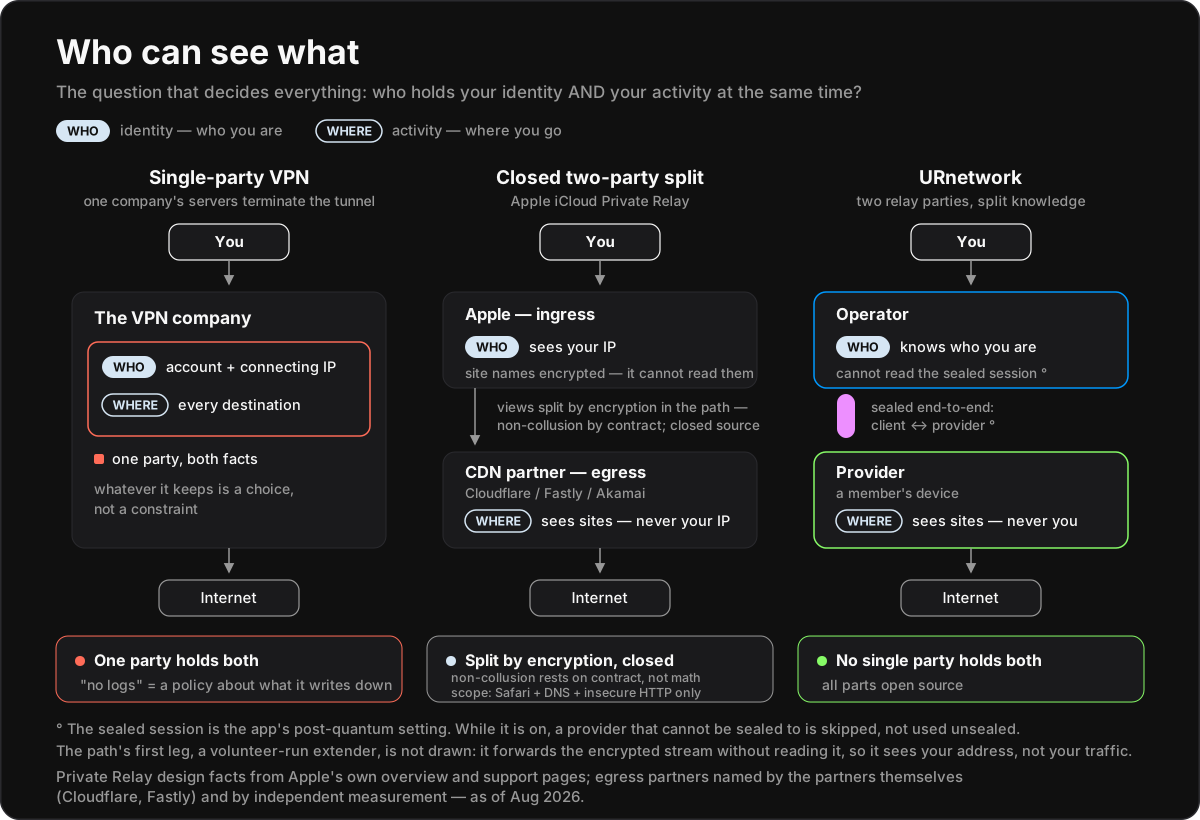
| Traffic path | Through other owners' routers; hop count and what each node sees are not documented | Two relay parties; the exit never sees your IP, and the operator cannot read the sealed session |
| Away from home | Covers devices behind the router | Goes wherever the device goes, on any network |
| Price | One-time hardware purchase, $349–399; no subscription | Free daily allowance; Pro $5/month or $40/year |
| Supply side | Router owners share bandwidth and earn DPR, weighted by a credit score | Member devices share by a switch in the regular app; providers participate in the UR protocol |
| Published verification | Chain code on GitHub; no audit and no firmware source named on the site | Open apps, connect engine and server; no independent audit of the protocol or server code |
Caveats below the table:
- Deeper's mining FAQ says rewards depend on the device staying online and sharing, a credit score built "up to 800 points starting from 0 simply by sharing your bandwidth," and staking DPR adds to it. It also says the DPN feature "is optional and not necessary in order to share bandwidth and earn rewards."
- The DPR chain is a Substrate-based chain in the deeper-chain repository. Code for the router's firmware is not linked from deeper.network.
- URnetwork's sealed session, X25519MLKEM768 from client to provider, is a native-app switch that ships off. The browser extension has no sealed session; there, the operator's data path logs nothing, pinned by a test in the open code.
What the router does and does not tell you
A router-level design has a real strength: a smart TV, a console or a guest's phone gets the same protection without installing anything. The cost is that the box is the trust anchor, and the vendor's pages describe its outcomes ("7-layer firewall," "DNS encryption") rather than its design. Deeper's pages do not say how many hops a DPN connection takes, whether the exit router sees your home IP, or what an exit owner can log. A bug bounty is linked; no audit is.
URnetwork publishes the path and what each party sees: you → extender → operator → provider → internet. The provider sees the destinations it carries and never your IP; the operator relays a session it cannot read when sealed. Both endpoints of that session live in code anyone can read.
The exit owner's side
On both networks a stranger's traffic can leave from your home address. Deeper's pages do not describe a filter at the exit. On URnetwork, an open-source filter on the member's own device drops copyright-class file-sharing and intrusion-class attack traffic before it leaves the line, recording no destination or contents, and every byte moves under a signed, metered contract. Providing is off unless the member turns it on.
Where Deeper Network wins
- One device covers the whole home network, including devices that cannot run a VPN app.
- No recurring fee after the hardware purchase.
- A firewall in the same box.
- A token reward for sharing, with the rules in a public FAQ.
Where URnetwork wins
- A documented split on every session: the exit never sees your IP, and the operator cannot read the sealed session.
- Protection on any network the device joins, not only at home.
- Open code from the app to the server, versus a closed router firmware.
- A free daily allowance and a one-tap account with no email; nothing to buy up front.
- Exits you can choose: browse a large selection of countries or search for a city.
- Protection for the member at the exit, enforced in open code.
Limits and evidence
URnetwork's main limits:
- No independent audit covers the protocol, the connect engine, or the operator's server code. Two 2025 third-party assessments cover other surfaces: a penetration test of the web application and API, and the Leviathan MASA AL2 assessment of the Android app, which passed. Neither examined logging, retention, or the data path.
- The split assumes the operator and the providers in your window are independent. Nothing in the system attests that independence. See the threat model, §6.1.
- URnetwork does not protect devices that cannot run its app, which is the case a router handles.
- Speed moves with the providers in your window.
Deeper Network's limit is documentation. The router is the trust anchor, and the vendor publishes outcomes and node counts, not the path, the exit's view or an audit.
Trying URnetwork costs nothing: the Instant Account takes one tap and no email. More questions are answered in the FAQ, and the decentralized VPN comparison sets Deeper beside the other dVPNs.
To try it yourself, install UR.
Facts checked 2026-11-18 against deeper.network, Deeper's how it works, Deeper's mining FAQ and deeper-chain.