
On Thursday 30 July, in a Nashville courtroom, a Meta lawyer asked Arturo Bejar about the settings on his phone. Bejar ran user security at Facebook, now Meta, for six years. He now testifies against it. He answered honestly.
"Yes, I have ephemeral messaging on Signal," Bejar said. "My background is a security engineer and from a professional paranoid, I try to be very mindful about my communications OPSEC." Asked whether his texts with former Meta colleagues disappear, he said: "Yes, they do."
We know he said it because Meta wrote it down. Eight days later that exchange was reproduced, with Meta's own emphases, inside a 26-page motion in a federal court 2,000 miles away, asking the judge there to keep him off the witness stand altogether.
The court heard argument on 13 August and gave its reasons on the record. Today the denial arrived in writing.
"[I]t is obvious," Chief Judge Yvonne Gonzalez Rogers wrote, "that this motion falls into the category of a 'Hail Mary' attempt to eliminate a strong witness for the plaintiffs. The attempt fails, and although Meta can cross-examine Bejar, it cannot imply that a legal obligation to preserve those texts existed."
Paragraph 2, between the housekeeping
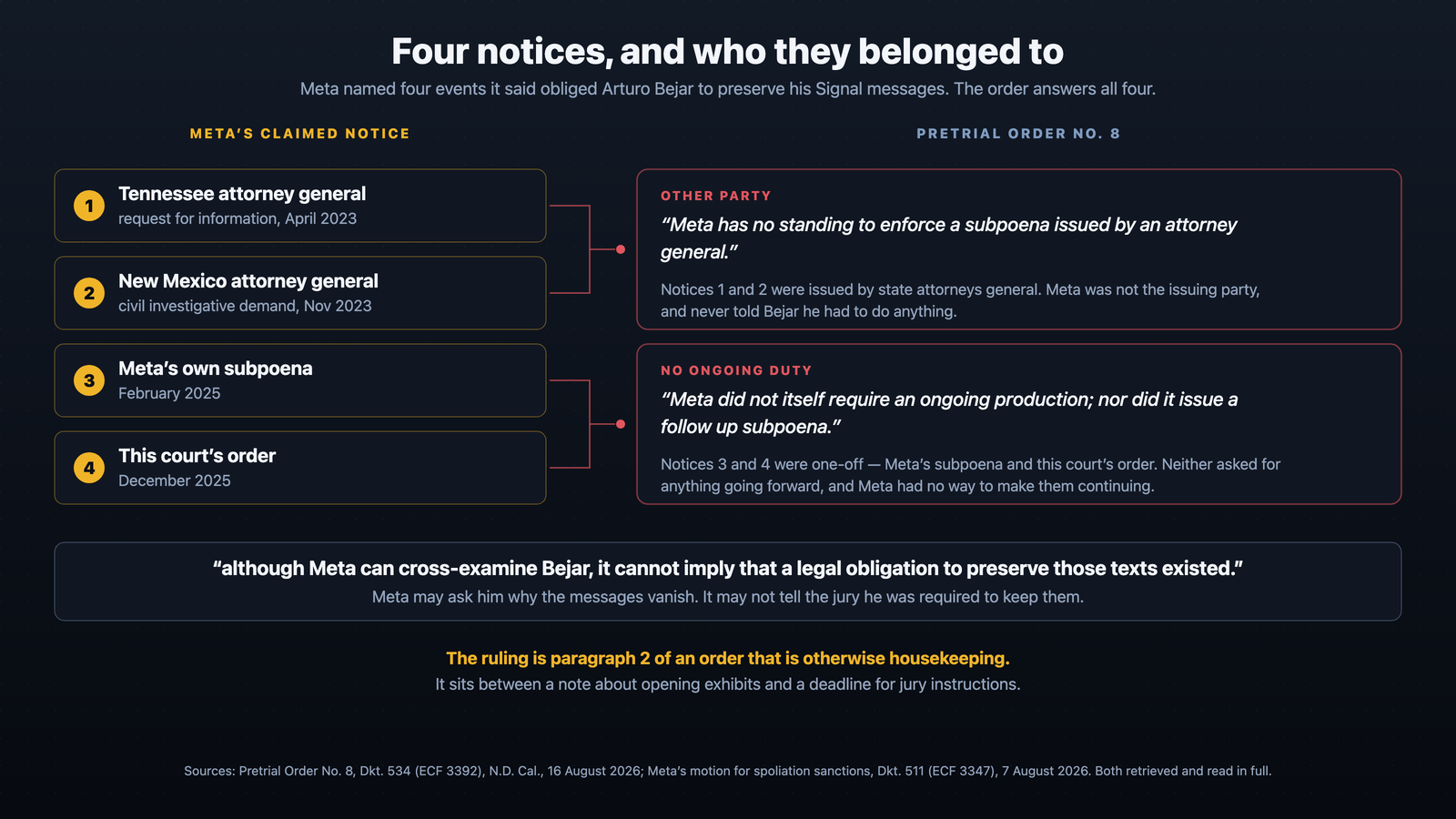
Pretrial Order No. 8 is three pages, filed two days before opening statements. The ruling is its paragraph 2, one of five running from opening exhibits to briefing deadlines — an order that bundles a holding with housekeeping.
"Meta's request to exclude Bejar from testifying at trial is DENIED," it reads.
Meta may ask Bejar why his messages vanish. It may not tell the jury he was required to keep them.
Who he is, and why Meta wants him gone
Bejar left Meta in 2015 and went back four years later as a consultant to its Instagram unit, after his teenage daughter and her friends told him about the unwanted sexual advances they were getting there. In October 2021 he sent what he found to Zuckerberg, Instagram head Adam Mosseri and Sheryl Sandberg. He says the reply was "complete silence."
He has testified against Meta at three trials. On Tuesday he is expected to do it again in Oakland, where 29 states accuse Meta of collecting children's data illegally, and four also say it lied about how safe its products are.
Meta's motion argued that he had destroyed evidence by using an application that deletes messages on a timer, and asked that he be excluded, or the jury told to infer the worst.
Four notices, and who they belonged to
Bejar is not a party. Parties must preserve documents relevant to a lawsuit; witnesses generally need not, unless something puts them on notice. So Meta built the duty out of whatever notice it could find, and named four: the Tennessee attorney general's request in April 2023, New Mexico's civil investigative demand that November, Meta's own subpoena in February 2025, and this court's December 2025 order for exactly the communications Meta says are missing.
The ruling does not take them in that sequence, but it answers all four. The first two are somebody else's process, and Meta has no legal right to enforce another party's: "Meta has no standing to enforce a subpoena issued by an attorney general," Gonzalez Rogers wrote. The third is Meta's own subpoena and the fourth is this court's order, and whoever issued them, Meta cannot make them continuing. It "does not have, in reality, a legal mechanism to enforce its claim that Bejar was under a continuing obligation to preserve Signal communications. Meta did not itself require an ongoing production; nor did it issue a follow up subpoena."
Nashville, read from Oakland
Meta's theory of relevance was that Bejar had been recruiting former colleagues to testify against the company, and that the messages would have shown it. Deciding whether she needed an evidentiary hearing at all, Gonzalez Rogers read four days of his testimony from State of Tennessee v. Meta Platforms, where he was the first witness called. "Very little concerned any allegations of recruitment," she found. "Rather, the issues focused on Bejar's actual work at Meta."
The deletion Meta cannot name
Meta cannot say what the missing messages said. What it has is an inference built out of pixels.
Bejar produced two Signal threads in March 2025 as eight screenshots, one thread with the whistleblower Frances Haugen. He produced no metadata with them, which, Meta concedes, makes it "impossible for Meta to know exactly how these chats were captured."
So Meta went to the picture. Signal's help page, the motion says, states that "[e]ach and every disappearing message will have a timer countdown icon that is visible at the bottom of the message bubble." Meta found no countdown icons in the eight screenshots, and from their absence concluded that Bejar must have turned the timer on after those conversations, or switched it off to take those captures.
That is the modern evidentiary problem in one image: a company arguing a deletion from the bottom edge of a message bubble in a screenshot of a conversation it was never part of.
Meta's case is better than that makes it sound
On the general question the law is on Meta's side. Courts do sanction litigants for letting evidence expire — spoliation, the destruction of material somebody was obliged to keep: a federal judge in Arkansas called a mid-litigation switch to Signal "intentional, bad-faith spoliation of evidence" in 2019, and Meta's motion cites two more. Gonzalez Rogers had also already ordered Bejar to hand these communications over, holding that Meta's need outweighed his argument that disclosure would expose people who had spoken to him in confidence.
And one window is genuinely awkward. Anneke Buffone, a Meta safety researcher laid off in December 2025, messaged Bejar on Signal; they had never met. Deposed in June 2026, she testified to exchanges in December 2025 and February 2026 about this litigation. His final production came on 12 January 2026, after the first of them. No Signal messages with her were produced.
The best material against him is in the declaration he signed himself. He has, he says, "routinely purged unnecessary information from my email accounts for many years," and did not keep the October 2021 memo to Zuckerberg — the document his public account of Meta rests on. A judge could conclude, without thinking him dishonest, that a habitual deleter who had become a witness this important ought to have stopped deleting.
His answer is a flat, sworn denial. "Meta's counsel has alleged that I used a feature they called 'auto delete' or that I otherwise deleted messages. That is false." From the day he installed Signal in 2023 until he finished producing in January 2026, he says, he used no auto-deletion on any exchange with a former Meta employee. That reaches the December exchange. It stops short of the February one.
The same idea, pointing two ways
The same order set a noon deadline, as directed at the 13 August hearing, for proposed jury instructions on Section 230, the federal platform shield. Both sides filed today.
Meta's instruction asks that jurors be told they may not find it engaged in unfair practices, or any of its statements false or misleading, on the basis of any of ten listed things. The sixth is "[a]llowing third-party content to be private or to disappear after a period of time."
These are different bodies of law, and the shield argument is not one Meta invented: this court held in 2024 that ephemeral content is a protected publishing function, and the states' own instruction complies under protest. But it is the same idea — content that vanishes on a timer — arriving as a shield where Meta builds it and as destruction of evidence where a witness uses it, over the signature of Ashley M. Simonsen of Covington & Burling, Meta's outside counsel, in filings nine days apart.
What the order does not say
It does not say that using Signal is protected, or that a witness may switch on a timer whenever he likes. It says that this company could not enforce this claimed duty against this witness: no mechanism, no follow-up subpoena, no standing over somebody else's demand, and no showing of "reliance actually communicated to Bejar." That is narrower than a right, and more useful than one.
A court that finds no duty need not go on to forbid the losing party from implying one. This one did.
Meta, in a statement before trial, says it strongly disagrees with the states' allegations and points to its longstanding work supporting young people.
Bejar explains why the app is on his phone. "Some people interested in discussing issues like online safety are fearful that they will be retaliated against by Meta if their communications are discovered."
References
References
Every filing in this case carries two docket numbers — the trial docket 4:23-cv-05448 and the MDL 4:22-md-03047-YGR — and the order's own footnote directs parties to cite the trial number with the MDL number in parentheses. Where only one number is given below, this desk has the MDL number and not the trial one.
- Pretrial Order No. 8, Dkt. 534 in
4:23-cv-05448(ECF 3392 in MDL4:22-md-03047-YGR), N.D.
Cal., signed by Chief Judge Yvonne Gonzalez Rogers and filed 16 August 2026. Retrieved from RECAP, HTTP 200, 267,251 bytes, 3 pages. https://storage.courtlistener.com/recap/gov.uscourts.cand.401490/gov.uscourts.cand.401490.3392.0.pdf
- Meta's motion for spoliation sanctions, Dkt. 511 (ECF 3347), 7 August 2026, 26 pages, retrieved and
read in full (317,536 bytes). https://storage.courtlistener.com/recap/gov.uscourts.cand.401490/gov.uscourts.cand.401490.3347.0.pdf The Nashville exchange quoted at the top of this piece is quoted from that motion, at transcript 1712:11–21. Meta's own version carries emphases and a bracketed gloss, neither reproduced here. This desk has not read the Tennessee transcript itself.
- Bejar's opposition and sworn declaration, ECF 3365 and 3365-1, 11 August 2026.
- The 13 August hearing rests on the order itself: ¶1 cites "the August 13, 2026 hearing", and ¶2 says
"The Court heard argument on defendant's motion ... is DENIED" "[f]or reasons discussed further on the record". This desk has not read that transcript or any report of it, and makes no claim about the content of what was said there. The denial quoted in this piece is the written one, filed 16 August.
- Meta's proposed Section 230 jury instruction, ECF 3393-1, and the State AGs', ECF 3394-1, both
filed 16 August 2026. The instructions are in the exhibits, not the notices.
- State of Tennessee v. Meta Platforms — Davidson County Chancery Court, Chancellor Russell T. Perkins,
brought by Attorney General Jonathan Skrmetti under the Tennessee Consumer Protection Act; jury selection 20 July 2026, listed for seven weeks. JURIST, 27 July 2026.
- Meta's statement to reporters before trial — not a filing. By Diana Novak Jones, 12 August 2026, read
in syndication at Claims Journal (HTTP 200, 68,192 bytes) because that is the retrievable copy. https://www.claimsjournal.com/news/national/2026/08/12/339459.htm It attributes the words to "a Meta spokesperson". This is the only non-court source in the piece and the only thing sourcing Meta's side.
- MLex, 30 July 2026, for the close of Bejar's four days in Nashville. Retrieved by
curlwith a browser
user-agent; the article is paywalled below the standfirst and only the standfirst was read.
Not established, and not asserted. What any of the missing messages said. Whether Bejar's Haugen thread is dated January–February 2024 as Meta says or 6 December 2023 as Bejar says — the two accounts cannot be reconciled from the filings, so this piece dates it not at all. What the states are asking for in damages: three sources give three different answers and none is authoritative. Signal's own help page could not be retrieved from three clients today — curl with a browser UA, WebFetch and r.jina.ai all returned 403 behind Cloudflare, and the Internet Archive returned 503 — so the countdown-icon description is attributed to Meta's motion rather than to Signal.