
Thirty-three pages, on the last day
On Friday, the day the judge's four days ran out, the Department of Homeland Security filed its explanation: a 25-page brief signed at Main Justice — the Justice Department's Washington headquarters — and an eight-page sworn declaration from the agent who approved the operation. Together they say that Homeland Security Investigations (HSI), the department's criminal-investigations arm, sent an undercover agent into the basement gymnasium of University Baptist Church in Minneapolis on the evening of 28 May with "a concealed body-worn audio recorder," that she stayed about two hours, and that a supervisor had signed off on it after discussing the court's injunction and deciding it did not apply.
The declaration puts the operation's name into this court's record for the first time, under oath: Project Whipple Shield, opened on 11 February 2026. (The name was already public in a Minneapolis criminal case's filings.) And in its twentieth paragraph, asked to account for every place of worship on the court's list, the agent answers for one project and stops. "To my knowledge, HSI has not investigated any other location on the current protected areas list as part of Project Whipple Shield." Then: "I cannot confirm or deny that there are additional investigations at other locations on the protected locations list."
The judge who has to weigh that is F. Dennis Saylor IV of the federal district court in Massachusetts. The sentence of his Monday order that matters: "Defendants shall show cause, in writing filed on the docket, on or before August 28, 2026, why they should not be held in contempt for violating the preliminary injunction." The hearing is by video next Friday, 4 September.
The people in the gym
The injunction is Saylor's own, entered on 13 February in New England Synod v. Department of Homeland Security — a suit brought by eight church bodies after the administration rescinded the policy that had kept immigration enforcement out of houses of worship. It bars DHS and Immigration and Customs Enforcement (ICE) from taking any "Immigration Enforcement Action" inside a protected place of worship except in an emergency, and within a hundred feet of its entrances without headquarters approval. The order defines that term broadly: "any action … planned, conducted, undertaken, or executed, in whole or in part, to enforce the immigration laws of the United States, including any arrest, seizure, search, interrogation, questioning, interview, or investigation."
University Baptist Church, in the Dinkytown neighborhood by the University of Minnesota, is not a plaintiff by name. The injunction covers the eight bodies that sued "and all of their member churches, congregations, and meetings," and University Baptist belongs to two of them. It has been on the court's list since 27 February; its entrances say so.
The people the government's declaration describes never knew they were in a court record. On Sunday 12 April, agents watching from the public library's parking lot across the street photographed three cars, ran their registrations, and counted "five individuals enter the basement of the Church." On Thursday 28 May at about 7:05 p.m., the undercover agent walked into the gym for a boxing and mixed-martial-arts class run by a group called Left Jab, and the recorder ran.
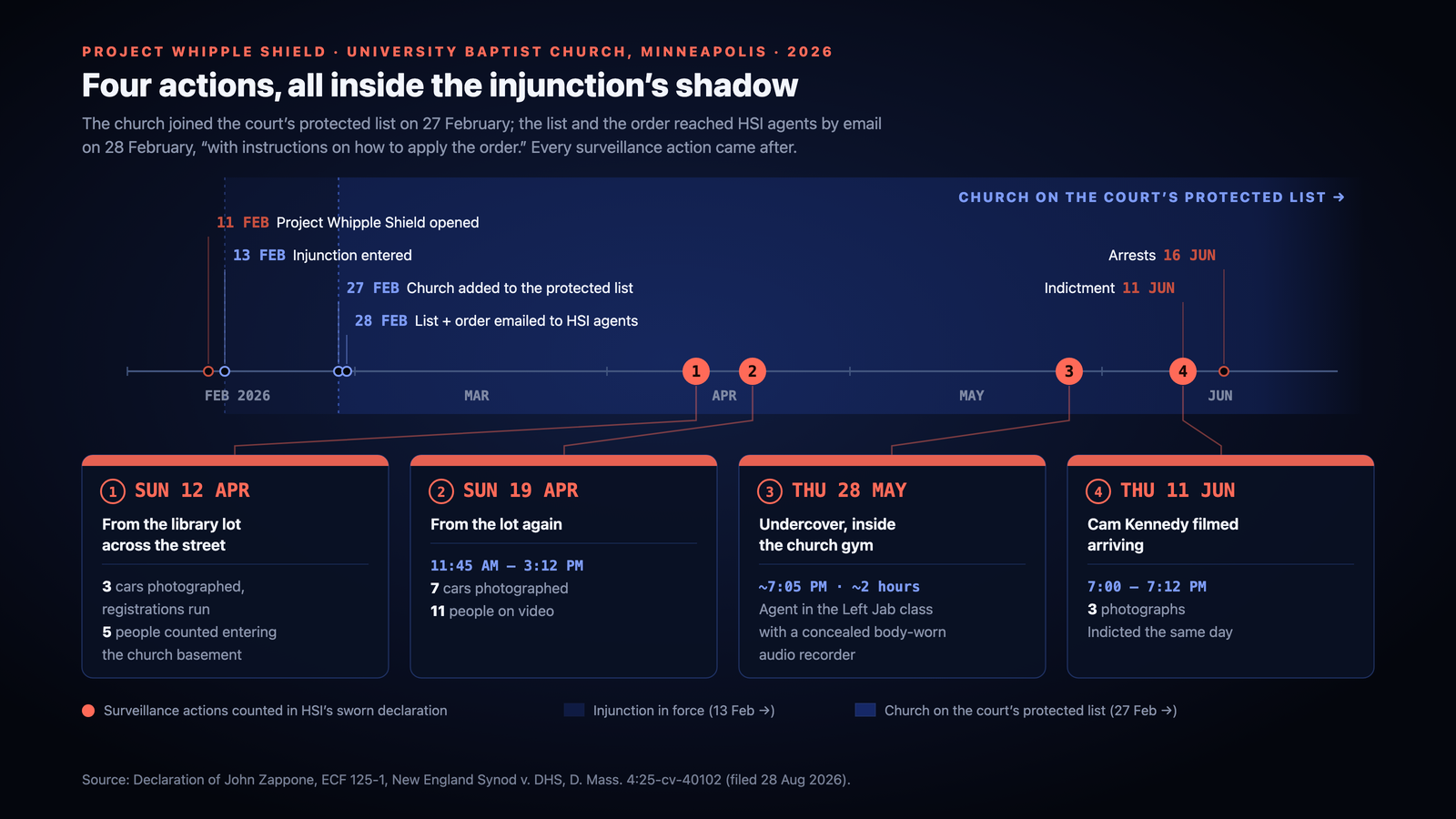
By Saturday evening three of the four surveillance reports behind that account were publicly readable, redacted; what can be read matches the declaration.
The congregation learned all this from the news, on Friday 14 August, after a defense lawyer in that Minneapolis criminal case filed the agent's own report. Two days later the interim pastor opened worship by telling them. "We should not become accustomed to this," Rev. Cody Sanders said. "We should not let this become sort of the taken-for-granted, status-quo norm that we just expect, because this is wrong." A member who had been the church's president, Jean Lubke, put it in a sworn declaration of her own: "This is a complete violation of our sacred space."
What the agent swore to
The declarant is John Zappone, an assistant special agent in charge at HSI. He says he received the injunction and the list of protected places by email on 28 February, "with instructions on how to apply the order."
Before 12 April: "HSI agents discussed this Court's preliminary injunction and determined the investigative activity would not violate the Court's order as the investigation had no nexus to immigration enforcement … I approved the investigative activity at the Church." Before 28 May: "I again authorized this operation."
The man they were looking for, the brief says, is Cam Kennedy, one of Left Jab's leaders, a "self-described revolutionary anarchist" who was organising "de-arrest" and "swarm" training.
The brief concedes what it cannot avoid. "University Baptist Church is a Protected Area under the Preliminary Injunction." The library lot is not — but "Agents could not confirm whether the parking lot was not Near a Protected Area," which is the order's hundred-foot zone. And it does not deny the gym. It defends it.
Three ways to read one clause
The government's argument is that none of this was immigration enforcement, so none of it was covered. Project Whipple Shield, the brief says, investigated Title 18 — the federal criminal code — not Title 8, the immigration laws; the June indictment's eight counts are all Title 18, and "none of the indicted suspects are aliens."
The churches' answer, filed eight days earlier, is the injunction's own wording: "in whole or in part." The indictment's first paragraph charges a conspiracy to stop DHS and ICE agents, and the first purpose it lists is "[p]reventing the enforcement of federal immigration law by force, intimidation, and threats."
"In part," the brief argues, should be read as the Supreme Court read it in Bostock, the 2020 employment-discrimination case: a reason, not a subject.
And if the court did intend it? Then, the brief says in its last section, the order "was not 'clear and unambiguous'" — an element of civil contempt in the First Circuit — and the government cannot be held in contempt for guessing wrong.
Part of their religion
On the gym, the brief says: "Plaintiffs have failed to explain why the Left Jab classes are part of their religion." And it reminds the judge that at the injunction hearing in February, when he asked whether the churches wanted to be "a sanctuary from law enforcement … 24-7," their lawyer said no.
The order protects a building "regularly used" for worship, not an hour of the week; the gym is inside that building, directly below the sanctuary; protection "does not vary from hour to hour." The order lets DHS move to strike any location "at any time." It never did.
The case the government chose
For the gym itself, the brief reaches back thirty-six years, to Presbyterian Church v. United States. In 1984 the Immigration and Naturalization Service — ICE's predecessor — hired informants to infiltrate the churches of the Sanctuary movement — congregations then sheltering Central American refugees — and at least once taped a worship service. In 1990 the district court in Arizona upheld the government's methods: the interest compelling, undercover work the least restrictive means, so long as the investigation was in good faith and the agent stayed within the invitation.
Two things about that case go unmentioned in the brief's section on it. The first is that it was an immigration investigation — the one kind of investigation the government insists Whipple Shield was not. The second is how it ended: the court granted the churches' motion in part and declared their rights, that they "are protected against governmental intrusion."
What it will not say
There is one thing the churches asked for that the government will not give. On 18 August a Justice Department trial attorney had written to the churches' lawyers that the surveillance reports "are accurate" and that the lists and the injunction had gone "to all ERO and HSI personnel" — ERO is ICE's deportation arm — "along with … instructions on how to apply the order."
The churches asked to see the instructions. Friday's brief says the government "affirm[s]" it disseminated the list and the order, but that the instructions themselves are attorney-client privileged.
So the record now holds the church's address on a list that went to every HSI agent, an agent who says he discussed the order and approved the operation anyway, and a legal theory of what the order means that the court has never heard until now. It also holds a sentence no defense lawyer would have chosen: an official of the agency, asked what else it is doing at the other places on that list, declining under oath to say. That is what the judge who wrote the definitions will hear on Friday.
References (1 sources)
References
- https://www.courtlistener.com/docket/70939776/new-england-synod-evangelical-lutheran-church-in-america-v-department-of/ — CourtListener (RECAP mirror of PACER, New England Synod v. DHS, D. Mass. 4:25-cv-40102) — retrieved 29 Aug 2026. Docket probes, all UTC 29 Aug: the desk's pulls at 06:52 and 07:06 (876,895 B; docket ends at ECF 125) and start/end probes 07:18:09 and 07:30:00 (search count 328, no entry 126); the desk lead's re-probe at 22:41 (unchanged, filing unreported); the writer's probe at 23:00 (count 328, still ends at ECF 125 of 28 Aug; no plaintiffs' reply, no order; Exhibits D–F newly
is_available: true, Exhibit G still not). - https://storage.courtlistener.com/recap/gov.uscourts.mad.287352/gov.uscourts.mad.287352.125.0.pdf — ECF 125, Defendants' Opposition (25 pp) — filed 28 Aug 2026 (on the RECAP mirror by 6:03 p.m. display time); read in full from extracted text.
- https://storage.courtlistener.com/recap/gov.uscourts.mad.287352/gov.uscourts.mad.287352.125.1_1.pdf — ECF 125-1, Declaration of John Zappone (8 pp) — executed 27 Aug 2026, filed 28 Aug; read in full; all paragraph citations verbatim.
- https://storage.courtlistener.com/recap/gov.uscourts.mad.287352/gov.uscourts.mad.287352.125.5.pdf (with …125.6.pdf and …125.7.pdf) — Exhibits D, E, F: HSI Reports of Investigation for 12 April, 19 April and 28 May 2026 — filed 28 Aug 2026, first seen available and retrieved 23:00 UTC 29 Aug. Redacted; print stamps 25 Aug 2026; case MS02PR26MS0004; each reported by the same special agent and approved by the same supervisory special agent; readable text consistent with the declaration. Exhibit G (11 June report, ECF 125-8) was not available at any probe; its contents are known only through the brief and declaration.
- ECF 119 (electronic order, 24 Aug 2026, quoted verbatim) and ECF 120 (notice: show-cause hearing 4 Sept 2026, 11:00 a.m., by video) — via the CourtListener search API on the docket above; re-verified 23:00 UTC 29 Aug, unchanged.
- ECF 117 (Plaintiffs' Motion for Order to Show Cause, 20 Aug 2026), ECF 117-6 (Declaration of Jean E. Lubke) and the 18 Aug 2026 Justice Department email (ECF 117 exhibit) — same docket; from the desk's banked retrievals, quotes verbatim from the filed documents.
- https://www.courtlistener.com/opinion/1588560/presbyterian-church-usa-v-united-states/ — Presbyterian Church (U.S.A.) v. United States, 752 F. Supp. 1505 (D. Ariz., 11 Dec 1990) — read in full 29 Aug ~07:25 UTC via a text-rendering fallback client after the direct fetch returned an empty challenge page (HTTP 202, 0 bytes); background and disposition quoted from the opinion text.
- https://www.mprnews.org/story/2026/08/26/rightleaning-groups-say-mn-15-prosecution-violates-free-speech-of-antiice-activists — MPR News — 26 Aug 2026. Carries the three operation names ("Operation Keyhole," "Operation Puppet Master," "Project Whipple Shield") from documents in the Minnesota criminal case; fetched and read by the desk lead 29 Aug, 22:38–22:55 UTC.
- https://wordandway.org/2026/08/17/in-worship-and-in-court-churches-respond-to-dhs-spying-in-their-buildings/ — Word&Way — 17 Aug 2026. Rev. Cody Sanders's 16 Aug pulpit remarks, quoted by the outlet from a recording of the service; raw HTML retrieved by the desk.
- https://religionnews.com/2026/08/19/despite-government-surveillance-of-their-churches-minnesota-congregations-remain-defiant/ — Religion News Service — 19 Aug 2026 — retrieved 29 Aug 07:21 UTC via a text-rendering client (full body, 58,899 B); congregation background.
- Press sweep at write time: Google News RSS, query
"New England Synod" OR "Whipple Shield" when:1d, 23:01 UTC 29 Aug — zero items; a general web search the same minute returned nothing about the filing dated 28–29 Aug. ECF 125 appears unreported at publish time; the body does not claim exclusivity.