
On 22 July, in a house in Naviraí, in the Brazilian state of Mato Grosso do Sul, a 13-year-old girl took her own life during a live video stream that ran for about forty-five minutes.
The people watching had spent weeks preparing her for it. Brazil's federal cyber-operations laboratory later told reporters that the group had opened a PIX account — an instant bank-transfer key — in the girl's name without her mother knowing, and had sent her money to buy razor blades.
The Polícia Civil of Mato Grosso do Sul named the investigation after her. Operação Lívia was presented in Brasília on 4 August: five adolescents between 13 and 17 held, and a suspected ringleader who is a boy of 14. The police also said they had found a second child, in another state, whose own livestreamed death had already been scheduled, and had stopped it.
The government also said what it thought the platform had done wrong. Victor Fernandes, the justice ministry's national secretary for digital rights, listed three failures: Discord did not cut the stream, did not take the content down at once, and did not tell the authorities. He announced a referral to the ANPD, Brazil's data protection authority, which also enforces the ECA Digital, the child-protection statute for the internet that took effect in March.
Discord says it removed the channel and suspended the accounts involved in under twenty-five minutes. What nobody disputes is what started that clock: a warning from the police.
The referral landed on 7 August. Five days later there was an order.
The parenthesis
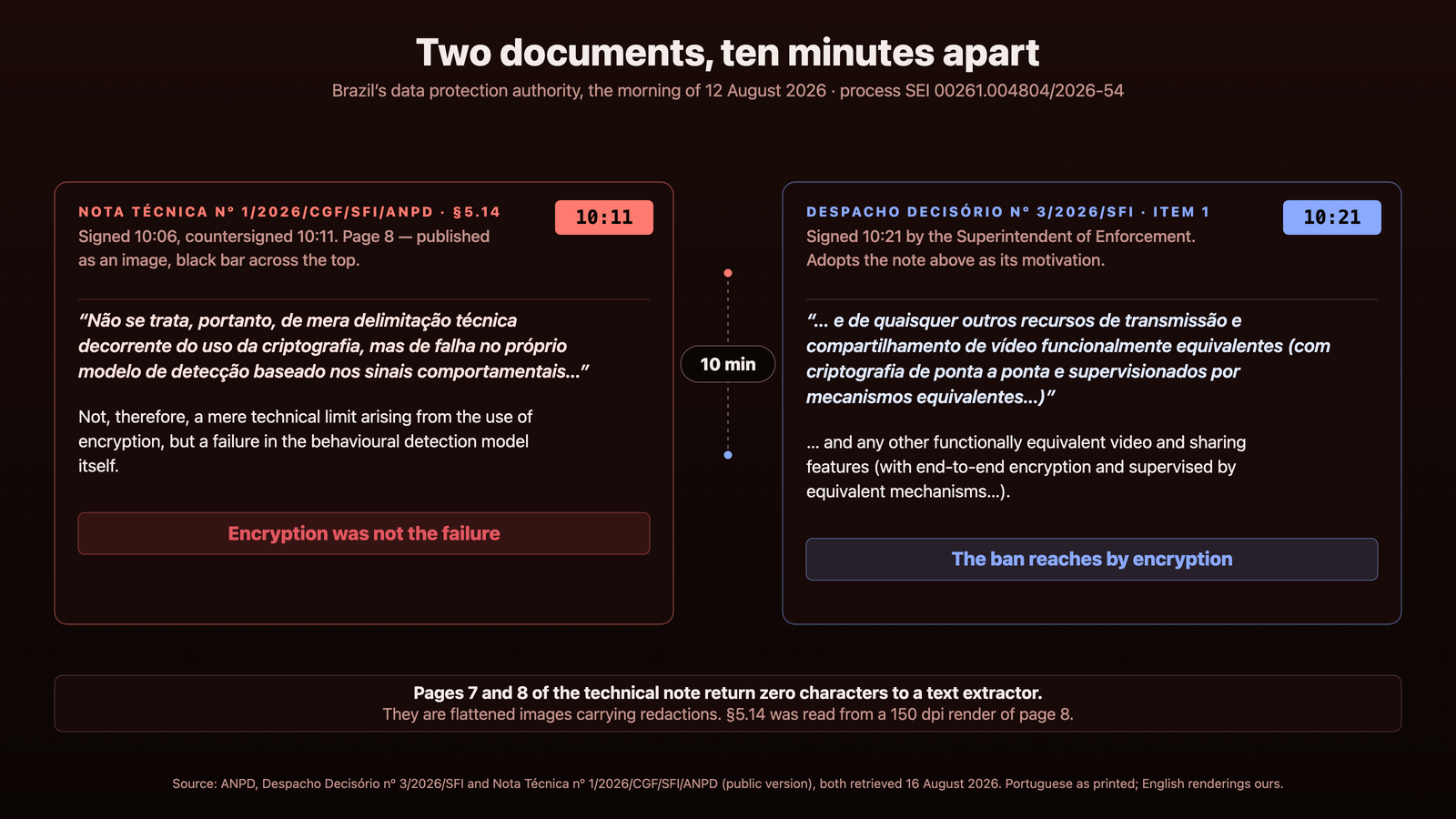
At 10:21 on the morning of 12 August, Fabrício Guimarães Madruga Lopes, the ANPD's Superintendent of Enforcement, signed three pages called Despacho Decisório nº 3/2026/SFI. It suspends, for every user in Brazil, Discord's Go Live feature — the button that streams your screen or camera into a voice channel. It also suspends any other functionally equivalent video and sharing feature "(com criptografia de ponta a ponta e supervisionados por mecanismos equivalentes aos adotados no âmbito da funcionalidade 'Go Live')": with end-to-end encryption, and supervised by mechanisms equivalent to the ones used for Go Live.
Go Live is banned by name. The parenthesis is how the order reaches beyond it, and it asks two things at once: that a feature be encrypted, and that it be supervised as Go Live was. Both limbs — but one of them is a cryptographic property, and that is new. The agency's public reasoning matches it: Discord has no access to the content of video transmissions while they are happening, and so cannot detect a violation in real time.
The next clause reaches past the button to the plumbing. Retransmission, mirroring and screen sharing all stop, whether through native features or through bots, webhooks, APIs and automations. Discord must then put in place technically effective measures against evasion — by renaming the feature, by intermediate domains, by invite codes, by redirects. Renaming is forbidden before anyone has proposed it.
The suspension lasts until the company both proves the measures work and obtains the agency's express prior authorisation to switch the feature back on.
It is really encrypted
Since September 2024 Discord has been migrating voice and video to a protocol it calls DAVE, built on Messaging Layer Security and reviewed by the security firm Trail of Bits. Its own description of the scope includes Go Live streams.
That is the company's account of its own product — and the regulator's file accepts it. The ANPD's technical note fixes the date the protocol reached live video: 2 March 2026, after the ECA Digital was passed and fifteen days before it took effect. The agency does not quite say that Discord encrypted Go Live to get ahead of the law. It sets the two dates beside each other.
The pages that are pictures
The three-page order decides but does not argue. Its reasons are borrowed wholesale from an eighteen-page technical note signed that morning at 10:06 and countersigned at 10:11 — ten minutes before the order — which the agency published in a public version, with pages seven and eight flattened into images, because those pages carry black rectangles over what Discord told the regulator about how its safety systems work. Ask a text extractor for those two pages and it returns nothing at all. We rendered them and read them as pictures.
Discord's proactive systems, the note records, do not analyse the content of private voice and video, because those features are end-to-end encrypted. The company scores servers and accounts on behaviour instead, and the note finds that the scoring was not close to flagging this one.
Then comes the sentence that unsettles the whole order:
"Não se trata, portanto, de mera delimitação técnica decorrente do uso da criptografia, mas de falha no próprio modelo de detecção baseado nos sinais comportamentais, que não foi capaz de identificar como prioritário um ambiente que já reunia indícios de risco alto."
This is not, therefore, a mere technical limit arising from the use of encryption, but a failure in the detection model itself, which was not able to identify as a priority an environment that already carried indications of high risk.
The regulator considered the argument that encryption was the problem, and rejected it — on page eight, under a black bar, in the document its own order adopts as its motivation. Ten minutes later, in the order itself, the operative text reaches other products partly by asking whether they are encrypted.
Safety that runs on reports needs a witness
None of which makes the order weak, and the case behind it is strong.
A reporting mechanism needs someone present who is not implicated, who is able to act, who knows the mechanism exists and trusts the company to use it in time. In a private server assembled for this purpose, that person does not exist. Discord's answer to a lower alert threshold was that it would produce more false positives; the agency's reply is that when the risk is grave injury or the death of a child, the cost of a false negative is incomparably higher than the cost of sending one more server for human review.
And the ANPD did not take Discord off the air, which is what Janja da Silva, Brazil's first lady, had demanded in public days earlier. It suspended one feature, left everything else running, and wrote the route back into the order.
Monday
The order gives Discord three business days to file a declaration, signed by a legal representative and a technical officer, proving the suspension is complete across Brazil and naming the date, the hour, the systems and the versions involved.
The clock does not start at signature. Both deadlines — the three days, and the ten business days to appeal — begin at the formal notification, and the desk has not established when that was served. Counted from Wednesday 12 August, three business days fall on Monday the 17th, which is the date the parties themselves give.
The technical note, ten minutes earlier, had proposed something gentler: that Discord switch Go Live off within three business days. The superintendent kept the three days and moved them. They are now the time allowed to prove a shutdown that should already have happened.
On Friday evening the company answered that it cannot be done. Engineering, testing and deploying a country-limited shutdown across desktop, mobile and console clients, with the verification evidence the decision requires, "não são materialmente executáveis, com integridade, no prazo fixado" — are not materially executable, with integrity, in the time allowed. The hard part is not the switch but the clause about invite codes. It asked for the order to be revoked, and failing that for fifteen business days. As of Saturday evening, 15 August, no answer from the agency had been reported.
The rest of the filing reaches for the same fact the order does and pulls it the other way. It was the encryption, Discord says, that stopped it blocking the content. And one server going wrong is not a broken system: the company invokes the statute's carve-out for a "falha isolada ou residual, inerente ao estado da técnica" — an isolated or residual failure inherent in the state of the art. Each side is arguing the position you might have expected from the other.
Somebody in Brasília has to decide on Monday.
What they decide is narrow. What the order writes down is not: that a video feature may exist if its operator can watch it, and not if it cannot. A 13-year-old died because nobody was watching, which is a real reason to want that rule. It is still a rule about every encrypted product, arrived at in a case about one.
References (1 sources)
References
- Despacho Decisório nº 3/2026/SFI, ANPD Superintendência de Fiscalização, Processo SEI
00261.004804/2026-54, document 0321226 — signed 12 August 2026, 10:21 Brasília time, by Fabrício Guimarães Madruga Lopes. https://www.gov.br/anpd/pt-br/centrais-de-conteudo/documentos-tecnicos-orientativos/despacho_decisorio_3_discord-inc.pdf/@@display-file/file — retrieved 16 August 2026 04:2xZ, HTTP 200, 49,863 bytes, 3 pages. Legal basis stated in the document: art. 6º, incisos II and III of Lei nº 15.211/2025, with art. 30 of the Regulamento de Fiscalização.
- Nota Técnica nº 1/2026/CGF/SFI/ANPD, public version, document 0321183, same process — 18 pages
plus cover. https://www.gov.br/anpd/pt-br/centrais-de-conteudo/documentos-tecnicos-orientativos/nota_tecnica_1_versao_publica_discord-inc.pdf/@@display-file/file — retrieved 16 August 2026 04:2xZ, HTTP 200, 734,819 bytes. Pages 7 and 8 return zero characters to pdftotext; every other page returns 1,366–2,600. Those two pages were rendered at 150 dpi and read as images. The §5.14 quotation and the §5.15 and §5.16 reasoning summarised here were read from that render and checked against it a second time.
- Discord, "Meet DAVE: E2EE for audio & video" —
https://discord.com/blog/meet-dave-e2ee-for-audio-video
— the company's own scope statement, including Go Live streams; whitepaper and Trail of Bits reviews linked from it.
- Discord's response of Friday 14 August, reported by G1 and Jornal de Brasília, 15 August 2026,
including the verbatim "não são materialmente executáveis" and the "falha isolada ou residual" carve-out argument. https://g1.globo.com/politica/noticia/2026/08/15/discord-pede-revogacao-da-suspensao-de-lives-e-diz-nao-conseguir-cumprir-prazo-da-anpd.ghtml
- Operação Lívia and the 4 August Brasília press conference, including Victor Fernandes's three stated
failures — Diário de Pernambuco and other Brazilian outlets, 11 August 2026. The PIX account and the razor blades are attributed in the body to what the federal cyber-operations laboratory told reporters; they are briefing material, not primary documents, and are not independently verified here.
- ECA Digital: Lei nº 15.211/2025, sanctioned 17 September 2025, in force 17 March 2026.
A retrieval limit at publication time. Both ANPD documents above were retrieved successfully at 04:2xZ on 16 August. A final re-probe of the agency's news feed at 04:47:49Z returned HTTP 200 carrying Estamos em manutenção — a maintenance page, not content and not a 404. That is a limit on this desk's last check, not evidence that the agency has published nothing, and the sentence about Saturday evening rests on reporting rather than on that probe.
Not established, and not asserted. Whether Go Live is in fact switched off in Brazil today. The date the intimação was served. Whether the ANPD would say that §5.14 and the operative parenthesis are consistent — the desk did not seek a statement, and if the agency's position is that encryption is not the wrong but is the reason a fix cannot be verified, then the two texts are reconcilable and the finding here is only that they read as they read.