
A few bars, up a mountain
To talk to France 24, a man the network calls Usman climbs into the mountains above Rawalakot, in Pakistan-administered Kashmir, until his phone catches a few bars of signal from outside the region. That climb is the most precise measurement anyone has of the blackout: its edge is partway up a mountain.
Azad Jammu and Kashmir — Azad Kashmir, the part of Kashmir Pakistan administers — has been substantially offline since 5 June. That day the government announced elections and suspended what Amnesty International called "all internet and mobile network signals in the region" — a seven-day order that is now in its thirteenth week — and its Home Department listed the Joint Awami Action Committee, the protest movement known as the JAAC, as a proscribed organization under its Anti-Terrorism Act. A UK-based verification group, the Jammu Kashmir Human Rights Observatory (JKHRO), has verified 89 civilian deaths since then, as of early August. The government fixed a 10-million-rupee reward — "head money," as the Pakistani daily Dawn reported it — for information leading to the arrest of four of the movement's leaders; Shaukat Nawaz Mir has since been detained. And this afternoon, under that blackout, the new assembly elected a prime minister. What none of the coverage explains is why the rest of the world's dashboards say nothing is wrong.
Flat at half-mast
IODA, Georgia Tech's internet-outage observatory, counts network blocks that answer probes. Its event detector still holds one outage open for Azad Kashmir: started 5 June at 18:40 UTC, now on day 84. Across the three big public observatories — IODA, the censorship-measurement network OONI, and Cloudflare Radar — that event is the only place this blackout registers, and it registers only if you query one region code, 3083, and compare against a baseline from spring.
Look at the last two weeks of the chart and you see a flat line — flat at 42 to 48 responsive blocks, against a March-to-June median of 99. Twelve weeks in, half the region's network is the new baseline.
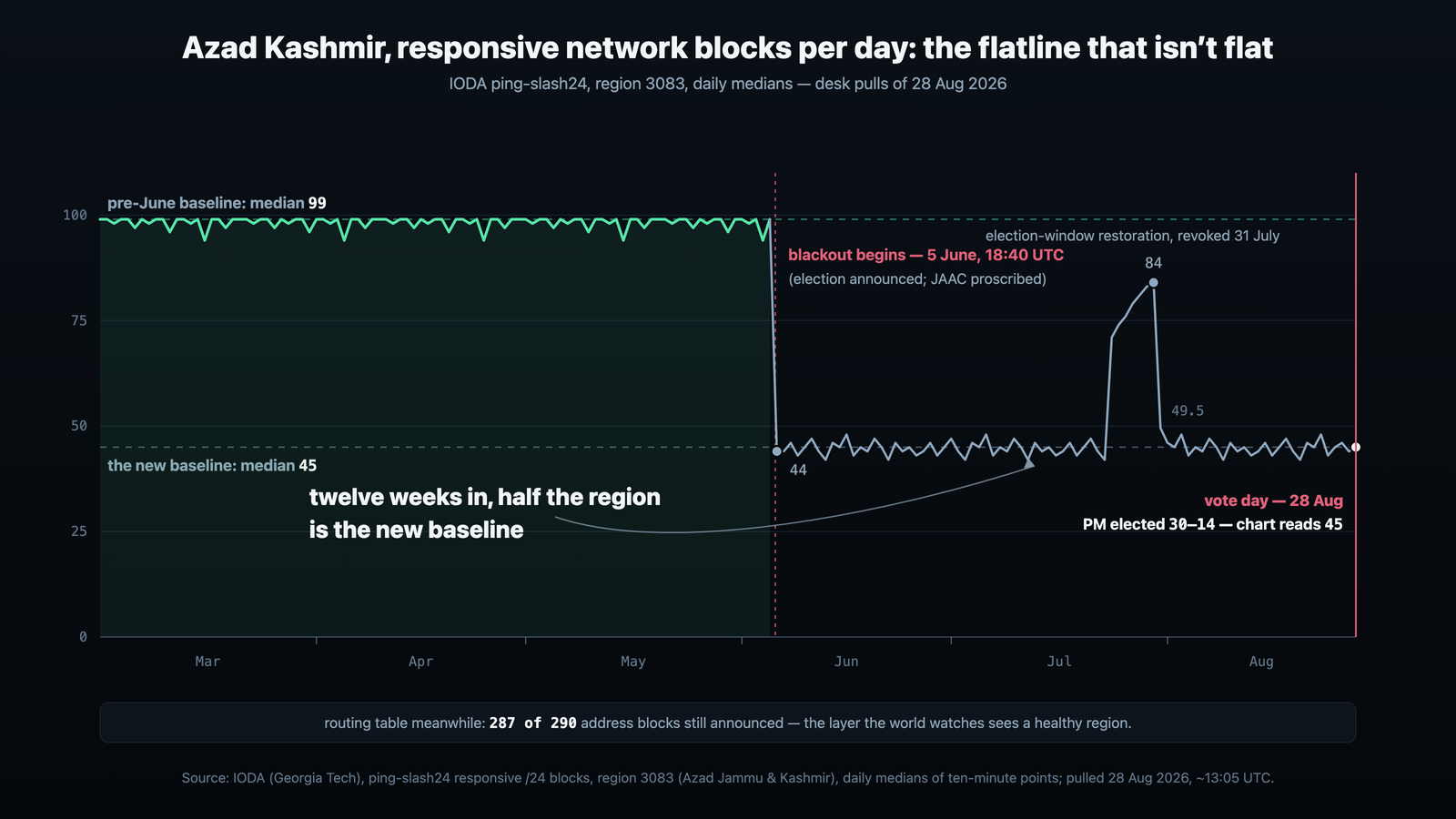
Every other layer shows nothing. At the BGP layer — the routing table the global internet actually sees — the blackout barely exists: the June cliff that halved the region's responsiveness withdrew about fifteen of 290 announced address blocks, and 287 are announced today. At country level, Azad Kashmir's loss disappears into Pakistan's daily noise. And the mobile networks, the layer the shutdown actually rides on, are not measurable in Azad Kashmir at all: exactly three networks geolocate to the region — the military-run Special Communications Organization, the national carrier PTCL, and a small ISP called Sky Telecom — and none of them is a mobile operator. A mobile shutdown there is invisible by construction.
OONI is no better off: its volunteer model needs a probe running inside the network being censored — and its entire history for Sky Telecom, the one measurable Azad Kashmir-only ISP, is 267 measurements across two days in August 2024. Someone did start running a probe on the Special Communications Organization's network on 7 August this year — with Al Jazeera's website failing in all 98 attempts — but that network spans both Azad Kashmir and Gilgit-Baltistan, and the data cannot say which side of the mountains the probe sits on. The websites of the JAAC, of the JKHRO, and of Jeddojehad, the Urdu paper documenting the deaths, have never been tested from Pakistan.
The instrument that still works
What replaces measurement is verification, one video at a time. France 24's Observers team matched a video of men in dark uniforms stepping out of a police vehicle and firing toward a crowd to a specific stretch of Mian Muhammad Road in Mirpur, "by identifying the towers and billboards visible in the video." The JKHRO toll is built the same way — case by case, with names: 44 verified deaths from 5 June to 26 July, 45 more from 27 July on, four still unconfirmed. The authorities have published no figures at all.
What the footage cannot carry is the slow damage. Banking in the region has been down since 5 June, a JKHRO member told France 24; a hospital blood test may never reach its result; the schools are closed.
A dead Ranger, and a written answer
The violence is not one-sided, and the state's case deserves its full weight. On Wednesday a member of the Pakistan Rangers was killed when armed men opened fire during a road-clearance operation. The information ministry, in a written statement to France 24 dated 26 August, says the authorities have "repeatedly placed evidence on record" of automatic weapons, hostage-taking and torture, and that its restrictions on communications were "calibrated, limited to areas affected by violence and imposed only for the period considered necessary for public safety." The JAAC denies using violence.
What the public-safety reading cannot explain is the calibration. The shutdown began not on a day of violence but on the day the election was announced — the same day as the terror listing. It has now outlived the 10 August final polling day by eighteen days, everywhere at once. The state's response is calibrated to something; the record says it is information, not violence.
The permission slip
The other sensor is people, and people have been licensed. Since 4 August, anyone working for foreign media — Pakistani citizens included — needs a No Objection Certificate from the information ministry to report outside Islamabad, Lahore and Karachi. The Diplomat reports the requirement now reaches "coverage of any news" in the region. Citizens who post protest footage have been put on a terrorist watch list, France 24 reports — which blocks their bank accounts, SIM cards and identity documents. Jeddojehad's editor, Farooq Sulehria, was in London when security agencies raided his home and detained three of his family members; they told the family his articles on Kashmir were "anti-national." He cannot go back. The ministry, in the same written statement, calls the certificates "regulatory and procedural measures."
No order, on day 84
Nobody has ever published an order for any of this. On day 84, the Pakistan Telecommunication Authority's website mentions neither a suspension nor Kashmir anywhere on its front page, and the Azad Kashmir government's own site answers every request from here with a wall. A blackout with no instrument, on networks no graph can see, in a region reporters need a certificate to enter.
Chosen in Islamabad
The man the assembly elected today was not chosen in Muzaffarabad, the region's capital. Late Wednesday night, at the Prime Minister's House in Islamabad, Pakistan's prime minister, Shehbaz Sharif, told four senior Azad Kashmir men from his party, the Pakistan Muslim League-Nawaz, that his elder brother, party supremo Nawaz Sharif, had decided the nomination: Barrister Syed Iftikhar Ali Gillani, a 46-year-old the party's own regional leadership had not asked for. The party's Azad Kashmir president, Shah Ghulam Qadir, and a former prime minister of the region, Raja Farooq Haider, objected and said they would stay away from the vote.
Gillani holds no constituency. He lost his assembly seat in 2021, and entered the new assembly on 24 August through a reserved seat — the one set aside for technocrats, filled by the members rather than the voters. Dawn's same-day profile describes the arc: "a return through a reserved seat and, finally, a decision made at the very top of the party."
The chamber at two o'clock
At two o'clock this afternoon, the assembly convened in Muzaffarabad and elected Gillani prime minister by 30 votes to 14 over the Pakistan Peoples Party's Sardar Mukhtar Ahmed Abbasi. Forty-four votes, not forty-six: the speaker does not vote, and Qadir made good on his objection and stayed away — the winning party's own regional president. Haider, the other objector, entered and voted. The ministry's statement, issued two days before the vote, says "the electoral process in AJK has since been completed" and internet restrictions are "being progressively normalized." Dawn's count of the chamber says what "completed" means: the assembly seats 53, and its present strength is 46, because seven seats have never been polled. Polling's third phase — all eleven constituencies of Poonch Division — was allowed to proceed only in two of its districts, Bagh and Haveli; the election commission cited law and order. Five seats in Poonch district itself and two in Sudhnoti, the protest belt around Rawalakot, have never voted. The PPP, which alleges widespread rigging, put up its candidate anyway.
The same statement says internet services "remained available in the majority of areas." The chart nobody is expected to read says Azad Kashmir has answered at less than half its March level for twelve straight weeks; through the hour of the count it read 45. They cut the internet, banned the movement, licensed the press — and then held the vote.
Rawalakot has no elected member and, as far as anyone outside can measure, no internet. The graphs are flat. The ministry says normal. And a man climbs a mountain to send a text.
References (8 sources)
References
- Measurement (this desk, 28 Aug 2026 — three dated pulls): IODA v2 API, Georgia Tech.
(1) Baseline and full-window pull, morning ~10:16 UTC: signals/raw/region/3083 ping-slash24 1 Jun–28 Aug (daily medians 42–48 every day of August; pre-blackout 94–99; restoration week peaking 84 on 30 Jul) and 1 Mar–5 Jun baseline (median 99.0, n=13,962 ten-minute points) — the pre-June baseline of 99 rests on this pull alone; bgp 1 Jun–28 Aug (290 pre-blackout → 274–277 blackout-era → 287 since 5 Aug); entities/query?entityType=asn&relatedTo=region/3083 — exactly three ASNs: AS18053 Special Communication Organization (6,912 IPs), AS17557 Pakistan Telecom Company Ltd, AS55453 Sky Telecom (3,840 IPs); signals/raw/asn/55453 — baseline median 9 (Mar–Jun), median 1 since 30 Jul; country-level PK ping-slash24 1–10 Jun: daily medians ~6,780 → ~6,710. (2) Evening re-probe ~20:10 UTC: 28 Aug median 45.0 through ~12:30 UTC; outages/events?entityType=region&entityCode=3083 — one ping-slash24 event, start 2026-06-05T18:40Z, still open, day 84. (3) Pre-publish probe, 13:05 UTC: 28 Aug median 45.0 (n=78 ten-minute points), latest reading 44; daily medians 24–27 Aug 43.0/45.0/46.0/44.0; the 5 June event still open (duration clipped 83.77 d at the query window). Raw JSON in scratchpad/c28-13/, scratchpad/c282-08/, and the writer's scratchpad (ioda-3083-prewrite.json, ioda-3083-events-prewrite.json). Clients: direct curl.
- Measurement (desk-lead independent confirmation, 28 Aug 2026, logged ~13:0x CDT, curl):
own 7-day pull of signals/raw/region/3083, three datasources — bgp n=2,011, median 287 (range 278–287); ping-slash24 n=1,008, median 44 (range 36–54); merit-nt ~0. Reproduces the spine independently of the desk's pulls: routing table full, reachability halved, darknet silent. The 7-day window does not reach the pre-June baseline, which rests on the desk's 1 Mar–5 Jun pull dated above.
- Measurement (this desk, 28 Aug 2026): OONI aggregation API — probe_cc=PK,
probe_asn=AS55453: 267 measurements ever, all 22–23 Aug 2024, zero since; probe_asn=AS18053: 15,411 measurements 7–27 Aug 2026, incl. www.aljazeera.com 98 measurements / 0 ok (re-checked this evening, unchanged), foreignpolicy.com 0 ok of 102; no published measurements yet for 28 Aug (a bounded null — upload lag and silence indistinguishable); domains jkjaac.co, jkhro.org, jeddojehad.com: zero measurements from PK, 1 Jun–29 Aug 2026.
- Bounds (this desk, 28 Aug): Cloudflare Radar
radar/annotations/outagesunauthenticated →
error 9106; radar.cloudflare.com/outage-center via r.jina.ai → JS shell (parser limit); Radar's location axis is ISO countries. pta.gov.pk → HTTP 200 to curl with a Chrome UA, homepage contains no occurrence of "suspension" or "Kashmir" (homepage only); ajk.gov.pk and ec.ajk.gov.pk → HTTP 403 Cloudflare block to curl-UA and r.jina.ai.
- Dawn, "PML-N's Syed Iftikhar Ali Gillani elected new AJK prime minister," Tariq Naqash,
Muzaffarabad, 28 Aug 2026, 15:37 PKT, re-fetched at press time ~13:00 UTC — every digit unchanged (30 of 44 votes; Abbasi 14; present strength 46 of 53; seven Poonch/Sudhnoti seats unheld; the Islamabad nomination meeting; phase mechanics). Dunya News, "PML-N's Iftikhar Gilani elected new AJK prime minister," 28 Aug 2026 (30–14; 44 members besides the Speaker participated; technocrat seat) — independent confirmation of the tallies. Dawn, "Who is Syed Iftikhar Ali Gillani, the new prime minister of AJK?", 28 Aug 2026 (2021 seat loss; "a return through a reserved seat"). Dawn, "Newly elected members of AJK Legislative Assembly take oath of office," 24 Aug 2026 (Article 22(1): eight members "chosen by directly elected representatives"; Gillani's technocrat-seat election, 26 votes; 38 of 45 direct members participating). Dawn and Dunya read raw via r.jina.ai / pulse-desk pull.
internet blackout," 27 Aug 2026, 16:04 UTC (Usman's mountain; JKHRO; geolocated video at Mian Muhammad Road, Mirpur, 33°08'49.3"N 73°44'53.8"E; the watch list blocking bank accounts, SIM cards and identity documents; seven constituencies postponed).
- Ministry of Information and Broadcasting, Islamabad, "Response… regarding the situation in Azad
Jammu and Kashmir," 26 Aug 2026 — 1-page statement to France 24, PDF fetched and archived (all ministry quotations; "progressively normalized"; "majority of areas"; "the electoral process in AJK has since been completed"; NOC defense).
- Jammu Kashmir Human Rights Observatory, "JKHRO Updates Verified Civilian Death Toll to 89…,"
5 Aug 2026 (44 + 45 verified, 4 unconfirmed, 93 reported; named cases).
- The Diplomat, "Pakistan's Kashmir Crackdown," Kunwar Khuldune Shahid, 26 Aug 2026 (at least 80
killed over three months; NOC "for coverage of any news"; Farooq Sulehria quotes; Shaukat Nawaz Mir's detention; Rawalakot inaccessible, media barred).
- ABC News Pakistan, "AJK govt bans Joint Awami Action Committee under Anti-Terrorism Act,"
5 Jun 2026 (Home Department notification quoted: section 12, AJK Anti-Terrorism Act 2014, First Schedule).
- Dawn: "Sedition cases, 'head money' against JAAC leaders ordered," 10 Jun 2026 (Rs10m, four
names); "Fourth Schedule: Combating terrorism or silencing dissent?", 16 Oct 2024 (listing mechanics).
- Amnesty International, "Pakistan: 'Terrorism' designation of protest movement marks dangerous
escalation…," Jun 2026 (Isabelle Lassee; 5 Jun suspension of "all internet and mobile network signals… until 12 June"; Shahzeb Habib).
- Geo News / Dunya News / Aaj / Daily Pakistan / 24NewsHD / Arab News, 26–27 Aug 2026 (Rangers
member killed, one wounded, during a road-clearance operation — title-level, six outlets).
- URnetwork, "Connectivity Was Lent," 6 Aug 2026 (the election-staged restoration arc; the
31 Jul re-blackout; the unsigned order; Sky Telecom's switch-off — background edition).