
On 1 July, a Dallas contracting office of ICE — US Immigration and Customs Enforcement — signed a $94,655,840 contract with TRM Labs, a blockchain-tracing firm. It was a sole-source award — ICE went to one company and received one offer — which is precisely the kind of purchase federal disclosure rules were written for. The office handled it by the book: the award was publicly advertised, and its notice went up on 2 July, the day after signature.
On 10 July the same office — Investigations and Operations Support, Dallas — signed the contract one number along in the series: $13,000,000 to ZeroFox, a company that sells social-media threat monitoring. Three firms bid this time. Yet the award was advertised nowhere, and the public justification the regulation demands has not been found. The thirty-day clock for publishing it runs out on Sunday 9 August. Tonight is day 28.
Hold the two records side by side and they are backwards: the enormous no-competition deal handled in the open, the small competed one gone dark. That inversion is worth a few minutes of your attention for one reason. Whichever way Sunday goes, this pair of contracts demonstrates that the disclosure rule cannot be checked from outside — not late, not kept, not at all.
The loud purchase and the quiet one
The two awards sit one number apart in the federal series, 70CMSD26C00000005 and …006, and every field runs against intuition. The sole-source award is the advertised one: solicited from a single firm, one offer received, public notice posted the next day. The competed award is the invisible one: three offers through a negotiated procedure, and no public advertisement — the database field that records one reads NO.
The Sunday deadline comes from the urgency exception, FAR 6.302-2, which lets an agency limit competition when delay would cause serious financial or operational injury, and which gives it thirty days after award to publish the written justification. But the government's own database codes the ZeroFox purchase "full and open competition after exclusion of sources" — and three bidders in a negotiated competition is not what an emergency looks like. Either the coding is loose, or the purchase was more ordinary than urgency implies. The more ordinary it was, the harder the missing advertisement is to explain.
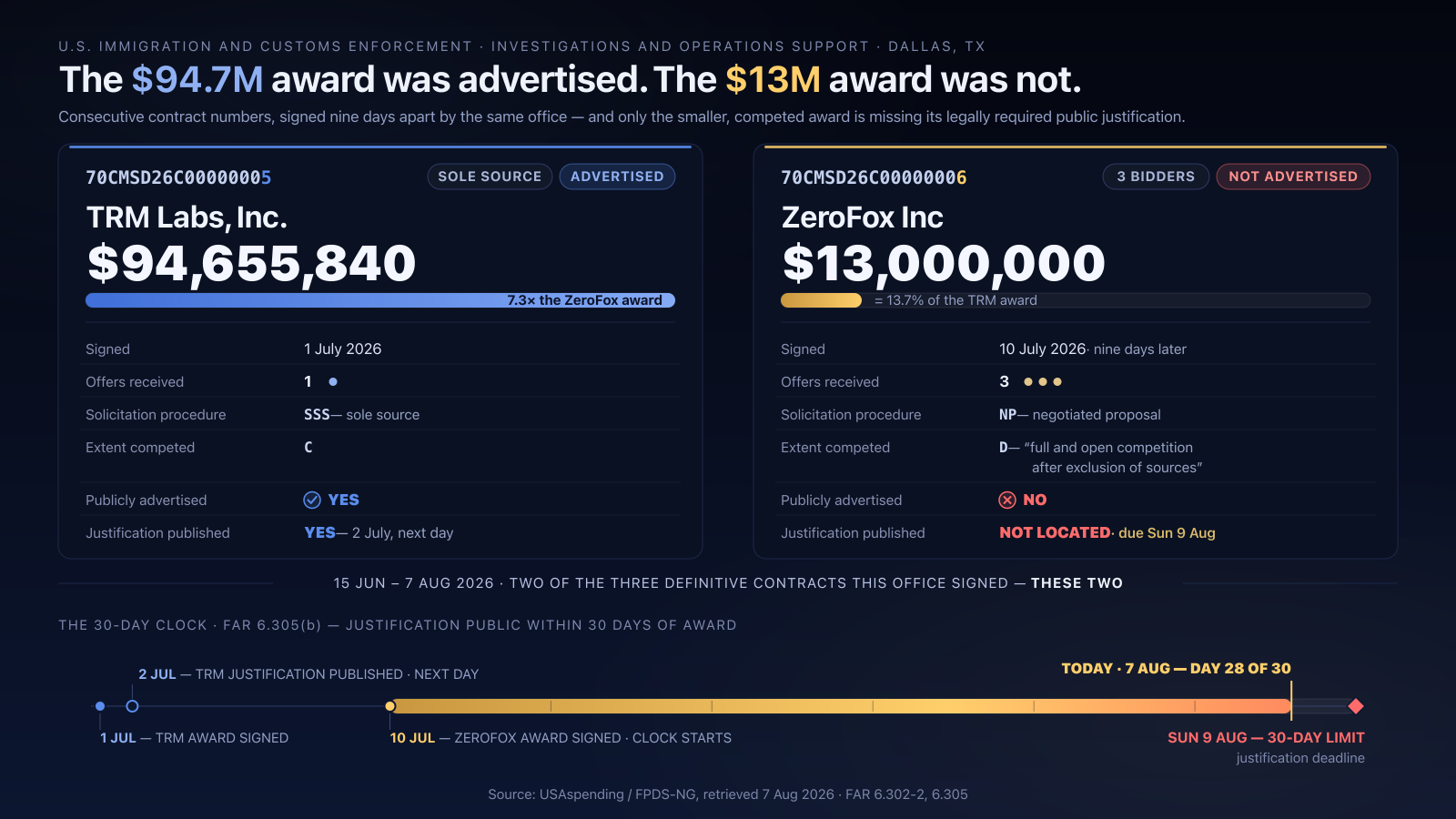
Size cuts the same direction. $13 million is small by ICE standards, and awards that size are the ones only paperwork ever surfaces: the $94.7 million next door would draw attention whatever the record said. A $13 million line item passes unnoticed — unless the disclosure rule works.
There were three, and two were dark
The natural objection is cherry-picking, so here is the whole population. Between 15 June and 7 August this office signed 82 awards; exhaustive pagination of the ICE record — 633 rows across seven pages, not the two pages a default pull returns — turns up exactly three definitive contracts, meaning fresh standalone ones rather than orders placed against vehicles competed earlier.
The third is small enough to fall out of any pull sorted by size: 70CMSD26C00000004, $486,749.68 to Guardian Centers of Georgia, signed 20 July, sole-source under FAR 6.302-1. Its fed_biz_opps field reads NO. So the count is three, and two of the three were never advertised. The $94.7 million award is the only standalone contract this office put in public all summer — which makes the pattern worse than a pair, not better.
What ZeroFox sells
ZeroFox sells brand protection and social-media threat monitoring; its parent is LookingGlass Cyber Solutions. Its new customer is the ICE office whose name says what it does: investigations and operations support.
What ICE actually bought is not in the record. The award describes no deliverable, and the desk will not infer a capability from a vendor's product line. But that unknown is exactly what the missing document exists to resolve: a justification is where the government explains, in writing, what it is buying and why competition was limited. For a never-advertised $13 million contract between an immigration-enforcement agency and a social-media monitoring firm, that document was the only public account there was ever going to be.
The innocent explanation
Take the office's side for a moment, because its case is real. Three firms bid — whatever this is, it is not a handout to a vendor nobody could compete with. Late paperwork is the most ordinary failure in federal contracting: publication deadlines slip across the government, and a slipped date is not a cover-up. The clock has not even expired — a justification posted by Sunday is full compliance, and this becomes a story about a rule that worked. Strongest of all, this same office advertised its far larger award the next day. Offices bent on hiding things do not do that.
All of it stands. What none of it restores is the ignorance excuse. The office that advertised in a day on $94.7 million is the office that has published nothing in twenty-eight on $13 million — same buyer, same series, same month. That proves no wrongdoing. It means that if Sunday passes in silence, nobody in that office can say they didn't know the rule.
A rule that cannot catch anyone
Here is the desk's actual view, and it is not that a contracting officer in Dallas is hiding something. It is that nobody outside the building could tell if one were.
The Federal Acquisition Regulation does everything right until the last step. An agency that limits competition must write a justification, have it approved at a level that rises with the dollar value, and make it public — within thirty days of award for urgency buys. It even anticipated the obvious dodge. Paragraph (e) of FAR 6.305 tells the contracting officer to strip proprietary material and anything exempt under the Freedom of Information Act, and then closes the door: "This process must not prevent or delay the posting of the justification …" Sensitive contents are a reason to publish less, not a reason to publish nothing.
The exit is paragraph (f), and it is narrow: the requirement lifts only where posting "would disclose the executive agency's needs and disclosure of such needs would compromise national security or create other security risks." Fair enough — except that nothing requires the agency to say (f) was used. No stub, no marker, no "withheld" notice. And the public window where justifications appear cannot show an outsider the difference between nothing posted and nothing visible. From outside, a lawful withholding and a blown deadline produce the identical record: nothing.
A transparency rule whose compliance cannot be told from its breach has stopped being a rule. It is a convention — something an agency does when it chooses to be seen doing it. That is what the Dallas pair looks like: seen on the big one, unseen on the small one, and no way to say which kind of unseen.
The repair costs one line. Whenever (f) is invoked, require a public placeholder — a justification exists, it is withheld, here is the authority. Lawful secrecy stays lawful. Silence becomes legible.
Sunday
The ZeroFox award record is public and needs no login; the exact address is in the references. On Sunday, day thirty, either a justification is on SAM.gov or there is still nothing. If it appears, the rule worked, and this piece is the record of a system functioning. If it does not, you still will not have caught anyone — paragraph (f) guarantees that — and the guarantee is the finding.
Sunday will not tell us whether anyone did anything wrong. It will tell us whether the rule is capable of telling us anything at all.
Follow-up, Monday 10 August. Sunday passed in silence. Day thirty has come and gone and SAM.gov carries nothing for 70CMSD26C00000006 — and this time that is a real absence rather than a failed search, because the same query returns a hit for the contract signed nine days earlier. Searching SAM.gov's own public search service for the ZeroFox PIID returns totalElements: 0; the identical search for 70CMSD26C00000005 returns one record, "Award Notice — TRM Labs, Inc.", last modified 2 July. So the index reaches this contract series, it reaches this office, and it holds no justification for the award that needed one.
It also settles what the sister award actually got. The ...005 record is an award notice — the announcement that a contract was signed — not the FAR 6.303 justification for limiting competition. The advertised contract was advertised. Neither of these two contracts has a published justification. The difference between them was never diligence versus concealment; it was a notice, and a notice is not the document the rule is about.
Which leaves the finding exactly where the piece left it, and no further. Nobody has been caught. A lawful withholding under (f) and a missed deadline still look identical from outside, and one of them is now thirty-one days old.
References
References
70CMSD26C00000006— ZeroFox Inc, $13,000,000,date_signed2026-07-10, period of performance
2026-07-13 → 2027-07-12; awarding office Investigations and Operations Support Dallas; number_of_offers_received 3, extent_competed D ("full and open competition after exclusion of sources"), solicitation_procedures NP, fed_biz_opps N ("NO"), type_set_aside NONE; recipient UEI TQDAJ722E397, parent LookingGlass Cyber Solutions, Inc. (UEI LTGWWC211763). Retrieved from api.usaspending.gov/api/v2/awards/CONT_AWD_70CMSD26C00000006_7012_-NONE-_-NONE-/, 7 August 2026 21:49 UTC. FAR 6.305(b)'s thirty days run from date_signed (10 July), not the period-of-performance start (13 July); the latter would wrongly move the deadline to Wednesday 12 August.
70CMSD26C00000005— TRM Labs, Inc., $94,655,840,date_signed2026-07-01, same awarding office;
number_of_offers_received 1, extent_competed C, solicitation_procedures SSS, fed_biz_opps Y ("YES"). Same endpoint, ...00000005....
- Denominator, this desk.
api.usaspending.gov/api/v2/search/spending_by_award/, award type codes
A–D, awarding subtier "U.S. Immigration and Customs Enforcement", action dates 2026-06-15 → 2026-08-07, paginated to exhaustion at limit: 100 until hasNext went false — 633 records across seven pages, of which 82 carry the 70CMSD26 prefix. Three are C-series definitive contracts: ...C00000005 (TRM Labs, $94,655,840), ...C00000006 (ZeroFox, $13,000,000) and ...C00000004 (Guardian Centers of Georgia, $486,749.68). Correction, 10 August: this edition first reported "200 records across two pages" and two definitive contracts. Two hundred is 2 × the page limit — the pull had stopped at the pagination boundary, sorted by amount descending, truncating at $2,093,074.55 and hiding the $486,749.68 award below it. The count is three, and the third is also unadvertised.
- FAR 6.302-2 (unusual and compelling urgency), 6.303 (justification), 6.304 (approval levels),
6.305(a)–(b) (public availability; 30 days after award for 6.302-2), 6.305(e) (redact proprietary and FOIA-exempt material, but "this process must not prevent or delay the posting"), 6.305(f) (requirement lifts where posting would disclose the agency's needs and disclosure of those needs would compromise national security or create other security risks, with no requirement to disclose that (f) was used). Correction, 10 August: this edition first described (f) as permitting withholding "when it contains classified matter or information exempt from disclosure." That conflated (f) with (e), and (e) is the paragraph that forbids using redaction to delay posting at all. The narrower reading strengthens the argument here rather than weakening it: the FAR did close this dodge, which is why the absence of any marker for (f) matters.
- Gap, named.
api.sam.gov/opportunities/v2/searchreturned HTTP 404 for both PIIDs to
unauthenticated requests, which cannot distinguish "no notice" from "not authorised"; SAM.gov's web interface renders an empty shell indistinguishable from zero results, including through a text proxy. No FAR 6.302-2 justification for ...006 was located. This is reported as a search failure, not as evidence that none exists.