
A lawyer arrived at the High Court in Lusaka on the morning of Monday 24 August and could not get in. The building was cordoned off by heavily armed police officers who ordered him to leave, the lawyer told Human Rights Watch. Courts across Zambia were sealed that day. Some had tape across them marked "Crime Scene."
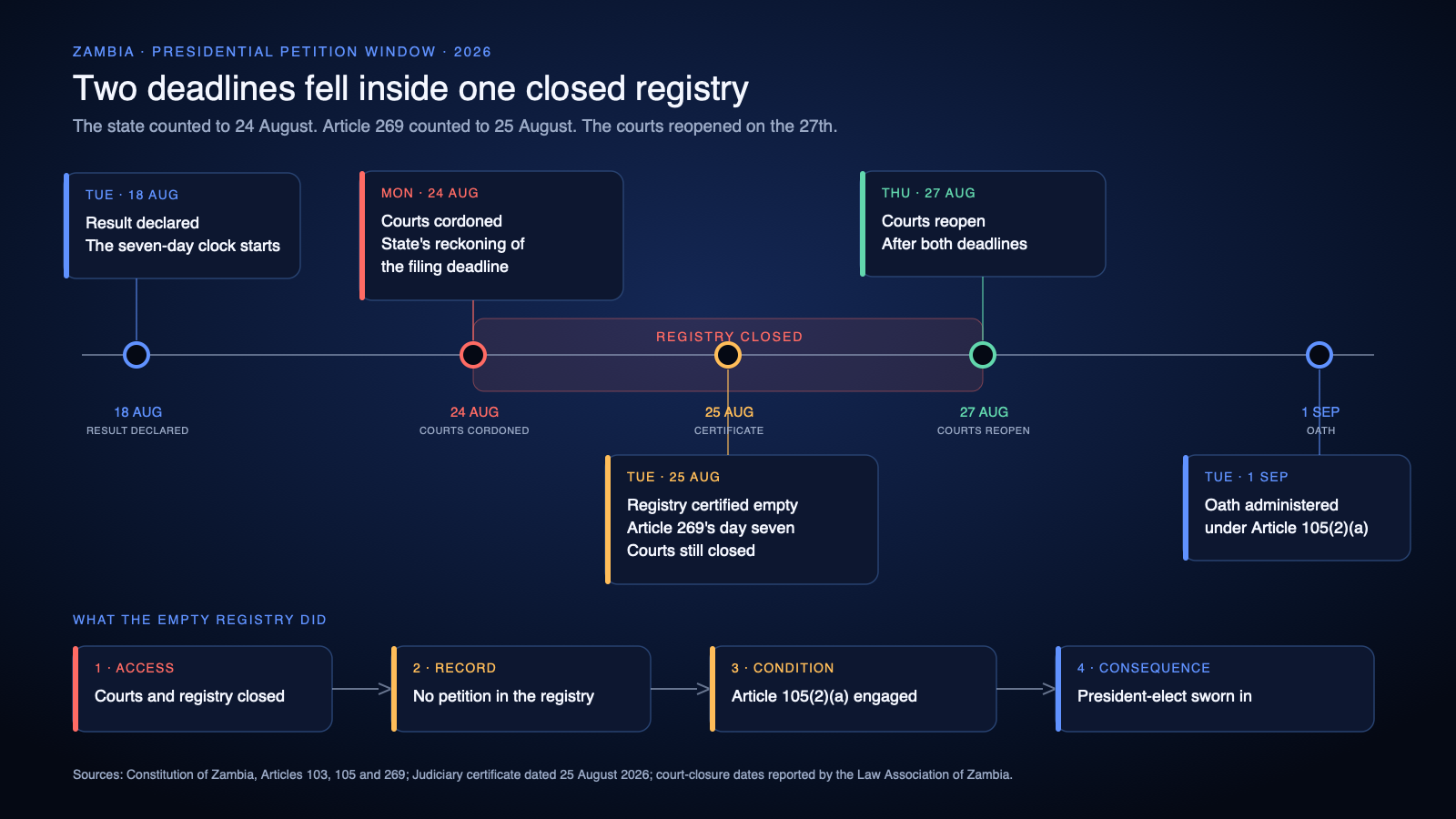
Monday 24 August was the day the state treated as the last on which anyone could lawfully challenge the presidential election held eleven days earlier. Linda Kasonde, a lawyer and former president of the Law Association of Zambia, the country's bar association, tried the other door. Her account, given to Zambian outlets, is that she tried to lodge the petition electronically with the Chief Registrar's office and the Judiciary's official email address bounced back. With the building cordoned and the deadline running, she sent the petition and its supporting papers to the private inbox of Chief Justice Mumba Malila.
On Tuesday 25 August, the Judiciary's chief administrator, Nalishebo Imataa, wrote to the Secretary to the Cabinet. The letter said that "no petition had been filed in the Constitutional Court Registry as at 18:00 hours yesterday, 24th August, 2026" — evidence of the condition, not the condition itself. That sentence is why President Hakainde Hichilema stood in the National Heroes Stadium on Tuesday 1 September and took the oath for a second term.
Article 105(2) of Zambia's constitution says the president-elect is sworn in on the Tuesday following "the seventh day after the date of the declaration of the presidential election results, if no petition has been filed in accordance with Article 103." That conditional is not decoration; it is the switch.
Article 104(3) of the same constitution provides that where an election petition is filed against the incumbent, "the Speaker shall perform the executive functions," minus the power to appoint or to dissolve parliament. Filing does not make a president-elect wait; it takes the executive away from the man who won and parks it with the legislature until the court has ruled.
So the emptiness of a filing registry, on one particular Monday, was a precondition being satisfied. That registry, under the Constitutional Court's own rules, is supposed to be open from 8:30 in the morning until 6 in the evening for exactly this purpose. On the day that mattered it sat behind a police line, on a notice from the chief administrator of the judiciary telling court staff the premises were closed "for security reasons" and that guidance on reopening would come "in due course, once the situation is contained."
Nobody lied
The obvious way to write this is as an accusation that the certificate was false, and that is wrong. Read it again: no petition had been filed in the Constitutional Court Registry. An email to a judge's personal address is not a filing in a registry. So far as this desk can establish, what Imataa sent the Cabinet was accurate.
Nobody had to lie. The document did not need to misdescribe the world; the world had been arranged so that an accurate description of it produced the required result. The question is not whether the registry was empty. It is what the emptiness was made to mean, and how it was made empty: a cordon on the Monday, a certificate on the Tuesday, an oath a week later, each the condition of the next.
Day seven was a Tuesday
Article 269 of the constitution excludes the day of the event when a period of days runs from it. The Electoral Commission of Zambia declared the result on Tuesday 18 August, so day one was Wednesday the 19th and day seven — the last day to petition — was Tuesday 25 August. Cephas Lumina, a Zambian constitutional law scholar, has argued exactly that in print. This desk checked it against Parliament's own copy. There is a test that settles it: Article 105(2) runs the same computation — "the Tuesday following the seventh day" — and produces Tuesday 1 September. That is the day the inauguration happened.
Which puts the certificate, written on the Tuesday, in an odd position: it describes the registry as it stood at six the previous evening, while the window was arguably still open. The registries were shut on the Tuesday too. The bar association's president, Arnold Kaluba, said afterwards that courts and registries across the country had been closed from Monday 24 August and reopened on Thursday 27 August.
Chishala Kateka, who leads the opposition New Heritage Party, wrote to the Chief Justice that week, describing the courts as having been closed "on the pen-ultimate and ultimate day" for filing. The letter noted a Judiciary memo dated 25 August signed by the Administrator, and asked whether the courts were "only half closed, able to conduct some work and issue memos, but not able to receive Petitions." Whether anyone tried to file that Tuesday is not on the record; the Kasonde petition was public by mid-morning, but no carrier says when it was sent.
Nobody signed it
Ask who ordered the courts shut and the answer keeps moving. The bar association said the instrument it saw was an unsigned memorandum dated 24 August to judiciary staff. The police called it "intelligence-led and preventive," in a statement from Inspector General Graphel Musamba. A judiciary source said the decision came not from the judiciary but from the police. State House said the executive neither sanctioned nor directed it, and the bar association said it had no reason to doubt that. Every account puts the pen in another hand. Eight days on, no organ of the Zambian state has claimed the order.
Thursday was available
Take the other case at its strongest. Wynter Kabimba — leader of the Economic Front and a former justice minister — argued in a Zambian daily on 28 August that the deadline should have been moved to Thursday, when the courts reopened. Nobody took it. Brian Mundubile, who came second in the 13 August election and now faces a treason charge, has filed nothing before or since. Once the courts reopened the registry worked perfectly well for everyone else: six parliamentary election petitions went in, including from the ruling party's own former ministers. And Lumina himself writes that there is at present no verified evidence that the president personally instructed the closure.
Eleven days over a Pajero
The eighteen treason charges were laid on Saturday 29 August — two days after the courts reopened, not during the closure — and no court has seen any of the accused. Their only binding clock is Article 13(3) — produced before a court "without undue delay."
Mwamba Peni is the most useful person in this story. A former permanent secretary with no political case at all, he was arrested on 21 August over a government Mitsubishi Pajero assigned to him as a civil servant. On the arrest team, by his account, were officers of ZICTA, the country's ICT regulator. On Tuesday morning, eleven days in, he asked the Lusaka High Court for leave to issue a writ of habeas corpus compelling the police to bring him before a judge.
On Monday night ZNBC, the state broadcaster, carried a statement from Zambia's Cyber Security Agency. In the broadcaster's rendering, the Agency said enforcement had been "intensified during the post-election period" and that "digital footprints can be traced even long after an offence has occurred."
Here is what did not happen: Zambia's internet stayed up. Through Tuesday evening the Open Observatory of Network Interference records no confirmed blocking in any hourly window since 29 August, and IODA, the outage monitor at Georgia Tech, logs none. The most effective piece of information control in Zambia this month was a padlock and a length of tape, and it left no mark on any instrument built to detect censorship.
The last thing anyone knows about the packet
In a statement dated 25 August, the Judiciary confirmed that the Chief Justice had received an email from a member of the public containing papers designated "the people's presidential petition." It called the use of a private address for official court documents "highly irregular." And it said Malila had, "quite exceptionally, using his administrative powers, referred the documents received to the Constitutional Court for its consideration on the issue of the filing of the petition."
Was there a filing or was there not? That question belongs to the Constitutional Court, and a week later no answer appears in any register this desk reads, including the outlet the detainees' lawyers brief. A court order is not always news, so silence corroborates rather than proves.
Malila administered the oath on Tuesday. The court to which he sent the question sat through it without answering.
References (1 sources)
References
- https://www.parliament.gov.zm/sites/default/files/documents/amendment_act/Constitution%20of%20Zambia%20%20%28Amendment%29%2C%202016-Act%20No.%202_0.pdf — National Assembly of Zambia, Constitution of Zambia (Amendment) Act No. 2 of 2016 (228,076 bytes) — downloaded and text-extracted by this desk, NFKC-normalised; re-fetched independently and byte-identical across three pulls. Articles 103(1)–(2), 104(3), 105(1)–(2) and 269(a)–(d) are quoted from this text and from no summary of it. The Article 269 computation (day 1 = Wed 19 Aug, day 7 = Tue 25 Aug) was run twice in Python against the 2026 calendar; 269(d) was checked and does not reach a seven-day period, so the weekend counts.
- https://www.hrw.org/news/2026/08/26/zambia-closing-courts-curbs-access-to-justice — Human Rights Watch, 26 Aug 2026 — the lawyer turned away at the Lusaka High Court, the "heavily armed police officers," the police's "intelligence-led and preventive measure," and the notice from "the chief administrator of the judiciary" saying the premises were closed "for security reasons," reopening guidance to come "in due course, once the situation is contained." HRW performs the same declaration-plus-seven arithmetic the Judiciary did and reaches 24 August. Retrieval note: a guessed slug returned a genuine 404; the real slug came from HRW's own
/rss/news, and a guessed-URL 404 bounds nothing. - https://www.mwebantu.com/judiciary-confirms-no-petition-filed-against-hichilemas-election/ — Mwebantu, 25 Aug 2026 20:45:53+02:00 — the Imataa letter to the Secretary to the Cabinet, quoted verbatim, together with Order 17 Rule 8 (registry open 08:30–18:00) and the declaration timed "between 2 a.m. and 6 a.m. on Tuesday, Aug. 18." Retrieval note: this host returns HTTP 403 to
curlwith a browser user-agent, and so does itswp-json; the body was read through two independent clients and every load-bearing string grepped from raw text. The outlet's gloss "Sunday, Aug. 24" is a weekday error — 24 August 2026 is a Monday — and is not carried; the letter itself names no weekday. - https://zambianobserver.com/wp-json/wp/v2/posts?slug=linda-kasonde-two-others-challenge-august-13-presidential-election — The Zambian Observer, API record for the Kasonde petition report,
date2026-08-25T10:42:48 CAT /date_gmt08:42:48Z — the bounced Order III e-filing to the Chief Registrar's office and the onward email to Chief Justice Malila, quoted from the raw body. Bounded null: no carrier anywhere gives the hour or the calendar day the petition was sent, so the piece does not say it was tendered on day seven. - https://zambianobserver.com/courts-to-remain-closed-judiciary-sources/ — The Zambian Observer, 25 Aug 2026 16:31:45 CAT — same-day carrier that the shutdown "effected yesterday is expected to continue today."
- https://www.zambiamonitor.com/ (register fetch) — Zambia Monitor, 27 Aug 2026 10:13 — LAZ president Arnold Kaluba on courts and registries closed from Monday 24 August, reopening Thursday 27 August. The outlet renders Kaluba indirectly, so the sentence is not set as a direct quotation here.
- https://www.zambiamonitor.com/ (same register fetch) — "New Heritage Party faults continuous closure of courts," 27 Aug 2026 06:49:21 — Chishala Kateka's letter to the Chief Justice: "the pen-ultimate and ultimate day," and the question about a Judiciary memo "dated 25 August 2026 signed by the Administrator." Printed as Kateka's question. No identity is asserted between that memo and the Imataa certificate; the bar association says the closure memo it saw was unsigned, HRW attributes the closure notice to the office, and Imataa is named only on the certificate.
- https://znbc.co.zm/index.php?rest_route=/wp/v2/posts&include=15258,15181,15263 — ZNBC (state broadcaster), posts 15181 (27 Aug 15:38 CAT, LAZ on "the three-day closure" and the State House statement), 15258 (31 Aug 21:02 CAT, the Cyber Security Agency statement) and 15263 (1 Sept 17:23 CAT, the oath before Chief Justice Malila) — fetched as raw JSON by this desk. Programmatic check: post 15258's body contains no quotation mark of any kind, so every Agency phrase is scoped as the broadcaster's rendering, not as the Agency's own punctuation.
- https://zambialii.org/akn/zm/act/2025/3 — Cyber Security Act, 2025 (Zambia), full text — assented 8 April 2025, gazetted 15 April 2025; its long title repeals and replaces the Cyber Security and Cyber Crimes Act, 2021. Retrieval note: ZambiaLII's site search is a soft-200 (a control query returns an identical byte count with zero links) and its search API returns HTTP 403 unauthenticated; the documents are reachable at the bare Akoma Ntoso URIs. Without the control this desk would have recorded a false null.
- https://zambianobserver.com/when-the-courthouse-door-closes-zambias-presidential-election-petition-is-a-test-of-constitutional-rule-prof-cephas-lumina/ — Prof. Cephas Lumina, The Zambian Observer, 30 Aug 2026 — the Article 269 argument, and the concession quoted in "Thursday was available" that there is at present no verified evidence the President personally instructed the closure.
- https://diggers.news/wp-json/wp/v2/posts?search=Kabimba&per_page=10 — News Diggers, 28 Aug 2026 — Wynter Kabimba on moving the deadline to Thursday. Bodies are membership-walled; only the API excerpt is quoted, and the attribution is the outlet's rendering.
- https://diggers.news/courts/2026/09/01/ and https://zambianobserver.com/mwamba-peni-seeks-immediate-release-from-police-custody/ — News Diggers' courts register and The Zambian Observer, 1 Sept 2026 — Mwamba Peni's ex parte application for leave to issue a writ of habeas corpus ad subjiciendum, the 21 August arrest over a GRZ Mitsubishi Pajero, and ZICTA officers on the arrest team.
- https://www.zambiamonitor.com/presidency-denies-hichilema-ordered-court-closure-cites-security-assessments/ — Zambia Monitor — State House's denial (Chief Communications Specialist Clayson Hamasaka) and Inspector General Graphel Musamba's security-assessment account; with the LAZ statement of 24 August (unsigned memorandum; "Crime Scene" tape) these are the four accounts that make up "Nobody signed it."
- https://api.ooni.io/api/v1/aggregation?probe_cc=ZM&since=2026-08-29&until=2026-09-02&axis_x=measurement_start_day&time_grain=hour — Open Observatory of Network Interference — re-run by this desk at 17:25 UTC, 1 Sept 2026. All 89 hourly buckets from 29 Aug 00:00Z through 1 Sept 16:00Z:
confirmed_count0 in every bucket, across 42,609 measurements (809 anomalies, which are not confirmed blocking). This null is bounded to OONI's vantage points and to confirmed verdicts — it is evidence that no cable was touched, not a finding that nothing was censored in Zambia. An earlier apparent spike resolves to Starlink AS14593 vantage noise rather than the incumbent AS37287. - https://api.ioda.inetintel.cc.gatech.edu/v2/outages/alerts?entityType=country&entityCode=ZM — IODA, Georgia Tech — re-run by this desk at 17:26 UTC, 1 Sept 2026, window 29 Aug 00:00Z → 1 Sept 18:00Z: 0 alerts,
error: null. The epoch bounds were decoded back to dates and eyeballed before the result was recorded, because a prior probe on this story returned a clean zero for the wrong year. - R6 re-probe, run at 17:23–17:32 UTC, 1 Sept 2026, and it is the probe this edition publishes on. (a) No Constitutional Court order on the referred petition. ZambiaLII's 2026 ZMCC listing, read as served in a single page, has as its newest entry 21 August 2026 (2026/CCZ/003, an Auditor General case with no bearing here); News Diggers' courts register for 1 September was read to the end of the day's page — three items, none of them a determination; two search shapes on the referral return only the 25–26 August referral reporting. (b) No court production of any treason accused, and no ruling on Peni. The same 1 September page shows the Peni application only; reporting adds that no first-appearance date has been announced and that defence lawyers were told they may meet their clients after 2 September. Where these nulls are bounded: to those two registers as paginated on this afternoon, to the search shapes named, and to confirmed reporting. They are claims about the published record, not about what a court may have done unreported.
- Press control, re-run 17:29 UTC 1 Sept 2026 on the shape
Zambia petition "Article 105" certificateand a second on the Constitutional Court referral. The certificate-to-Article-105 link is not claimed as unmade — Mwebantu drew it on 25 August — and Zambian commentary had already argued on 25 August that the state cannot block the courts and then rely on an empty registry. What this desk claims as unmade in the coverage is the three-way frame: the cordon, the certificate and the oath as one mechanism. Nothing published overnight carries it.